
P2X4 受体的结构和功能特征:免疫学视角。
Structural and Functional Features of the P2X4 Receptor: An Immunological Perspective.
机构信息
Institute for Integrative Biology of the Cell (I2BC), CEA, CNRS, Université Paris-Saclay, Gif-sur-Yvette, France.
Department of Biomedical Sciences, University of the Pacific, Arthur A. Dugoni School of Dentistry, San Francisco, CA, United States.
出版信息
Front Immunol. 2021 Mar 25;12:645834. doi: 10.3389/fimmu.2021.645834. eCollection 2021.
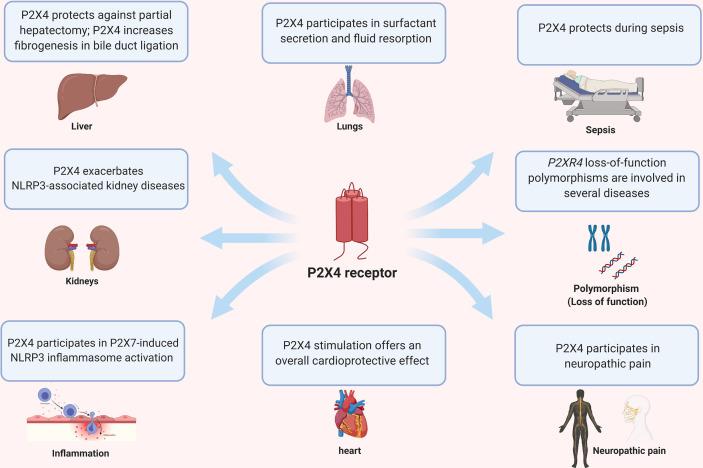
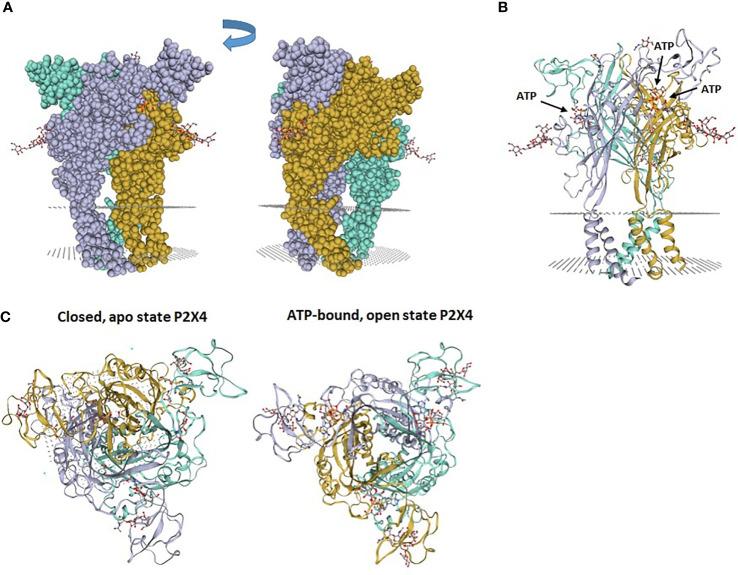
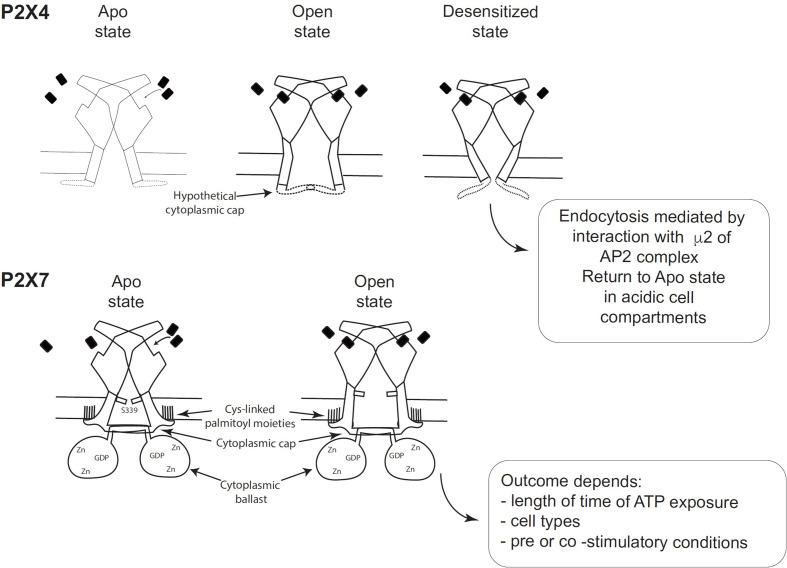
Extracellular nucleotides are important mediators of activation, triggering various responses through plasma membrane P2 and P1 receptors. P2 receptors are further subdivided into ionotropic P2X receptors and G protein-coupled P2Y receptors. P2X4 is an ATP-gated cation channel broadly expressed in most tissues of the body. Within the P2X family, P2X4 has a unique subcellular distribution, being preferentially localized in lysosomes. In these organelles, high ATP concentrations do not trigger P2X4 because of the low pH. However, when the pH increases to 7.4, P2X4 can be stimulated by intra-lysosomal ATP, which is in its active, tetra-anionic form. Elucidation of P2X4, P2X3 and P2X7 structures has shed some light on the functional differences between these purinergic receptors. The potential interaction between P2X4 and P2X7 has been extensively studied. Despite intensive effort, it has not been possible yet to determine whether P2X4 and P2X7 interact as heterotrimers or homotrimers at the plasma membrane. However, several publications have shown that functional interactions between P2X4 and P2X7 do occur. Importantly, these studies indicate that P2X4 potentiates P2X7-dependent activation of inflammasomes, leading to increased release of IL-1β and IL-18. The role of P2X4 in various diseases could be beneficial or deleterious even though the pathophysiological mechanisms involved are still poorly defined. However, in diseases whose physiopathology involves activation of the NLRP3 inflammasome, P2X4 was found to exacerbate severity of disease. The recent production of monoclonal antibodies specific for the human and mouse P2X4, some of which are endowed with agonist or antagonist properties, raises the possibility that they could be used therapeutically. Analysis of single nucleotide polymorphisms of the human gene has uncovered the association of gene variants with susceptibility to several human diseases.
细胞外核苷酸是激活的重要介质,通过质膜 P2 和 P1 受体触发各种反应。P2 受体进一步细分为离子型 P2X 受体和 G 蛋白偶联 P2Y 受体。P2X4 是一种广泛表达于体内大多数组织的 ATP 门控阳离子通道。在 P2X 家族中,P2X4 具有独特的亚细胞分布,优先定位于溶酶体。在这些细胞器中,由于 pH 值低,高浓度的 ATP 不会触发 P2X4。然而,当 pH 值增加到 7.4 时,P2X4 可以被溶酶体内的 ATP 刺激,此时 ATP 处于其活性的四阴离子形式。对 P2X4、P2X3 和 P2X7 结构的阐明揭示了这些嘌呤能受体之间的功能差异。P2X4 和 P2X7 之间的潜在相互作用已被广泛研究。尽管进行了大量努力,但仍无法确定 P2X4 和 P2X7 在质膜上是作为异三聚体还是同三聚体相互作用。然而,有几项出版物表明,P2X4 和 P2X7 之间确实存在功能相互作用。重要的是,这些研究表明,P2X4 增强了 P2X7 依赖性的炎症小体激活,导致 IL-1β 和 IL-18 的释放增加。尽管涉及的病理生理机制仍不清楚,但 P2X4 在各种疾病中的作用可能是有益的,也可能是有害的。然而,在涉及 NLRP3 炎症小体激活的疾病中,发现 P2X4 加剧了疾病的严重程度。针对人和小鼠 P2X4 的单克隆抗体的最近生产,其中一些具有激动剂或拮抗剂特性,这增加了它们可能被用于治疗的可能性。对人类 基因的单核苷酸多态性的分析揭示了基因变异与几种人类疾病易感性的关联。
 Zotero 插件