
溶质结合蛋白在信号转导中的作用。
The role of solute binding proteins in signal transduction.
作者信息
Matilla Miguel A, Ortega Álvaro, Krell Tino
机构信息
Department of Environmental Protection, Estación Experimental del Zaidín, Consejo Superior de Investigaciones Científicas, Prof. Albareda 1, Granada 18008, Spain.
Department of Biochemistry and Molecular Biology 'B' and Immunology, Faculty of Chemistry, University of Murcia, Regional Campus of International Excellence "Campus Mare Nostrum", Murcia, Spain.
出版信息
Comput Struct Biotechnol J. 2021 Mar 26;19:1786-1805. doi: 10.1016/j.csbj.2021.03.029. eCollection 2021.
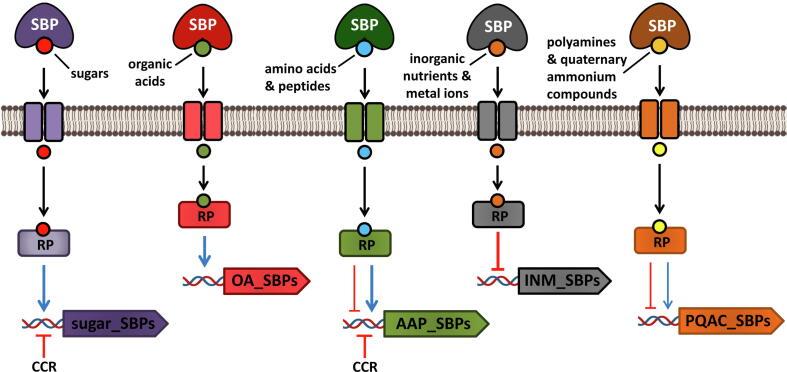
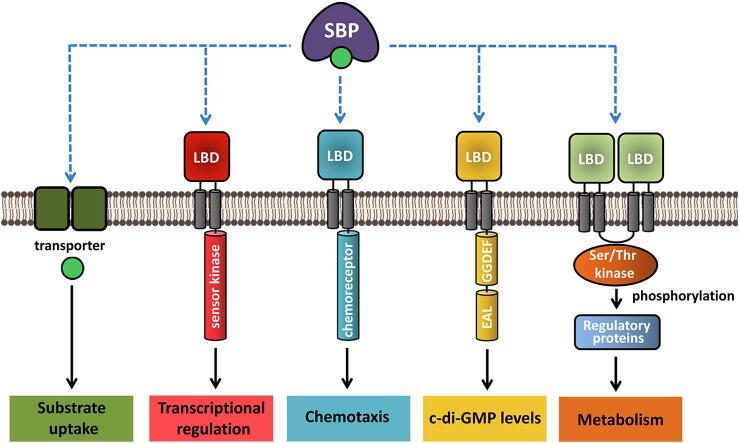
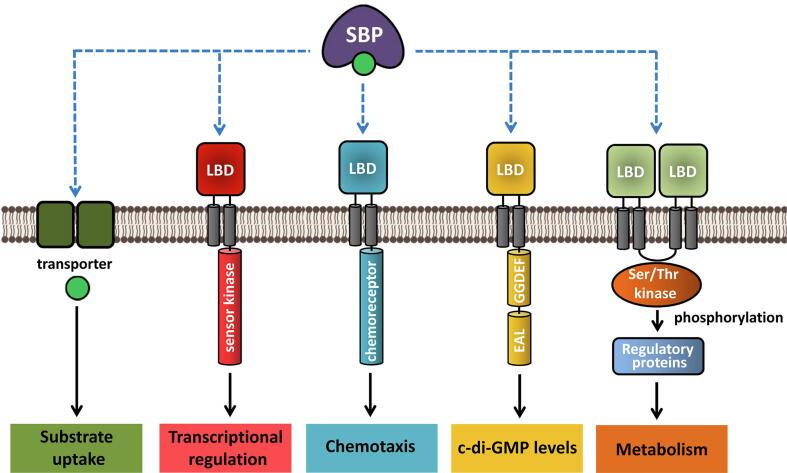
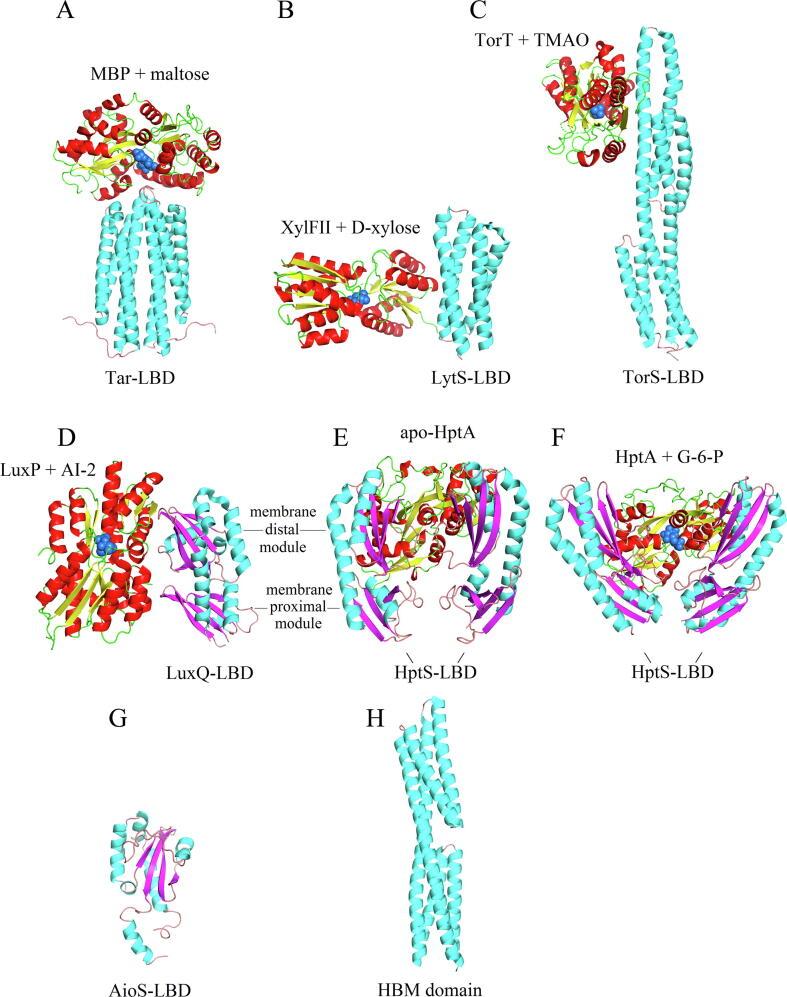
The solute binding proteins (SBPs) of prokaryotes are present in the extracytosolic space. Although their primary function is providing substrates to transporters, SBPs also stimulate different signaling proteins, including chemoreceptors, sensor kinases, diguanylate cyclases/phosphodiesterases and Ser/Thr kinases, thereby causing a wide range of responses. While relatively few such systems have been identified, several pieces of evidence suggest that SBP-mediated receptor activation is a widespread mechanism. (1) These systems have been identified in Gram-positive and Gram-negative bacteria and archaea. (2) There is a structural diversity in the receptor domains that bind SBPs. (3) SBPs belonging to thirteen different families interact with receptor ligand binding domains (LBDs). (4) For the two most abundant receptor LBD families, dCache and four-helix-bundle, there are different modes of interaction with SBPs. (5) SBP-stimulated receptors carry out many different functions. The advantage of SBP-mediated receptor stimulation is attributed to a strict control of SBP levels, which allows a precise adjustment of the systeḿs sensitivity. We have compiled information on the effect of ligands on the transcript/protein levels of their cognate SBPs. In 87 % of the cases analysed, ligands altered SBP expression levels. The nature of the regulatory effect depended on the ligand family. Whereas inorganic ligands typically downregulate SBP expression, an upregulation was observed in response to most sugars and organic acids. A major unknown is the role that SBPs play in signaling and in receptor stimulation. This review attempts to summarize what is known and to present new information to narrow this gap in knowledge.
原核生物的溶质结合蛋白(SBP)存在于细胞外空间。尽管其主要功能是为转运蛋白提供底物,但SBP也能刺激不同的信号蛋白,包括化学感受器、传感激酶、双鸟苷酸环化酶/磷酸二酯酶和丝氨酸/苏氨酸激酶,从而引发广泛的反应。虽然已鉴定出的此类系统相对较少,但有几条证据表明SBP介导的受体激活是一种广泛存在的机制。(1)这些系统已在革兰氏阳性菌、革兰氏阴性菌和古细菌中被鉴定出来。(2)与SBP结合的受体结构域存在结构多样性。(3)属于13个不同家族的SBP与受体配体结合结构域(LBD)相互作用。(4)对于两个最丰富的受体LBD家族,即dCache和四螺旋束,它们与SBP的相互作用模式不同。(5)SBP刺激的受体执行许多不同的功能。SBP介导的受体刺激的优势归因于对SBP水平的严格控制,这使得系统的敏感性能够得到精确调节。我们收集了关于配体对其同源SBP转录本/蛋白质水平影响的信息。在87%的分析案例中,配体改变了SBP的表达水平。调节作用的性质取决于配体家族。无机配体通常会下调SBP的表达,而大多数糖类和有机酸则会导致SBP表达上调。一个主要的未知因素是SBP在信号传导和受体刺激中所起的作用。本综述试图总结已知信息,并提供新信息以缩小这一知识差距。
 Zotero 插件