
在地中海城市地区的圣栎树林中,将i-Tree生态模型对颗粒物沉降的估算结果与叶片和树冠测量结果进行比较。
Comparing i-Tree Eco Estimates of Particulate Matter Deposition with Leaf and Canopy Measurements in an Urban Mediterranean Holm Oak Forest.
作者信息
Pace Rocco, Guidolotti Gabriele, Baldacchini Chiara, Pallozzi Emanuele, Grote Rüdiger, Nowak David J, Calfapietra Carlo
机构信息
Institute of Research on Terrestrial Ecosystems (IRET), National Research Council (CNR), Porano (TR), 05010, Italy.
Biophysics and Nanoscience Centre, Department of Ecological and Biological Sciences (DEB), University of Tuscia, Viterbo, 01100, Italy.
出版信息
Environ Sci Technol. 2021 May 18;55(10):6613-6622. doi: 10.1021/acs.est.0c07679. Epub 2021 Apr 28.
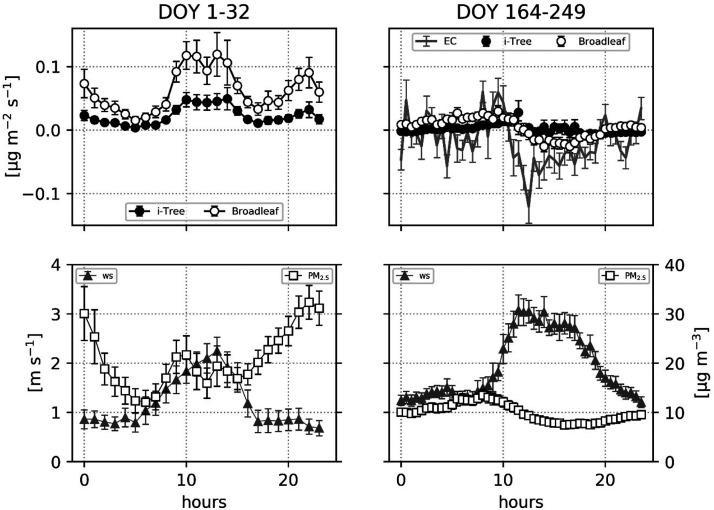
Trees and urban forests remove particulate matter (PM) from the air through the deposition of particles on the leaf surface, thus helping to improve air quality and reduce respiratory problems in urban areas. Leaf deposited PM, in turn, is either resuspended back into the atmosphere, washed off during rain events or transported to the ground with litterfall. The net amount of PM removed depends on crown and leaf characteristics, air pollution concentration, and weather conditions, such as wind speed and precipitation. Many existing deposition models, such as , calculate PM removal using a uniform deposition velocity function and resuspension rate for all tree species, which vary based on leaf area and wind speed. However, model results are seldom validated with experimental data. In this study, we compared calculations of PM deposition with fluxes determined by eddy covariance assessments (canopy scale) and particulate matter accumulated on leaves derived from measurements of vacuum/filtration technique as well as scanning electron microscopy combined with energy-dispersive X-ray spectroscopy (leaf scale). These investigations were carried out at the Capodimonte Royal Forest in Naples. Modeled and measured fluxes showed good overall agreement, demonstrating that net deposition mostly happened in the first part of the day when atmospheric PM concentration is higher, followed by high resuspension rates in the second part of the day, corresponding with increased wind speeds. The sensitivity analysis of the model parameters showed that a better representation of PM deposition fluxes could be achieved with adjusted deposition velocities. It is also likely that the standard assumption of a complete removal of particulate matter, after precipitation events that exceed the water storage capacity of the canopy (Ps), should be reconsidered to better account for specific leaf traits. These results represent the first validation of PM removal with experimental data and are a starting point for improving the model parametrization and the estimate of particulate matter removed by urban trees.
树木和城市森林通过将颗粒物沉积在叶片表面来去除空气中的颗粒物(PM),从而有助于改善城市空气质量并减少呼吸道问题。反过来,叶片上沉积的PM要么重新悬浮回大气中,在降雨时被冲刷掉,要么随着落叶被输送到地面。去除的PM净量取决于树冠和叶片特征、空气污染浓度以及风速和降水等天气条件。许多现有的沉积模型,如 ,使用统一的沉积速度函数和所有树种的再悬浮率来计算PM去除量,这些参数会根据叶面积和风速而变化。然而,模型结果很少用实验数据进行验证。在本研究中,我们将PM沉积的计算结果与涡度协方差评估(冠层尺度)确定的通量以及通过真空/过滤技术测量以及扫描电子显微镜结合能量色散X射线光谱法(叶片尺度)得出的叶片上积累的颗粒物进行了比较。这些研究是在那不勒斯的卡波迪蒙特皇家森林进行的。模拟通量和实测通量总体上显示出良好的一致性,表明净沉积主要发生在一天的第一部分,此时大气PM浓度较高,随后在一天的第二部分再悬浮率较高,这与风速增加相对应。模型参数的敏感性分析表明,通过调整沉积速度可以更好地表示PM沉积通量。在降水量超过树冠储水量(Ps)的降雨事件之后,对于颗粒物完全去除的标准假设也可能需要重新考虑,以便更好地考虑特定的叶片特征。这些结果是首次用实验数据对PM去除进行验证,是改进模型参数化和估算城市树木去除颗粒物的起点。


 Zotero 插件