
适老社区的衡量指标:来自 AARP 适老社区调查的发现。
Measurement Indicators of Age-Friendly Communities: Findings From the AARP Age-Friendly Community Survey.
机构信息
School of Social Work, Virginia Commonwealth University, Richmond, Virginia, USA.
出版信息
Gerontologist. 2022 Jan 14;62(1):e17-e27. doi: 10.1093/geront/gnab055.
BACKGROUND AND OBJECTIVES
Cities and counties worldwide have adopted the concept of "age-friendly communities." These communities aspire to promote older adults' well-being by providing a safe, affordable built environment and a social environment that encourages their participation. A major limitation in this field is the lack of valid and reliable measures that capture the complex dimensionality and dynamic nature of the aging-environment interface.
RESEARCH DESIGN AND METHODS
This study uses data from the AARP 2016 Age-Friendly Community Surveys (N = 3,652 adults aged 65 and older). The survey includes 62 indicators of age-friendliness, for example, outdoor spaces, transportation, housing, social participation, and community and health services. We randomly split the sample into 2 equal subsamples for confirmatory factor analysis (CFA) and structural equation modeling (SEM).
RESULTS
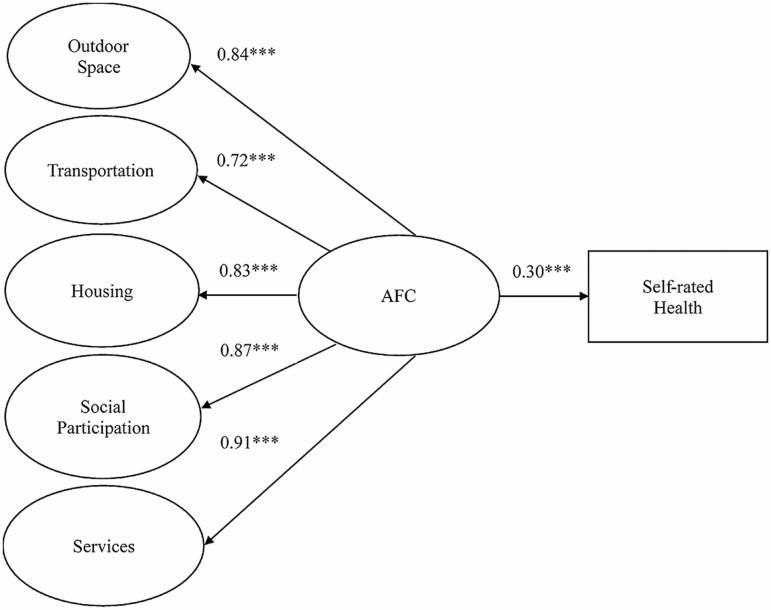
CFA results indicated that both the 5-factor model and the second-order factor model adequately fit the data. In the SEM 5-factor model, outdoor space (β = 0.134; p = .017), social participation (β = 0.307; p < .001), and community and health services (β = -0.149; p = .008) were associated with self-rated health, the outcome of interest. The path coefficients of housing and transportation were not significant. In the second-order factor model, people who lived in more age-friendly communities reported better self-rated health (β = 0.295; p < .001).
DISCUSSION AND IMPLICATIONS
Our findings show that the Age-Friendly Community Survey measures demonstrate reliability and concurrent validity. To promote older adults' well-being, practitioners, policymakers, and researchers should focus on improving their built and social environments. They can use these measures for short- and long-term planning, monitoring, and evaluating age-friendly community initiatives.
背景与目的
全球的城市和县城都采用了“宜居社区”的理念。这些社区旨在通过提供安全、经济实惠的建筑环境和鼓励老年人参与的社会环境来促进老年人的幸福。该领域的一个主要局限是缺乏有效和可靠的措施来捕捉老龄化环境界面的复杂维度和动态性质。
研究设计与方法
本研究使用了 AARP 2016 年宜居社区调查的数据(N = 3652 名 65 岁及以上的成年人)。该调查包括 62 个宜居指标,例如户外空间、交通、住房、社会参与以及社区和卫生服务。我们将样本随机分为两个相等的子样本,用于验证性因子分析(CFA)和结构方程建模(SEM)。
结果
CFA 结果表明,五因素模型和二阶因子模型都能很好地拟合数据。在 SEM 五因素模型中,户外空间(β = 0.134;p =.017)、社会参与(β = 0.307;p <.001)和社区及卫生服务(β = -0.149;p =.008)与自我评估健康有关,这是我们感兴趣的结果。住房和交通的路径系数不显著。在二阶因子模型中,居住在更宜居社区的人报告的自我评估健康状况更好(β = 0.295;p <.001)。
讨论与意义
我们的研究结果表明,《宜居社区调查》的测量方法具有可靠性和同时效度。为了促进老年人的幸福,从业者、政策制定者和研究人员应专注于改善他们的建筑和社会环境。他们可以使用这些措施进行短期和长期规划、监测和评估宜居社区的倡议。

 Zotero 插件