
精油和纯露:液相和气相化学成分及生物活性评估
, and Essential Oils and Hydrolates: Evaluation of Liquid and Vapor Phase Chemical Composition and Biological Activities.
作者信息
Ovidi Elisa, Laghezza Masci Valentina, Zambelli Marta, Tiezzi Antonio, Vitalini Sara, Garzoli Stefania
机构信息
Department for the Innovation in Biological, Agrofood and Forestal Systems, Tuscia University, 01100 Viterbo, Italy.
Department of Agricultural and Environmental Sciences, University of Milan, 20122 Milano, Italy.
出版信息
Plants (Basel). 2021 Apr 6;10(4):707. doi: 10.3390/plants10040707.
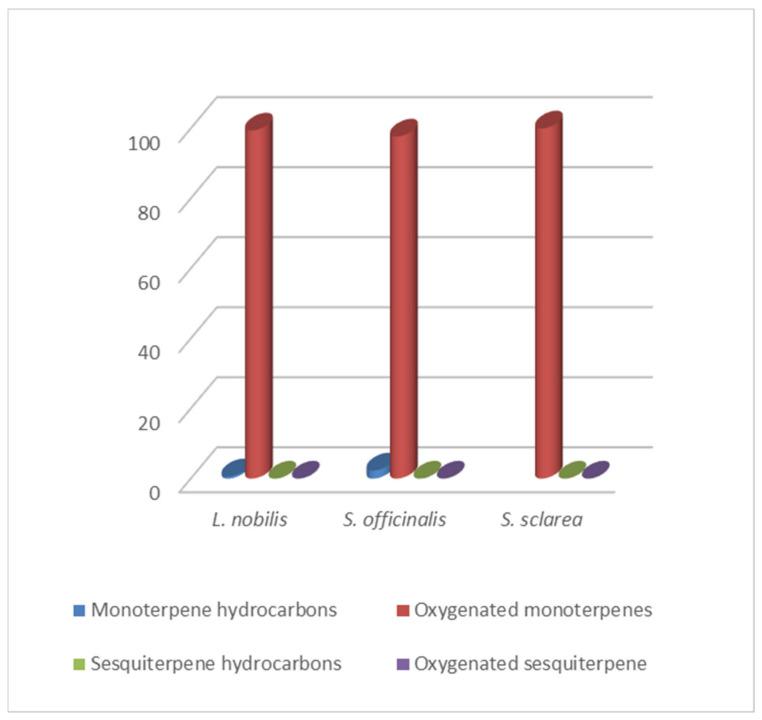
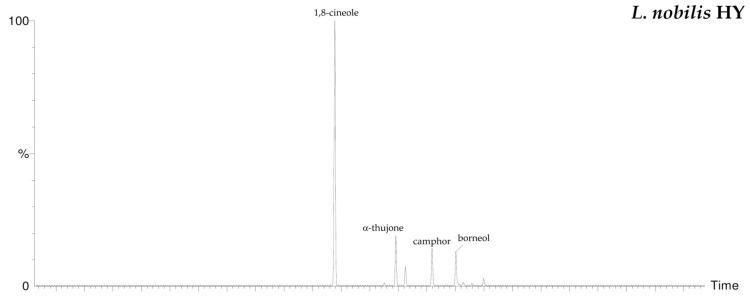
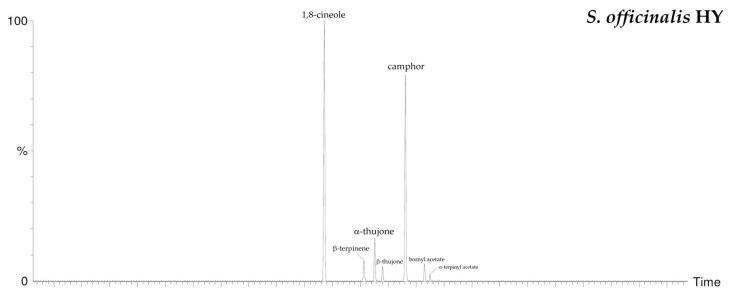
, and essential oils (EOs) and hydrolates (HYs) were investigated to define their chemical compositions and biological properties. Gas-chromatography/Mass-spectrometry (GC/MS) and Headspace-GC/MS (HS-GC/MS) techniques were used to characterize the liquid and vapor phase chemical composition of EOs and HYs. 1,8-Cineole (42.2%, 33.5%) and α-pinene (16.7%, 39.0%) were the main compounds of EO; 1,8-cineole (30.3%, 48.4%) and camphor (17.1%, 8.7%) were for EO; linalyl acetate (62.6%, 30.1%) and linalool (11.1%, 28.9%) were for EO for the liquid and vapor phase, respectively. Chemical profile of HYs was characterized by 1,8-cineole (65.1%, 61.4%) as a main constituent of and HYs, while linalool (89.5%) was the main constituent of HY. The antioxidant activity of EOs and HYs was carried out by DPPH and ABTS assays and antimicrobial properties were also investigated by microdilution and the disc diffusion method for liquid and vapor phase against five different bacterial strains such as ATCC 25922, ATCC 13525 and DSM 102855 among Gram-negative and ATCC 10876 and DSM 16420 among Gram-positive. and EOs demonstrated considerable antibacterial activity, while EO proved to be less effective. Agar diffusion method and vapor phase test showed the EOs activity with the biggest halo inhibition diameters against and . A remarkably high antioxidant activity was determined for showing low EC values and also for good EO results were obtained in both of the used assays. EC values were slightly higher to which corresponds to a lower antioxidant activity. Concerning the HYs, the EC values for , and were remarkably high corresponding to an extremely low antioxidant activity, as also obtained by expressing the values in Trolox equivalent antioxidant capacity (TEAC).
对[具体名称未给出]以及精油(EOs)和纯露(HYs)进行了研究,以确定它们的化学成分和生物学特性。采用气相色谱/质谱联用(GC/MS)和顶空气相色谱/质谱联用(HS-GC/MS)技术对精油和纯露的液相和气相化学成分进行表征。1,8-桉叶素(42.2%,33.5%)和α-蒎烯(16.7%,39.0%)是[第一种精油名称未给出]精油的主要成分;1,8-桉叶素(30.3%,48.4%)和樟脑(17.1%,8.7%)是[第二种精油名称未给出]精油的主要成分;乙酸芳樟酯(62.6%,30.1%)和芳樟醇(11.1%,28.9%)分别是[第三种精油名称未给出]精油液相和气相的主要成分。纯露的化学特征是,1,8-桉叶素(65.1%,61.4%)是[第一种纯露名称未给出]和[第二种纯露名称未给出]纯露的主要成分,而芳樟醇(89.5%)是[第三种纯露名称未给出]纯露的主要成分。通过DPPH和ABTS法测定了精油和纯露的抗氧化活性,并采用微量稀释法和纸片扩散法研究了它们对液相和气相中五种不同细菌菌株(如革兰氏阴性菌中的大肠杆菌ATCC 25922、金黄色葡萄球菌ATCC 13525和嗜麦芽窄食单胞菌DSM 102855,以及革兰氏阳性菌中的枯草芽孢杆菌ATCC 10876和表皮葡萄球菌DSM 16420)的抗菌性能。[第一种精油名称未给出]和[第二种精油名称未给出]精油表现出相当强的抗菌活性,而[第三种精油名称未给出]精油的效果较差。琼脂扩散法和气相试验表明,[第一种精油名称未给出]和[第二种精油名称未给出]精油对[相关细菌名称未给出]和[相关细菌名称未给出]的抑菌圈直径最大,表现出较强的活性。[具体名称未给出]表现出显著高的抗氧化活性,其EC值较低,[相关精油名称未给出]在两种所用试验中也获得了良好的结果。[具体名称未给出]的EC值略高,其抗氧化活性较低。关于纯露,[第一种纯露名称未给出]、[第二种纯露名称未给出]和[第三种纯露名称未给出]的EC值非常高,对应的抗氧化活性极低,以Trolox等效抗氧化能力(TEAC)表示时也是如此。

 Zotero 插件