
碳水化合物对睡眠影响的系统评价、荟萃分析和荟萃回归研究
A Systematic Review, Meta-Analysis and Meta-Regression on the Effects of Carbohydrates on Sleep.
机构信息
Department of Life and Health Sciences, University of Nicosia, 46 Makedonitisas Avenue, Nicosia CY1700, Cyprus.
Department of PE and Sport Science, University of Thessaly, 42100 Trikala, Greece.
出版信息
Nutrients. 2021 Apr 14;13(4):1283. doi: 10.3390/nu13041283.
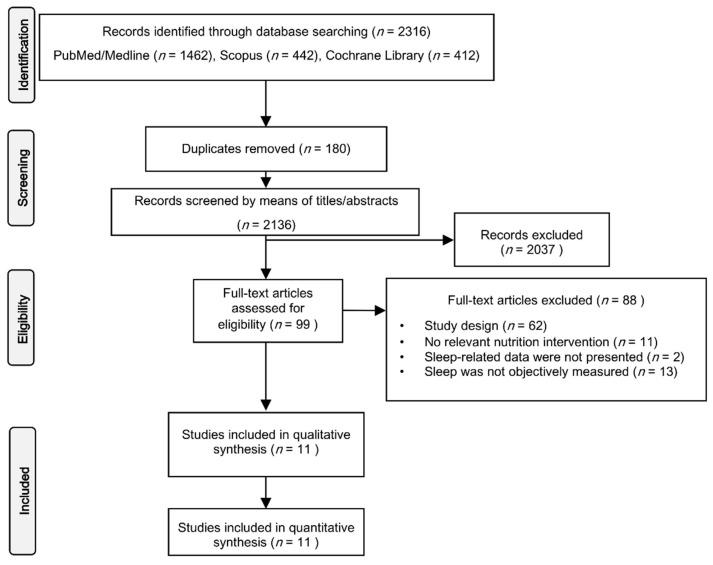
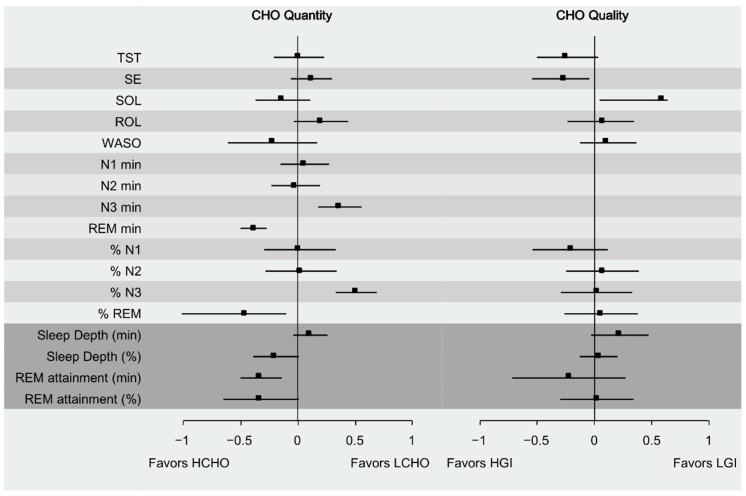
This study aimed to assess the effects of quantity, quality and periodization of carbohydrates consumption on sleep. PubMed, SCOPUS and Cochrane Library were searched through October 2020. Data were pooled using random-effects meta-analysis. Eleven articles were included in the meta-analysis which consisted of 27 separate nutrition trials, resulting in 16 comparison data sets (sleep quantity = 11; sleep quality = 5). Compared to high carbohydrate (HCI), low carbohydrate intake (LCI) moderately increased duration and proportion of N3 sleep stage (ES = 0.37; 95% CI = 0.18, 0.56; < 0.001 and ES = 0.51; 95% CI = 0.33, 0.69; < 0.001, respectively). HCI prolonged rapid eye movement (REM) stage duration (ES = -0.38; 95% CI = 0.05, -8.05; < 0.001) and proportion (ES = -0.46; 95% CI = -0.83, -0.01; < 0.001), compared to LCI. The quality of carbohydrate intake did not affect sleep stages. Meta-regression showed that the effectiveness of carbohydrate quantity and quality in sleep onset latency was significantly explained by alterations of carbohydrate intake as a percentage of daily energy intake (R = 25.87, = 0.018) and alterations in the glycemic load (R = 50.8, = 0.048), respectively. Alterations in glycemic load partially explained the variance of the effectiveness of carbohydrate quality in sleep efficiency (R = 89.2, < 0.001) and wake after sleep onset (R = 64.9, = 0.018). Carbohydrate quantity was shown to affect sleep architecture, and especially N3 and REM sleep stages. Alterations in both quantity and quality of carbohydrate intake showed a significant effect on sleep initiation. Variations in carbohydrate quality significantly affected measures of sleep continuation. Further studies are needed to assess the effect of long-term carbohydrate interventions on sleep.
这项研究旨在评估碳水化合物摄入量、质量和分期对睡眠的影响。通过 2020 年 10 月对 PubMed、SCOPUS 和 Cochrane Library 进行了检索。使用随机效应荟萃分析对数据进行了汇总。荟萃分析纳入了 11 篇文章,这些文章包含了 27 项独立的营养试验,产生了 16 个比较数据集(睡眠量=11;睡眠质量=5)。与高碳水化合物(HCI)相比,低碳水化合物摄入(LCI)适度增加了 N3 睡眠阶段的持续时间和比例(ES=0.37;95%CI=0.18,0.56;<0.001 和 ES=0.51;95%CI=0.33,0.69;<0.001)。HCI 延长了快速眼动(REM)阶段的持续时间(ES=-0.38;95%CI=0.05,-8.05;<0.001)和比例(ES=-0.46;95%CI=0.83,-0.01;<0.001),与 LCI 相比。碳水化合物摄入量的质量并不影响睡眠阶段。元回归表明,碳水化合物摄入量作为每日能量摄入量的百分比(R=25.87,=0.018)和血糖负荷的变化(R=50.8,=0.048)对睡眠潜伏期中碳水化合物数量和质量的影响具有显著的解释作用。血糖负荷的变化部分解释了碳水化合物质量对睡眠效率(R=89.2,<0.001)和睡眠后觉醒(R=64.9,=0.018)有效性的差异。碳水化合物的数量会影响睡眠结构,特别是 N3 和 REM 睡眠阶段。碳水化合物摄入量的数量和质量的变化对睡眠开始有显著影响。碳水化合物质量的变化显著影响了睡眠连续性的测量。需要进一步的研究来评估长期碳水化合物干预对睡眠的影响。
 Zotero 插件