
II 型胶原蛋白特异性 B 细胞诱导 Th1 偏向、Th2 偏向和关节炎倾向的小鼠品系产生免疫耐受。
Type II Collagen-Specific B Cells Induce Immune Tolerance in Th1-Skewed, Th2-Skewed, and Arthritis-Prone Strains of Mice.
机构信息
Department of Pharmacy Practice, Eugene Applebaum College of Pharmacy and Health Sciences, Wayne State University, Detroit, MI 48201, USA.
Department of Integrative Biology, College of Arts and Sciences, University of South Florida, St. Petersburg, FL 33701, USA.
出版信息
Cells. 2021 Apr 12;10(4):870. doi: 10.3390/cells10040870.
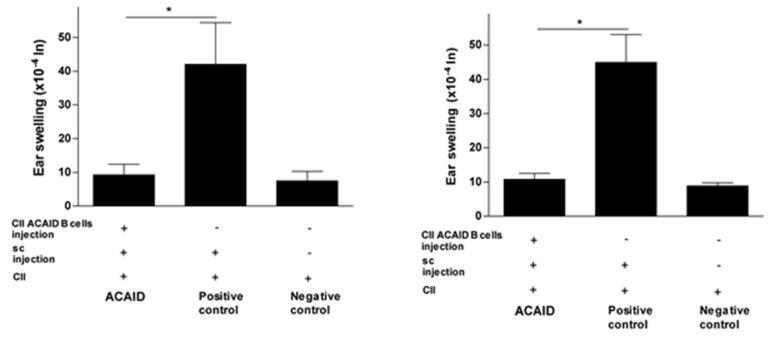
Antigen-specific regulatory T cells play key immune suppressive roles in autoimmune disease models and regulate the peripheral tolerance achieved via anterior chamber-associated immune deviation (ACAID). Articular cartilage has type II collagen (CII), which is a potent autoantigen protein in arthritis. There has not been much research on the clinical importance of CII-associated diseases. Moreover, the capability of CII to induce immune tolerance has not been previously assessed. We reported that delivery of CII either directly into the eye or via intravenous injection of CII-specific ACAID antigen presenting cells (APCs) can induce ACAID. Here, we hypothesized that peripheral tolerance can be induced following adoptive transfer of generated CII-specific ACAID B cells to naive mice. Delayed hypersensitivity (DTH) assays were used to assess the suppressive ability of adoptively transferred B cells. Immune responses of ACAID B cell-injected mice were significantly suppressed following challenges with CII as compared to positive controls. This effect was replicated in three different strains of mice (C57BL/6, BALB/c, and DBA/1). Thus, CII-specific ACAID B cells were able to induce immune tolerance in Th1-skewed, Th2-skewed, and arthritis-prone mice. ACAID B cell-mediated tolerance induced by CII could have therapeutic implications for the treatment of CII-mediated autoimmune diseases.
抗原特异性调节性 T 细胞在自身免疫性疾病模型中发挥关键的免疫抑制作用,并调节通过前房相关免疫偏离(ACAID)实现的外周耐受。关节软骨具有 II 型胶原(CII),这是关节炎中的一种潜在自身抗原蛋白。目前对于与 CII 相关疾病的临床重要性研究还不多。此外,CII 诱导免疫耐受的能力以前也没有被评估过。我们曾报道,直接将 CII 递送至眼睛或通过静脉内注射 CII 特异性 ACAID 抗原呈递细胞(APC),可诱导 ACAID。在这里,我们假设通过过继转移生成的 CII 特异性 ACAID B 细胞,可以在幼稚小鼠中诱导外周耐受。迟发型超敏反应(DTH)测定用于评估过继转移 B 细胞的抑制能力。与阳性对照相比,接受 ACAID B 细胞注射的小鼠的免疫反应在受到 CII 挑战后受到明显抑制。该效果在三种不同品系的小鼠(C57BL/6、BALB/c 和 DBA/1)中得到了复制。因此,CII 特异性 ACAID B 细胞能够在 Th1 偏向、Th2 偏向和关节炎易感的小鼠中诱导免疫耐受。CII 特异性 ACAID B 细胞介导的 CII 诱导的耐受性可能对 CII 介导的自身免疫性疾病的治疗具有重要意义。


 Zotero 插件