
避免在 2019 冠状病毒病(COVID-19)大流行期间在韩国使用医疗保健。
Avoidance of Healthcare Utilization in South Korea during the Coronavirus Disease 2019 (COVID-19) Pandemic.
机构信息
Department of Public Health Sciences, Graduate School of Public Health, Seoul National University, Seoul 08826, Korea.
Office of Dental Education, School of Dentistry, Seoul National University, Seoul 08826, Korea.
出版信息
Int J Environ Res Public Health. 2021 Apr 20;18(8):4363. doi: 10.3390/ijerph18084363.
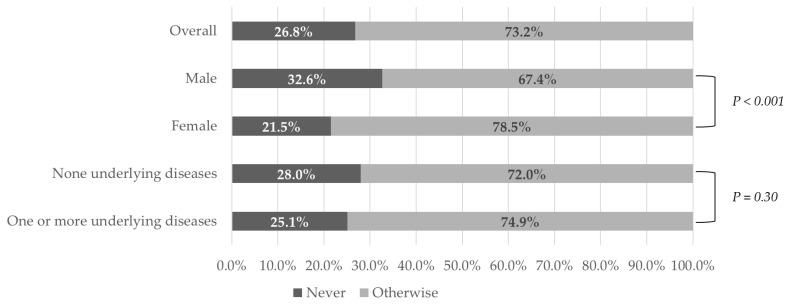
Avoidance of healthcare utilization among the general population during pandemic outbreaks has been observed and it can lead to a negative impact on population health. The object of this study is to examine the influence of socio-demographic and health-related factors on the avoidance of healthcare utilization during the global outbreak of a novel coronavirus (COVID-19) in 2020. Data were collected through an online survey four weeks after the Korea Centers for Disease Control and Prevention (KCDC) confirmed the first case in South Korea; 1000 subjects were included in the analysis. The logit model for regression was used to analyze the associations between sociodemographic and health-related factors regarding the avoidance of healthcare utilization. Among the participants, 73.2% avoided healthcare utilization, and there was no significant difference in the prevalence of healthcare avoidance between groups with (72.0%) and without (74.9%) an underlying disease. Sociodemographic characteristics (e.g., gender, age, income level, and residential area) were related to healthcare avoidance. Among the investigated influencing factors, residential areas highly affected by COVID-19 (i.e., Daegu/Gyeoungbuk region) had the most significant effect on healthcare avoidance. This study found a high prevalence of healthcare avoidance among the general population who under-utilized healthcare resources during the COVID-19 outbreak. However, the results reveal that not all societal groups share the burden of healthcare avoidance equally, with it disproportionately affecting those with certain sociodemographic characteristics. This study can inform healthcare under-utilization patterns during emerging infectious disease outbreaks and provide information to public health emergency management for implementing strategies necessary to improve the preparedness of the healthcare system.
在大流行爆发期间,普通人群避免使用医疗保健的现象已经观察到,这可能对人口健康产生负面影响。本研究的目的是检验社会人口学和与健康相关的因素对 2020 年新型冠状病毒(COVID-19)全球爆发期间避免使用医疗保健的影响。数据是在韩国疾病控制与预防中心(KCDC)确认韩国首例病例四周后通过在线调查收集的;共有 1000 名受试者纳入分析。使用逻辑回归模型分析了与避免使用医疗保健相关的社会人口学和与健康相关的因素之间的关联。在参与者中,73.2%的人避免使用医疗保健,有基础疾病组(72.0%)和无基础疾病组(74.9%)之间避免医疗保健的患病率没有显著差异。社会人口学特征(如性别、年龄、收入水平和居住地区)与医疗保健回避有关。在所调查的影响因素中,受 COVID-19影响较大的居住地区(即大邱/庆尚北道地区)对医疗保健回避的影响最大。本研究发现,在 COVID-19 爆发期间,普通人群普遍存在医疗保健利用不足的现象。然而,研究结果表明,并非所有社会群体都平等地承担医疗保健回避的负担,某些社会人口学特征的群体受到的影响不成比例。本研究可以为新兴传染病爆发期间的医疗保健利用不足模式提供信息,并为公共卫生应急管理提供信息,以实施必要的策略来改善医疗保健系统的准备工作。
 Zotero 插件