
牙龈间充质干细胞:在组织工程和再生医学中的潜在应用——全面综述。
Gingiva-Derived Mesenchymal Stem Cells: Potential Application in Tissue Engineering and Regenerative Medicine - A Comprehensive Review.
机构信息
Department of Oral & Maxillofacial Surgery & Pharmacology, School of Dental Medicine, University of Pennsylvania, Philadelphia, PA, United States.
Center of Innovation & Precision Dentistry, School of Dental Medicine, School of Engineering and Applied Sciences, University of Pennsylvania, Philadelphia, PA, United States.
出版信息
Front Immunol. 2021 Apr 16;12:667221. doi: 10.3389/fimmu.2021.667221. eCollection 2021.
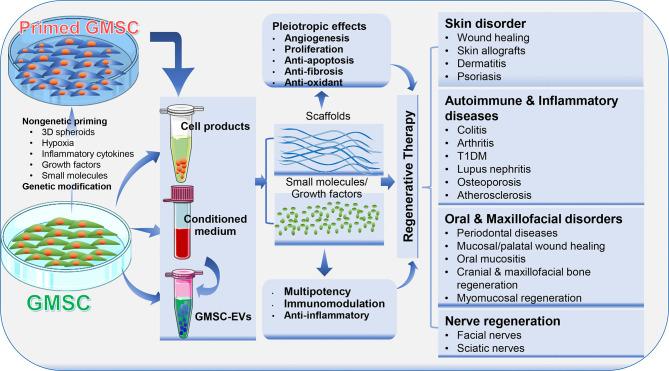
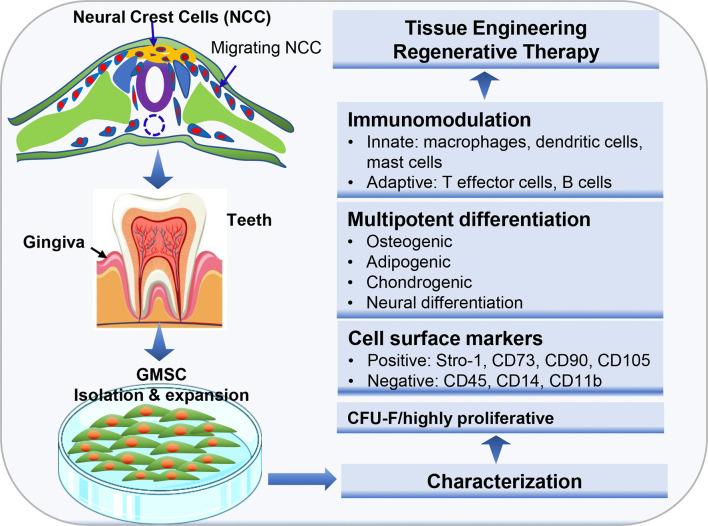
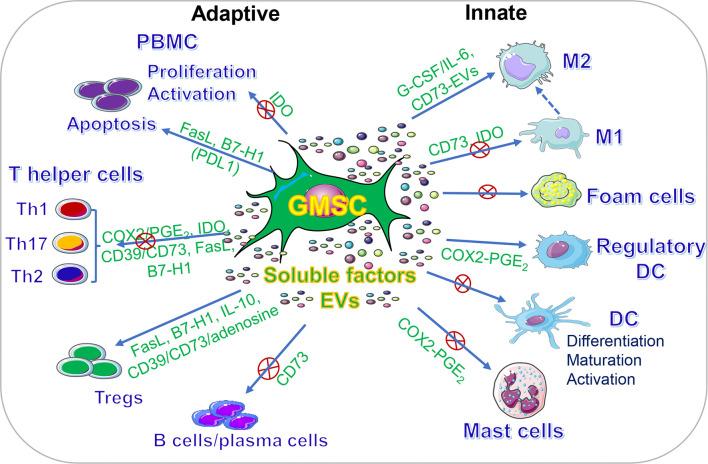
A unique subpopulation of mesenchymal stem cells (MSCs) has been isolated and characterized from human gingival tissues (GMSCs). Similar to MSCs derived from other sources of tissues, e.g. bone marrow, adipose or umbilical cord, GMSCs also possess multipotent differentiation capacities and potent immunomodulatory effects on both innate and adaptive immune cells through the secretion of various types of bioactive factors with immunosuppressive and anti-inflammatory functions. Uniquely, GMSCs are highly proliferative and have the propensity to differentiate into neural cell lineages due to the neural crest-origin. These properties have endowed GMSCs with potent regenerative and therapeutic potentials in various preclinical models of human disorders, particularly, some inflammatory and autoimmune diseases, skin diseases, oral and maxillofacial disorders, and peripheral nerve injuries. All types of cells release extracellular vesicles (EVs), including exosomes, that play critical roles in cell-cell communication through their cargos containing a variety of bioactive molecules, such as proteins, nucleic acids, and lipids. Like EVs released by other sources of MSCs, GMSC-derived EVs have been shown to possess similar biological functions and therapeutic effects on several preclinical diseases models as GMSCs, thus representing a promising cell-free platform for regenerative therapy. Taken together, due to the easily accessibility and less morbidity of harvesting gingival tissues as well as the potent immunomodulatory and anti-inflammatory functions, GMSCs represent a unique source of MSCs of a neural crest-origin for potential application in tissue engineering and regenerative therapy.
已从人牙龈组织(GMSCs)中分离和鉴定出一种独特的间充质干细胞(MSCs)亚群。与源自其他组织(例如骨髓、脂肪或脐带)的 MSCs 相似,GMSCs 还具有多能分化能力,并通过分泌具有免疫抑制和抗炎功能的各种类型的生物活性因子,对固有和适应性免疫细胞产生强大的免疫调节作用。独特的是,GMSCs 具有高度增殖能力,由于神经嵴起源,倾向于分化为神经细胞谱系。这些特性使 GMSCs 在各种人类疾病的临床前模型中具有强大的再生和治疗潜力,特别是一些炎症和自身免疫性疾病、皮肤病、口腔和颌面疾病以及周围神经损伤。所有类型的细胞都会释放细胞外囊泡(EVs),包括外泌体,它们通过其包含各种生物活性分子(如蛋白质、核酸和脂质)的货物在细胞间通讯中发挥关键作用。与源自其他 MSC 来源的 EVs 一样,GMSC 衍生的 EVs 已被证明在几种临床前疾病模型中具有类似的生物学功能和治疗效果,因此代表了一种有前途的无细胞再生治疗平台。总之,由于获取牙龈组织的便利性和低发病率以及强大的免疫调节和抗炎功能,GMSCs 代表了一种独特的神经嵴起源的 MSC 来源,可用于组织工程和再生治疗。
 Zotero 插件