
从肿瘤教育的血小板中吸取教训。
Lessons to learn from tumor-educated platelets.
机构信息
Hematology Division, Brigham and Women's Hospital, Boston, MA; and.
Department of Medicine, Harvard Medical School, Harvard University, Boston, MA.
出版信息
Blood. 2021 Jun 10;137(23):3174-3180. doi: 10.1182/blood.2019003976.
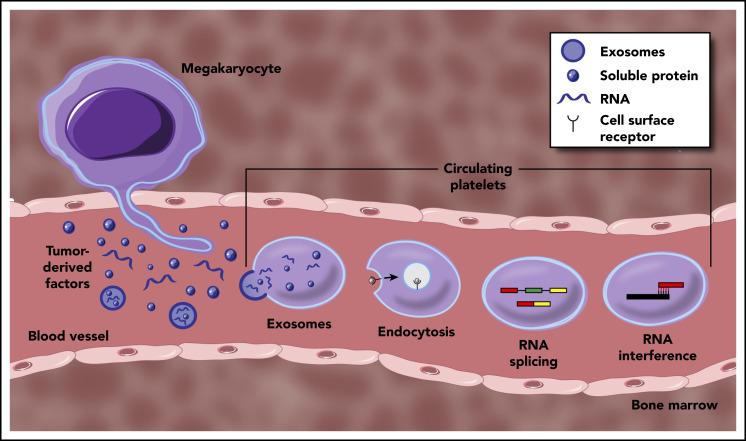
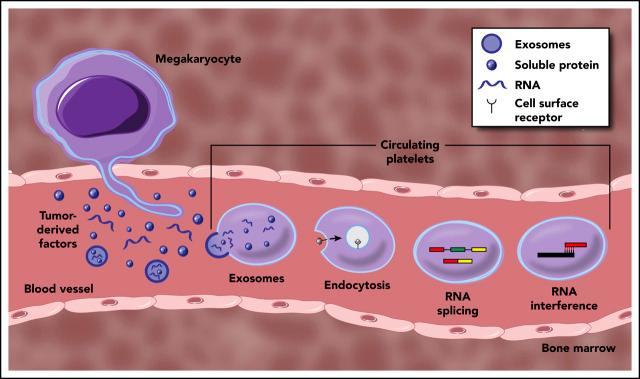
Platelets have long been known to play important roles beyond hemostasis and thrombosis. Now recognized as a bona fide mediator of malignant disease, platelets influence various aspects of cancer progression, most notably tumor cell metastasis. Interestingly, platelets isolated from cancer patients often display distinct RNA and protein profiles, with no clear alterations in hemostatic activity. This phenotypically distinct population, termed tumor-educated platelets, now receive significant attention for their potential use as a readily available liquid biopsy for early cancer detection. Although the mechanisms underpinning platelet education are still being defined, direct uptake and storage of tumor-derived factors, signal-dependent changes in platelet RNA processing, and differential platelet production by tumor-educated megakaryocytes are the most prominent scenarios. This article aims to cover the various modalities of platelet education by tumors, in addition to assessing their diagnostic potential.
血小板在止血和血栓形成之外发挥着重要作用,这一点早已为人所知。现在,人们已经认识到血小板是恶性疾病的一种真正的介质,它影响着癌症进展的各个方面,尤其是肿瘤细胞的转移。有趣的是,从癌症患者中分离出的血小板通常表现出不同的 RNA 和蛋白质谱,而止血活性没有明显改变。这种表型独特的群体,被称为肿瘤诱导的血小板,由于其作为早期癌症检测的一种现成的液体活检的潜在用途,现在受到了广泛关注。虽然支持血小板教育的机制仍在定义中,但肿瘤的直接摄取和储存肿瘤来源的因子、血小板 RNA 处理的信号依赖性变化,以及肿瘤诱导的巨核细胞产生的差异血小板是最突出的情况。本文旨在涵盖肿瘤对血小板的各种诱导方式,并评估其诊断潜力。
 Zotero 插件