
接受大型开放性腹部癌症手术患者的实际术后蛋白质和卡路里摄入量:一项前瞻性观察队列研究。
Actual postoperative protein and calorie intake in patients undergoing major open abdominal cancer surgery: A prospective, observational cohort study.
机构信息
Department of Surgery, University Medical Center Groningen, Groningen, the Netherlands.
Department of Gastroenterology and Hepatology, University Medical Center Groningen, Groningen, the Netherlands.
出版信息
Nutr Clin Pract. 2022 Feb;37(1):183-191. doi: 10.1002/ncp.10678. Epub 2021 May 12.
BACKGROUND
Adequate nutritional protein and energy intake are required for optimal postoperative recovery. There are limited studies reporting the actual postoperative protein and energy intake within the first week after major abdominal cancer surgery. The main objective of this study was to quantify the protein and energy intake after major abdominal cancer surgery.
METHODS
We conducted a prospective cohort study. Nutrition intake was assessed with a nutrition diary. The amount of protein and energy consumed through oral, enteral, and parenteral nutrition was recorded and calculated separately. Based on the recommendations of the European Society for Clinical Nutrition and Metabolism (ESPEN), protein and energy intake were considered insufficient when patients received <1.5 g/kg protein and 25 kcal/kg for 2 or more days during the first postoperative week.
RESULTS
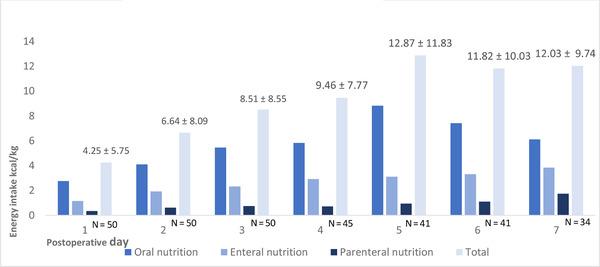
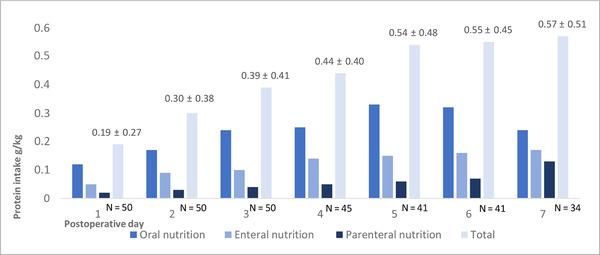
Fifty patients were enrolled in this study. Mean daily protein and energy intake was 0.61 ± 0.44 g/kg/day and 9.58 ± 3.33 kcal/kg/day within the first postoperative week, respectively. Protein and energy intake were insufficient in 45 [90%] and 41 [82%] of the 50 patients, respectively. Patients with Clavien-Dindo grade ≥III complications consumed less daily protein compared with the group of patients without complications and patients with grade I or II complications.
CONCLUSION
During the first week after major abdominal cancer surgery, the majority of patients do not consume an adequate amount of protein and energy. Incorporating a registered dietitian into postoperative care and adequate nutrition support after major abdominal cancer surgery should be a standard therapeutic goal to improve nutrition intake.
背景
充足的营养蛋白和能量摄入是实现术后最佳恢复的必要条件。目前仅有少数研究报告了大型腹部癌症手术后第一周内的实际术后蛋白和能量摄入情况。本研究的主要目的是量化大型腹部癌症手术后的蛋白和能量摄入。
方法
我们进行了一项前瞻性队列研究。通过营养日记评估营养摄入。分别记录和计算口服、肠内和肠外营养的蛋白和能量摄入量。根据欧洲临床营养与代谢学会(ESPEN)的建议,如果患者在术后第一周的 2 天或以上时间内接受的蛋白量<1.5 g/kg 且能量量<25 kcal/kg,则认为蛋白和能量摄入不足。
结果
本研究纳入了 50 名患者。术后第一周,患者的平均每日蛋白和能量摄入量分别为 0.61 ± 0.44 g/kg/day 和 9.58 ± 3.33 kcal/kg/day。50 名患者中有 45 名(90%)和 41 名(82%)的蛋白和能量摄入分别不足。与无并发症患者和 Clavien-Dindo 分级为 I 或 II 并发症患者相比,发生≥III 级并发症的患者每日蛋白摄入量较低。
结论
在大型腹部癌症手术后的第一周内,大多数患者的蛋白和能量摄入量不足。在大型腹部癌症手术后将注册营养师纳入术后护理和充分的营养支持应成为改善营养摄入的标准治疗目标。
 Zotero 插件