
18F-DCFPyL PET/CT成像在早期检测生化复发前列腺癌中的性能:一项系统评价和荟萃分析
Performance of 18F-DCFPyL PET/CT Imaging in Early Detection of Biochemically Recurrent Prostate Cancer: A Systematic Review and Meta-Analysis.
作者信息
Sun Jiale, Lin Yuxin, Wei Xuedong, Ouyang Jun, Huang Yuhua, Ling Zhixin
机构信息
Department of Urology, The First Affiliated Hospital of Soochow University, Suzhou, China.
出版信息
Front Oncol. 2021 Apr 26;11:649171. doi: 10.3389/fonc.2021.649171. eCollection 2021.
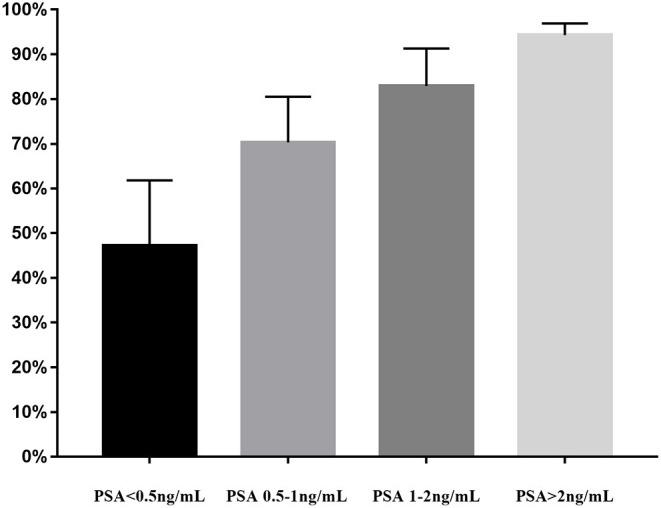
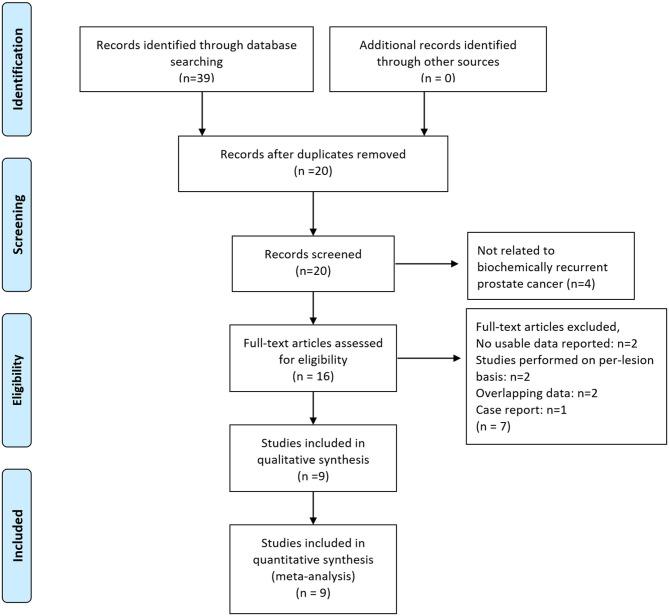
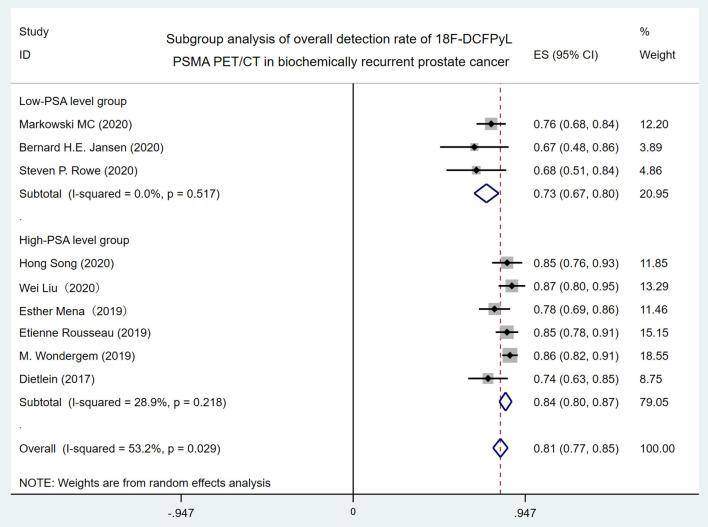
Prostate-specific membrane antigen (PSMA)-targeted 2-(3-{1-carboxy-5-[(6-[18F] fluoro-pyridine-3-carbonyl)-amino]-pentyl}-ureido)-pentanedioic acid (18F-DCFPyL) positron emission tomography/computed tomography (PET/CT) has shown advantages in primary staging, restaging, and metastasis detection of prostate cancer (PCa). However, little is known about the role of 18F-DCFPyL PET/CT in biochemically recurrent prostate cancer (BRPCa). Hence, we performed a systematic review and meta-analysis to evaluate 18F-DCFPyL PET/CT as first-line imaging modality in early detection of BRPCa. A comprehensive literature search of PubMed, Web of Science, Embase, and Cochrane Library was conducted until December 2020. The pooled detection rate on a per-person basis and together with 95% confidence interval (CI) was calculated. Furthermore, a prostate-specific antigen (PSA)-stratified performance of detection positivity was obtained to assess the sensitivity of 18F-DCFPyL PET/CT in BRPCa with different PSA levels. A total of nine eligible studies (844 patients) were included in this meta-analysis. The pooled detection rate (DR) of 18F-DCFPyL PET/CT in BRPCa was 81% (95% CI: 76.9-85.1%). The pooled DR was 88.8% for PSA ≥ 0.5 ng/ml (95% CI: 86.2-91.3%) and 47.2% for PSA < 0.5 ng/ml (95% CI: 32.6-61.8%). We also noticed that the regional lymph node was the most common site with local recurrence compared with other sites (45.8%, 95% CI: 42.1-49.6%). Statistical heterogeneity and publication bias were found. The results suggest that 18F-DCFPyL PET/CT has a relatively high detection rate in BRPCa. The results also indicate that imaging with 18F-DCFPyL may exhibit improved sensitivity in BRPCa with increased PSA levels. Considering the publication bias, further large-scale multicenter studies are warranted for validation.
前列腺特异性膜抗原(PSMA)靶向的2-(3-{1-羧基-5-[(6-[¹⁸F]氟吡啶-3-羰基)-氨基]-戊基}-脲基)-戊二酸(¹⁸F-DCFPyL)正电子发射断层扫描/计算机断层扫描(PET/CT)在前列腺癌(PCa)的初始分期、再分期及转移灶检测方面已显示出优势。然而,关于¹⁸F-DCFPyL PET/CT在生化复发前列腺癌(BRPCa)中的作用知之甚少。因此,我们进行了一项系统评价和荟萃分析,以评估¹⁸F-DCFPyL PET/CT作为BRPCa早期检测的一线成像模式。截至2020年12月,我们对PubMed、Web of Science、Embase和Cochrane图书馆进行了全面的文献检索。计算了每人的合并检测率及95%置信区间(CI)。此外,还获得了前列腺特异性抗原(PSA)分层的检测阳性表现,以评估¹⁸F-DCFPyL PET/CT在不同PSA水平的BRPCa中的敏感性。本荟萃分析共纳入9项符合条件的研究(844例患者)。¹⁸F-DCFPyL PET/CT在BRPCa中的合并检测率(DR)为81%(95%CI:76.9 - 85.1%)。PSA≥0.5 ng/ml时的合并DR为88.8%(95%CI:86.2 - 91.3%),PSA<0.5 ng/ml时为47.2%(95%CI:32.6 - 61.8%)。我们还注意到,与其他部位相比,区域淋巴结是局部复发最常见的部位(45.8%,95%CI:42.1 - 49.6%)。发现了统计学异质性和发表偏倚。结果表明,¹⁸F-DCFPyL PET/CT在BRPCa中的检测率相对较高。结果还表明,¹⁸F-DCFPyL成像在PSA水平升高的BRPCa中可能表现出更高的敏感性。考虑到发表偏倚,需要进一步进行大规模多中心研究以进行验证。

 Zotero 插件