
基于糖尿病的心力衰竭患者心肺能力的混合综合远程康复治疗效果:TELEREH-HF 随机临床试验的亚分析。
Effects of hybrid comprehensive telerehabilitation on cardiopulmonary capacity in heart failure patients depending on diabetes mellitus: subanalysis of the TELEREH-HF randomized clinical trial.
机构信息
1st Chair and Department of Cardiology, Medical University of Warsaw, Warsaw, Poland.
Telecardiology Center, National Institute of Cardiology, Alpejska Str. 42, 04-828, Warsaw, Poland.
出版信息
Cardiovasc Diabetol. 2021 May 13;20(1):106. doi: 10.1186/s12933-021-01292-9.
BACKGROUND
Type 2 diabetes mellitus (DM) is one of the most common comorbidities among patients with heart failure (HF) with reduced ejection fraction (HFrEF). There are limited data regarding efficacy of hybrid comprehensive telerehabilitation (HCTR) on cardiopulmonary exercise capacity in patients with HFrEF with versus those without diabetes.
AIM
The aim of the present study was to analyze effects of 9-week HCTR in comparison to usual care on parameters of cardiopulmonary exercise capacity in HF patients according to history of DM.
METHODS
Clinically stable HF patients with left ventricular ejection fraction [LVEF] < 40% after a hospitalization due to worsening HF within past 6 months were enrolled in the TELEREH-HF (The TELEREHabilitation in Heart Failure Patients) trial and randomized to the HCTR or usual care (UC). Cardiopulmonary exercise tests (CPET) were performed on treadmill with an incremental workload according to the ramp protocol.
RESULTS
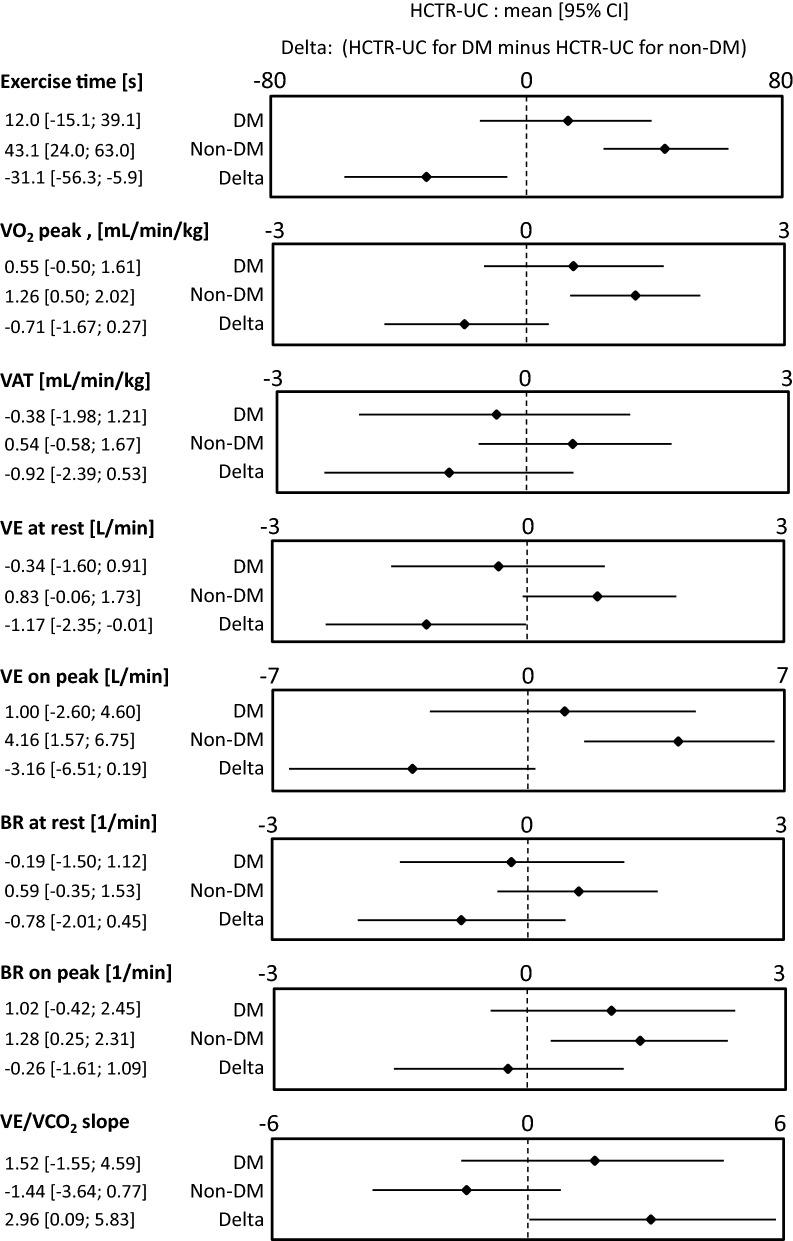
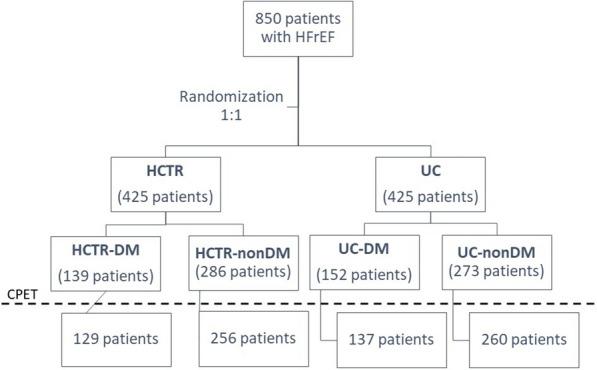
CPET was performed in 385 patients assigned to HCTR group: 129 (33.5%) had DM (HCTR-DM group) and 256 patients (66.5%) did not have DM (HCTR-nonDM group). Among 397 patients assigned to UC group who had CPET: 137 (34.5%) had DM (UC-DM group) and 260 patients (65.5%) did not have DM (UC-nonDM group). Among DM patients, differences in cardiopulmonary parameters from baseline to 9 weeks remained similar among HCTR and UC patients. In contrast, among patients without DM, HCTR was associated with greater 9-week changes than UC in exercise time, which resulted in a statistically significant interaction between patients with and without DM: difference in changes in exercise time between HCTR versus UC was 12.0 s [95% CI - 15.1, 39.1 s] in DM and 43.1 s [95% CI 24.0, 63.0 s] in non-DM, interaction p-value = 0.016. Furthermore, statistically significant differences in the effect of HCTR versus UC between DM and non-DM were observed in ventilation at rest: - 0.34 l/min [95% CI - 1.60, 0.91 l/min] in DM and 0.83 l/min [95% CI - 0.06, 1.73 l/min] in non-DM, interaction p value = 0.0496 and in VE/VCO slope: 1.52 [95% CI - 1.55, 4.59] for DM vs. - 1.44 [95% CI - 3.64, 0.77] for non-DM, interaction p value = 0.044.
CONCLUSIONS
The benefits of hybrid comprehensive telerehabilitation versus usual care on the improvement of physical performance, ventilatory profile and gas exchange parameters were more pronounced in patients with HFrEF without DM as compared to patients with DM.
TRIAL REGISTRATION
ClinicalTrials.gov Identifier: NCT02523560. Registered 3rd August 2015. https://clinicaltrials.gov/ct2/show/NCT02523560?term=NCT02523560&draw=2&rank=1 . Other Study ID Numbers: STRATEGME1/233547/13/NCBR/2015.
背景
2 型糖尿病(DM)是射血分数降低性心力衰竭(HFrEF)患者最常见的合并症之一。关于综合远程康复治疗(HCTR)对 HFrEF 患者心肺运动能力的疗效,数据有限,且这些研究中没有涉及到有糖尿病和没有糖尿病的患者。
目的
本研究旨在分析 9 周 HCTR 与常规护理相比,在有或没有糖尿病史的 HF 患者中对心肺运动能力参数的影响。
方法
因 HF 恶化而住院治疗的患者,在过去 6 个月内左心室射血分数 [LVEF] < 40%,病情稳定后,这些患者被纳入 TELEREH-HF(心力衰竭患者的远程康复治疗)试验,并随机分为 HCTR 组或常规护理(UC)组。心肺运动试验(CPET)是在跑步机上进行的,采用递增负荷的斜坡方案。
结果
385 名被分配到 HCTR 组的患者进行了 CPET:129 名(33.5%)患有糖尿病(HCTR-DM 组),256 名(66.5%)没有糖尿病(HCTR-nonDM 组)。397 名被分配到 UC 组的患者进行了 CPET:137 名(34.5%)患有糖尿病(UC-DM 组),260 名(65.5%)没有糖尿病(UC-nonDM 组)。在糖尿病患者中,从基线到 9 周的心肺参数变化在 HCTR 和 UC 患者之间仍然相似。相比之下,在没有糖尿病的患者中,HCTR 与 UC 相比,运动时间的 9 周变化更大,这导致有和没有糖尿病的患者之间存在统计学显著的交互作用:HCTR 与 UC 相比,运动时间的变化差异为 12.0 s [95%CI -15.1, 39.1 s]在糖尿病患者中,43.1 s [95%CI 24.0, 63.0 s]在非糖尿病患者中,交互作用 p 值=0.016。此外,在休息时通气和 VE/VCO 斜率方面,HCTR 与 UC 之间的效果在有和没有糖尿病的患者之间也存在统计学显著差异:在糖尿病患者中为 -0.34 l/min [95%CI -1.60, 0.91 l/min],在非糖尿病患者中为 0.83 l/min [95%CI -0.06, 1.73 l/min],交互作用 p 值=0.0496;在糖尿病患者中为 1.52 [95%CI -1.55, 4.59],在非糖尿病患者中为 -1.44 [95%CI -3.64, 0.77],交互作用 p 值=0.044。
结论
与常规护理相比,综合远程康复治疗在改善 HFrEF 患者的身体表现、通气特征和气体交换参数方面的益处,在没有糖尿病的患者中比在有糖尿病的患者中更为显著。
试验注册
ClinicalTrials.gov 标识符:NCT02523560。注册时间:2015 年 8 月 3 日。https://clinicaltrials.gov/ct2/show/NCT02523560?term=NCT02523560&draw=2&rank=1。其他研究 ID 号:STRATEGME1/233547/13/NCBR/2015。
 Zotero 插件