
2019年埃塞俄比亚西北部贡德尔大学综合专科医院成年HIV感染者中富马酸替诺福韦二吡呋酯相关的肾功能障碍:一项比较性回顾性队列研究
Tenofovir Disoproxil Fumarate-Associated Renal Dysfunction Among Adult People Living with HIV at the University of Gondar Comprehensive Specialized Hospital, Northwest Ethiopia, 2019: A Comparative Retrospective Cohort Study.
作者信息
Debeb Simachew Gidey, Muche Achenef Asmamaw, Kifle Zemene Demelash, Sema Faisel Dula
机构信息
Department of Clinical Pharmacy, School of Pharmacy, College of Medicine and Health Sciences, University of Gondar, Gondar, Ethiopia.
Department of Epidemiology and Biostatistics, Institute of Public Health, College of Medicine and Health Sciences, University of Gondar, Gondar, Ethiopia.
出版信息
HIV AIDS (Auckl). 2021 May 11;13:491-503. doi: 10.2147/HIV.S308339. eCollection 2021.
BACKGROUND
The use of tenofovir disoproxil fumarate (TDF) has been reported to be a significant contributor to renal dysfunction. However, patients in Ethiopia may be different than in other parts of the world, and findings from such studies may not apply in this setting.
OBJECTIVE
This study aimed to assess TDF-associated renal dysfunction among adult people living with HIV (PLHIV) at the University of Gondar Comprehensive Specialized Hospital, Northwest Ethiopia.
METHODS
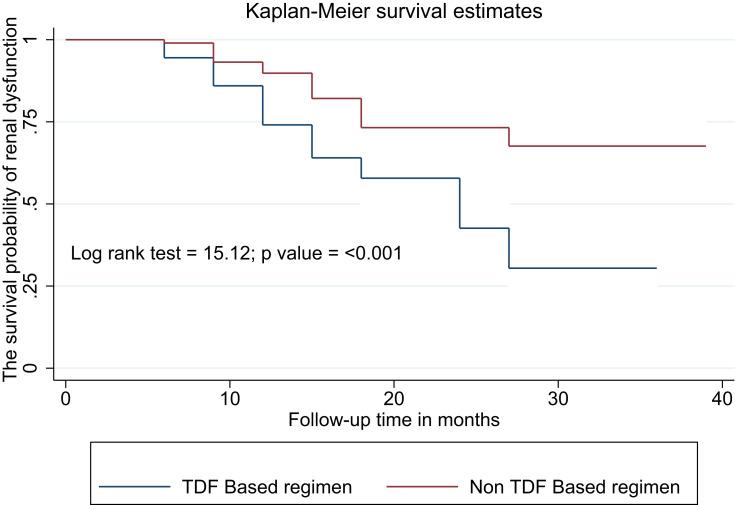
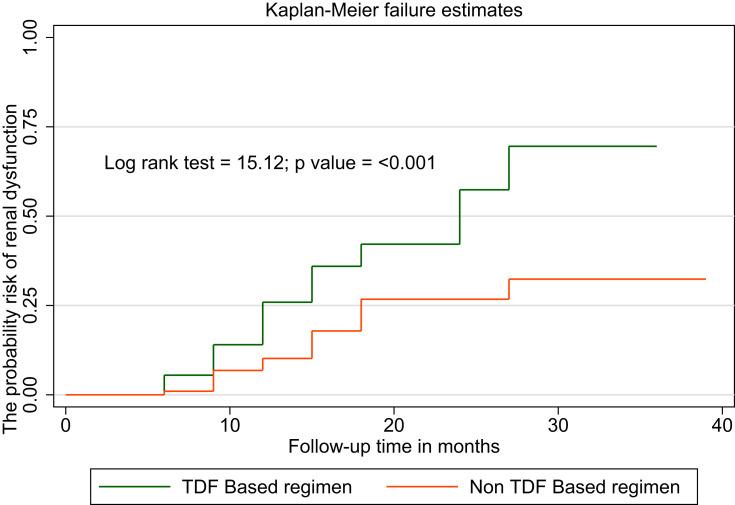
This retrospective cohort study included adult PLHIV between January 2015 and June 2019. The Chronic Kidney Disease Epidemiology (CKD-EPI) equation was used to estimate glomerular filtration rate (eGFR). Renal dysfunction was defined as eGFR <60 mL/min/1.73 m. Data were entered into Epi Info™ 7 and analyzed by using SPSS software version 20. The Kaplan-Meier method was used to estimate the survival curves. Cox proportional hazards models were used to identify predictors of renal dysfunction using a 95% confidence interval and p-value ≤ 0.05 as a statistical significance.
RESULTS
Out of 400 participants, 200 were TDF-based ART groups, and 200 were non-TDF-based ART groups. The incidence of renal dysfunction of TDF and the non-TDF group was 28.31 per 100 person-years (PYs) and 12.53 per 100 PYs, respectively. Adult PLHIV taking TDF-based regimens were 1.70 (adjusted HR = 1.70; 95% CI = 1.02-2.82) times at higher risk of renal dysfunction than non-TDF-based regimens. Age ≥55, diabetes mellitus, concurrent nephrotoxic drug use, and combined use of ritonavir-boosted protease inhibitors were also associated significantly with renal dysfunction.
CONCLUSION
The incidence rate of renal dysfunction among TDF users is higher than non-TDF users. Exposure to TDF is a significant risk of renal dysfunction in adult PLHIV. Clinicians should regularly monitor the renal function of adult PLHIV who are taking TDF.
背景
据报道,使用替诺福韦酯(TDF)是导致肾功能障碍的一个重要因素。然而,埃塞俄比亚的患者可能与世界其他地区的患者不同,此类研究的结果可能不适用于该环境。
目的
本研究旨在评估埃塞俄比亚西北部贡德尔大学综合专科医院成年艾滋病毒感染者(PLHIV)中与TDF相关的肾功能障碍。
方法
这项回顾性队列研究纳入了2015年1月至2019年6月期间的成年PLHIV。采用慢性肾脏病流行病学(CKD-EPI)方程估算肾小球滤过率(eGFR)。肾功能障碍定义为eGFR<60 mL/min/1.73 m²。数据录入Epi Info™ 7,并使用SPSS软件20版进行分析。采用Kaplan-Meier方法估计生存曲线。使用Cox比例风险模型,以95%置信区间和p值≤0.05作为统计学显著性来确定肾功能障碍的预测因素。
结果
在400名参与者中,200名是基于TDF的抗逆转录病毒治疗组,200名是非TDF的抗逆转录病毒治疗组。TDF组和非TDF组的肾功能障碍发生率分别为每100人年28.31例和每100人年12.53例。接受基于TDF方案治疗的成年PLHIV发生肾功能障碍的风险比接受非TDF方案治疗的高1.70倍(调整后HR = 1.70;95%CI = 1.02 - 2.82)。年龄≥55岁、糖尿病、同时使用肾毒性药物以及联合使用利托那韦增强型蛋白酶抑制剂也与肾功能障碍显著相关。
结论
TDF使用者的肾功能障碍发生率高于非TDF使用者。接触TDF是成年PLHIV发生肾功能障碍的一个重要风险因素。临床医生应定期监测服用TDF的成年PLHIV的肾功能。
 Zotero 插件