
在接受大手术的患者中,通过肌酐浓度评估 0.9%生理盐水与 Plasma-Lyte 148 对肾功能的影响:一项单中心、双盲、集群交叉试验。
The effects of 0.9% saline versus Plasma-Lyte 148 on renal function as assessed by creatinine concentration in patients undergoing major surgery: A single-centre double-blinded cluster crossover trial.
机构信息
Department of Anaesthesia, Austin Health, Heidelberg, Victoria, Australia.
Department of Surgery, The University of Melbourne, Austin Health, Heidelberg, Victoria, Australia.
出版信息
PLoS One. 2021 May 19;16(5):e0251718. doi: 10.1371/journal.pone.0251718. eCollection 2021.
OBJECTIVES
Saline and Plasma-Lyte have different physiochemical contents; consequently, they may differently affect patients' renal function. We compared the effects of fluid therapy with 0.9% saline and with Plasma-Lyte 148 on renal function as assessed by creatinine concentration among patients undergoing major surgery.
METHODS
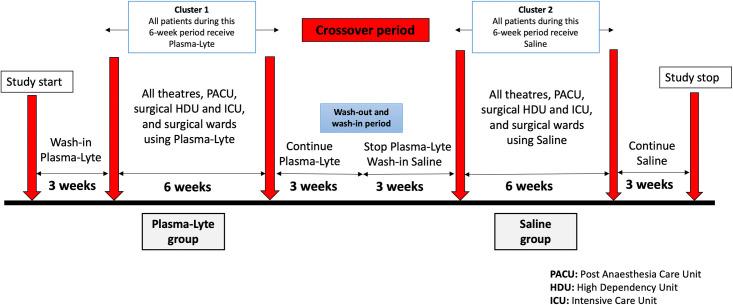
We conducted a prospective, double-blinded cluster crossover trial comparing the effects of the two fluids on major surgery patients. The primary aim was to establish the pilot feasibility, safety and preliminary efficacy evidence base for a large interventional trial to establish whether saline or Plasma-Lyte is the preferred crystalloid fluid for managing major surgery patients. The primary efficacy outcome was the proportion of patients with changes in renal function as assessed by creatinine concentration during their index hospital admission. We used changes in creatinine to define acute kidney injury (AKI) according to the RIFLE criteria.
RESULTS
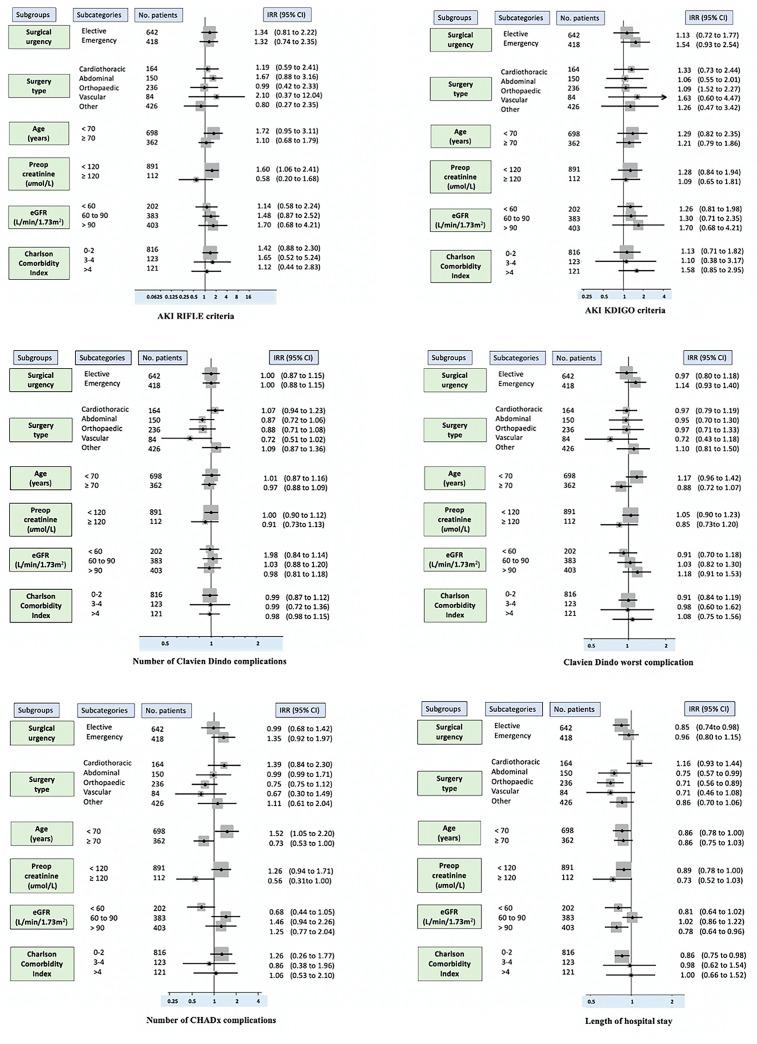
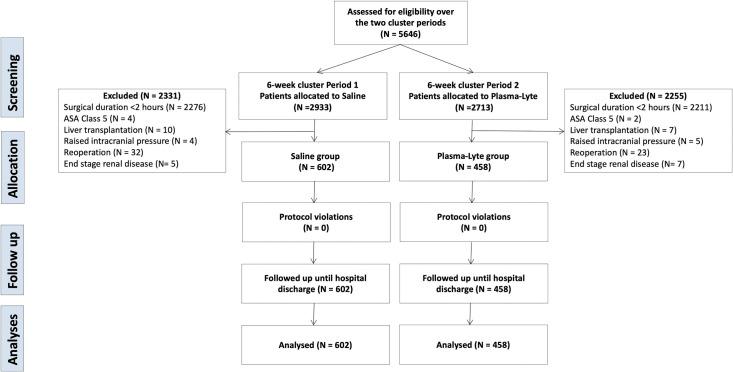
The study was feasible with 100% patient and clinician acceptance. There were no deviations from the trial protocol. After screening, we allocated 602 patients to saline and 458 to Plasma-Lyte. The median (IQR) volume of intraoperative fluid received was 2000 mL (1000:2000) in both groups. Forty-nine saline patients (8.1%) and 49 Plasma-Lyte patients (10.7%) developed a postoperative AKI (adjusted incidence rate ratio [aIRR]: 1.34; 95% CI: 0.93-1.95; p = 0.120). No differences were observed in the development of postoperative complications (aIRR: 0.98; 95% CI: 0.89-1.08) or the severity of the worst complication (aIRR: 1.00; 95% CI: 0.78-1.30). The median (IQR) length of hospital stay was six days (3:11) for the saline group and five days (3:10) for the Plasma-Lyte group (aIRR: 0.85; 95% CI: 0.73-0.98). There were no serious adverse events relating to the trial fluids, nor were there fluid crossover or contamination events.
CONCLUSIONS
The study design was feasible to support a future follow-up larger clinical trial. Patients treated with saline did not demonstrate an increased incidence of postoperative AKI (defined as changes in creatinine) compared to those treated with Plasma-Lyte. Our findings imply that clinicians can reasonably use either solution intraoperatively for adult patients undergoing major surgery.
TRIAL REGISTRATION
Registry: Australian New Zealand Clinical Trials Registry; ACTRN12613001042730; URL: https://www.anzctr.org.au/Trial/Registration/TrialReview.aspx?id=364988.
目的
生理盐水和 Plasma-Lyte 具有不同的理化特性;因此,它们可能会对患者的肾功能产生不同的影响。我们比较了在接受大手术的患者中,使用 0.9%生理盐水和 Plasma-Lyte 148 进行液体治疗对肾功能的影响,以肌酐浓度评估。
方法
我们进行了一项前瞻性、双盲、集群交叉试验,比较了两种液体对大手术患者的影响。主要目的是为一项大型干预试验建立试点可行性、安全性和初步疗效证据基础,以确定生理盐水或 Plasma-Lyte 是否是管理大手术患者的首选晶体液。主要疗效结局是评估指数住院期间肾功能变化的患者比例,以肌酐浓度表示。我们根据 RIFLE 标准,使用肌酐变化来定义急性肾损伤(AKI)。
结果
该研究具有 100%的患者和临床医生接受度,并且没有偏离试验方案。经过筛选,我们将 602 名患者分配到生理盐水组,将 458 名患者分配到 Plasma-Lyte 组。两组术中接受的液体量中位数(IQR)为 2000ml(1000:2000)。49 名生理盐水患者(8.1%)和 49 名 Plasma-Lyte 患者(10.7%)发生术后 AKI(调整发病率比[aIRR]:1.34;95%CI:0.93-1.95;p=0.120)。术后并发症的发生(aIRR:0.98;95%CI:0.89-1.08)或最严重并发症的严重程度(aIRR:1.00;95%CI:0.78-1.30)均无差异。生理盐水组的中位(IQR)住院时间为 6 天(3:11),Plasma-Lyte 组为 5 天(3:10)(aIRR:0.85;95%CI:0.73-0.98)。与试验液相关的严重不良事件、液体交叉或污染事件均无发生。
结论
该研究设计可行,可为未来更大的临床随访试验提供支持。与使用 Plasma-Lyte 的患者相比,使用生理盐水的患者术后 AKI(定义为肌酐变化)的发生率没有增加。我们的发现表明,临床医生可以合理地在术中使用这两种溶液为接受大手术的成年患者提供治疗。
试验注册
澳大利亚和新西兰临床试验注册中心;ACTRN12613001042730;网址:https://www.anzctr.org.au/Trial/Registration/TrialReview.aspx?id=364988。
 Zotero 插件