
机械敏感通道 YnaI 具有带有脂结合延伸传感器叶片。
Mechanosensitive channel YnaI has lipid-bound extended sensor paddles.
机构信息
Department of Biochemistry and Molecular Genetics, University of Colorado Anschutz Medical Campus, School of Medicine, Aurora, USA.
出版信息
Commun Biol. 2021 May 20;4(1):602. doi: 10.1038/s42003-021-02122-0.
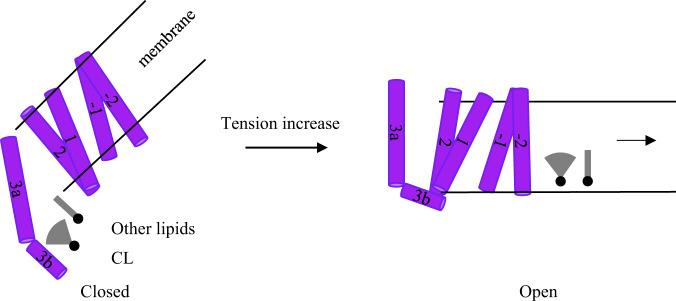
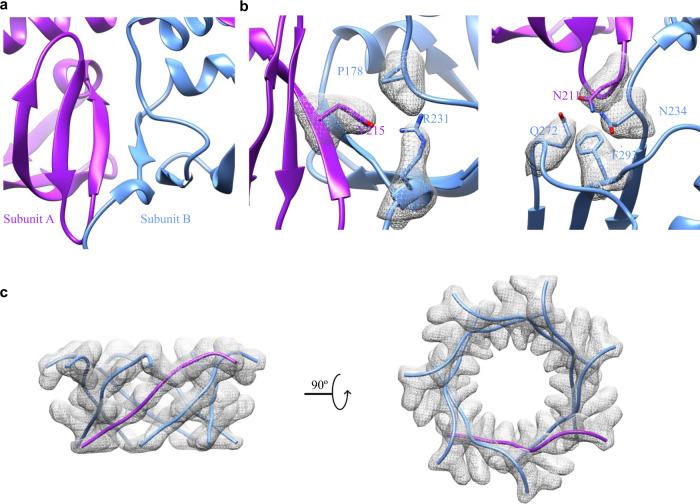
The general mechanism of bacterial mechanosensitive channels (MS) has been characterized by extensive studies on a small conductance channel MscS from Escherichia coli (E. coli). However, recent structural studies on the same channel have revealed controversial roles of various channel-bound lipids in channel gating. To better understand bacterial MscS-like channels, it is necessary to characterize homologs other than MscS. Here, we describe the structure of YnaI, one of the closest MscS homologs in E. coli, in its non-conducting state at 3.3 Å resolution determined by cryo electron microscopy. Our structure revealed the intact membrane sensor paddle domain in YnaI, which was stabilized by functionally important residues H43, Q46, Y50 and K93. In the pockets between sensor paddles, there were clear lipid densities that interact strongly with residues Q100 and R120. These lipids were a mixture of natural lipids but may be enriched in cardiolipin and phosphatidylserine. In addition, residues along the ion-conducting pathway and responsible for the heptameric assembly were discussed. Together with biochemical experiments and mutagenesis studies, our results provide strong support for the idea that the pocket lipids are functionally important for mechanosensitive channels.
细菌机械敏感通道(MS)的一般机制已通过对大肠杆菌(E. coli)中的小电导通道 MscS 的广泛研究得到了描述。然而,最近对同一通道的结构研究揭示了各种通道结合脂质在通道门控中的争议作用。为了更好地理解细菌 MscS 样通道,有必要对除 MscS 以外的同源物进行表征。在这里,我们通过冷冻电镜在 3.3Å 的分辨率下描述了大肠杆菌中最接近 MscS 同源物之一 YnaI 的非传导状态的结构。我们的结构揭示了 YnaI 中完整的膜传感器桨叶结构域,该结构域由功能重要的残基 H43、Q46、Y50 和 K93 稳定。在传感器桨叶之间的口袋中,存在与残基 Q100 和 R120 强烈相互作用的清晰脂质密度。这些脂质是天然脂质的混合物,但可能富含心磷脂和磷脂酰丝氨酸。此外,还讨论了沿离子传导途径的残基以及负责七聚体组装的残基。结合生化实验和突变研究,我们的结果为口袋脂质对机械敏感通道具有功能重要性的观点提供了有力支持。


 Zotero 插件