
机器学习方法预测抗血栓治疗患者胃肠道出血的效果比较。
Comparative Effectiveness of Machine Learning Approaches for Predicting Gastrointestinal Bleeds in Patients Receiving Antithrombotic Treatment.
机构信息
Division of Cardiology, Yale School of Medicine, New Haven, Connecticut.
Division of Gastroenterology and Hepatology, Department of Medicine, Mayo Clinic, Scottsdale, Arizona.
出版信息
JAMA Netw Open. 2021 May 3;4(5):e2110703. doi: 10.1001/jamanetworkopen.2021.10703.
IMPORTANCE
Anticipating the risk of gastrointestinal bleeding (GIB) when initiating antithrombotic treatment (oral antiplatelets or anticoagulants) is limited by existing risk prediction models. Machine learning algorithms may result in superior predictive models to aid in clinical decision-making.
OBJECTIVE
To compare the performance of 3 machine learning approaches with the commonly used HAS-BLED (hypertension, abnormal kidney and liver function, stroke, bleeding, labile international normalized ratio, older age, and drug or alcohol use) risk score in predicting antithrombotic-related GIB.
DESIGN, SETTING, AND PARTICIPANTS: This retrospective cross-sectional study used data from the OptumLabs Data Warehouse, which contains medical and pharmacy claims on privately insured patients and Medicare Advantage enrollees in the US. The study cohort included patients 18 years or older with a history of atrial fibrillation, ischemic heart disease, or venous thromboembolism who were prescribed oral anticoagulant and/or thienopyridine antiplatelet agents between January 1, 2016, and December 31, 2019.
EXPOSURES
A cohort of patients prescribed oral anticoagulant and thienopyridine antiplatelet agents was divided into development and validation cohorts based on date of index prescription. The development cohort was used to train 3 machine learning models to predict GIB at 6 and 12 months: regularized Cox proportional hazards regression (RegCox), random survival forests (RSF), and extreme gradient boosting (XGBoost).
MAIN OUTCOMES AND MEASURES
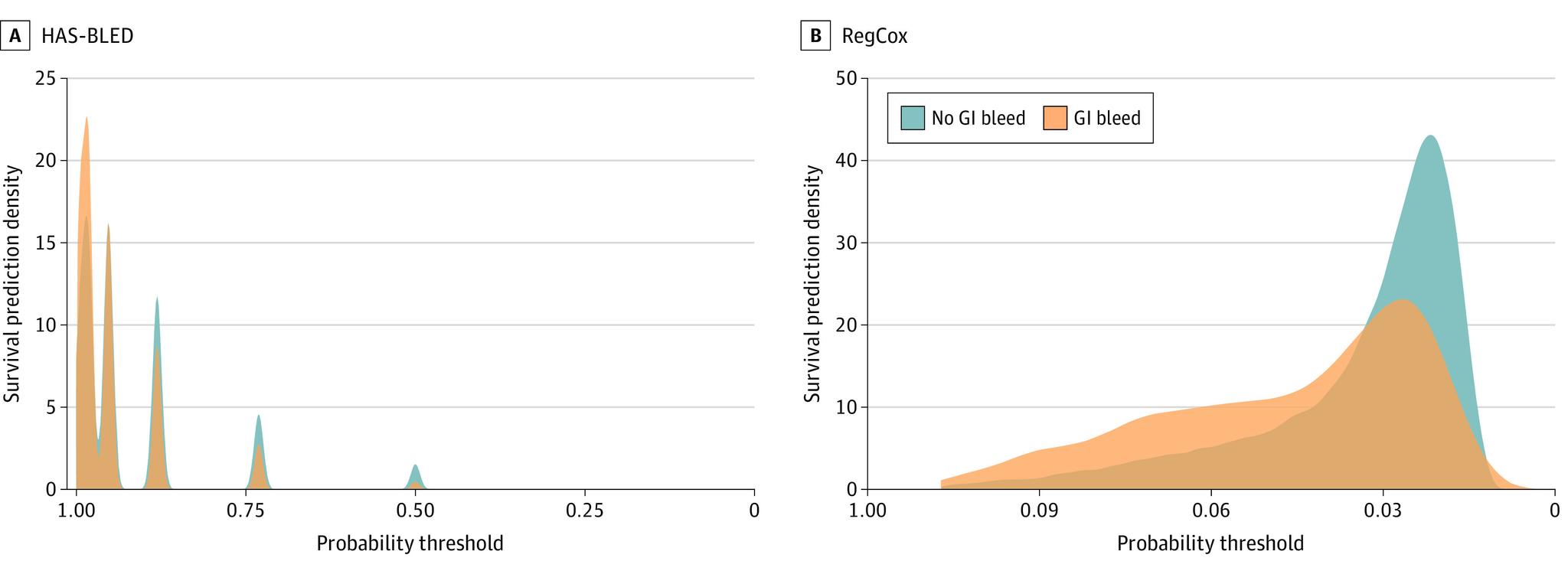
The performance of the models for predicting GIB in the validation cohort, evaluated using the area under the receiver operating characteristic curve (AUC), sensitivity, specificity, positive predictive value, and prediction density plots. Relative importance scores were used to identify the variables that were most influential in the top-performing machine learning model.
RESULTS
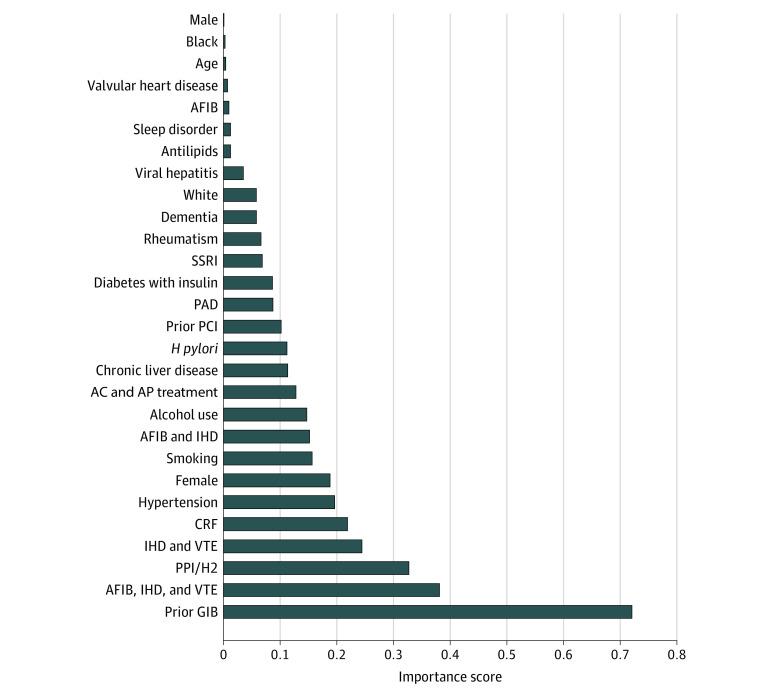
In the entire study cohort of 306 463 patients, 166 177 (54.2%) were male, 193 648 (63.2%) were White, the mean (SD) age was 69.0 (12.6) years, and 12 322 (4.0%) had experienced a GIB. In the validation data set, the HAS-BLED model had an AUC of 0.60 for predicting GIB at 6 months and 0.59 at 12 months. The RegCox model performed the best in the validation set, with an AUC of 0.67 at 6 months and 0.66 at 12 months. XGBoost was similar, with AUCs of 0.67 at 6 months and 0.66 at 12 months, whereas for RSF, AUCs were 0.62 at 6 months and 0.60 at 12 months. The variables with the highest importance scores in the RegCox model were prior GI bleed (importance score, 0.72); atrial fibrillation, ischemic heart disease, and venous thromboembolism combined (importance score, 0.38); and use of gastroprotective agents (importance score, 0.32).
CONCLUSIONS AND RELEVANCE
In this cross-sectional study, the machine learning models examined showed similar performance in identifying patients at high risk for GIB after being prescribed antithrombotic agents. Two models (RegCox and XGBoost) performed modestly better than the HAS-BLED score. A prospective evaluation of the RegCox model compared with HAS-BLED may provide a better understanding of the clinical impact of improved performance.
重要性
在开始抗血栓治疗(口服抗血小板或抗凝剂)时,预测胃肠道出血(GIB)的风险受到现有风险预测模型的限制。机器学习算法可能会产生优于现有模型的预测模型,以帮助临床决策。
目的
比较 3 种机器学习方法与常用的 HAS-BLED(高血压、肝肾功能异常、中风、出血、不稳定的国际标准化比值、年龄较大和药物或酒精使用)风险评分在预测抗血栓相关 GIB 中的表现。
设计、设置和参与者:这是一项回顾性的横断面研究,使用了来自 OptumLabs 数据仓库的数据,该数据仓库包含美国私人保险患者和医疗保险优势计划参与者的医疗和药房索赔信息。研究队列包括 18 岁或以上有房颤、缺血性心脏病或静脉血栓栓塞病史的患者,这些患者在 2016 年 1 月 1 日至 2019 年 12 月 31 日期间被处方口服抗凝剂和/或噻吩吡啶抗血小板药物。
暴露
根据索引处方的日期,将服用口服抗凝剂和噻吩吡啶抗血小板药物的患者队列分为开发和验证队列。开发队列用于训练 3 种机器学习模型,以预测 6 个月和 12 个月时的 GIB:正则化 Cox 比例风险回归(RegCox)、随机生存森林(RSF)和极端梯度增强(XGBoost)。
主要结果和测量
使用接收者操作特征曲线下的面积(AUC)、敏感性、特异性、阳性预测值和预测密度图评估模型在验证队列中的 GIB 预测性能。使用相对重要性评分来确定在表现最佳的机器学习模型中最具影响力的变量。
结果
在整个研究队列的 306463 名患者中,166177 名(54.2%)为男性,193648 名(63.2%)为白人,平均(SD)年龄为 69.0(12.6)岁,12322 名(4.0%)发生了 GIB。在验证数据集中,HAS-BLED 模型预测 6 个月和 12 个月时 GIB 的 AUC 分别为 0.60 和 0.59。在验证集中,RegCox 模型表现最佳,6 个月和 12 个月时的 AUC 分别为 0.67 和 0.66。XGBoost 相似,6 个月和 12 个月时的 AUC 分别为 0.67 和 0.66,而 RSF 的 AUC 分别为 6 个月和 12 个月时的 0.62 和 0.60。RegCox 模型中最重要的变量是先前的 GI 出血(重要性评分,0.72);房颤、缺血性心脏病和静脉血栓栓塞合并症(重要性评分,0.38);以及使用胃保护剂(重要性评分,0.32)。
结论和相关性
在这项横断面研究中,所检查的机器学习模型在识别服用抗血栓药物后发生 GIB 风险较高的患者方面表现出相似的性能。两种模型(RegCox 和 XGBoost)的表现略优于 HAS-BLED 评分。与 HAS-BLED 相比,对 RegCox 模型的前瞻性评估可能会更好地了解性能提高的临床影响。

 Zotero 插件