
应对 COVID-19 对医护人员心理影响:从早期干预一线应对者的系统综述中学习。
Addressing the psychological impact of COVID-19 on healthcare workers: learning from a systematic review of early interventions for frontline responders.
机构信息
School of Psychological Science, The University of Western Australia, Crawley, Western Australia, Australia
School of Psychological Science, The University of Western Australia, Crawley, Western Australia, Australia.
出版信息
BMJ Open. 2021 May 21;11(5):e044134. doi: 10.1136/bmjopen-2020-044134.
OBJECTIVES
Protecting healthcare workers from psychological harm is an urgent clinical issue within the current COVID-19 pandemic. Research on early psychological programmes that aim to prevent or reduce mental health symptoms and that have been tested in frontline responders may assist service providers with choosing a suitable intervention for rapid dissemination in healthcare settings.
DESIGN AND OUTCOME MEASURES
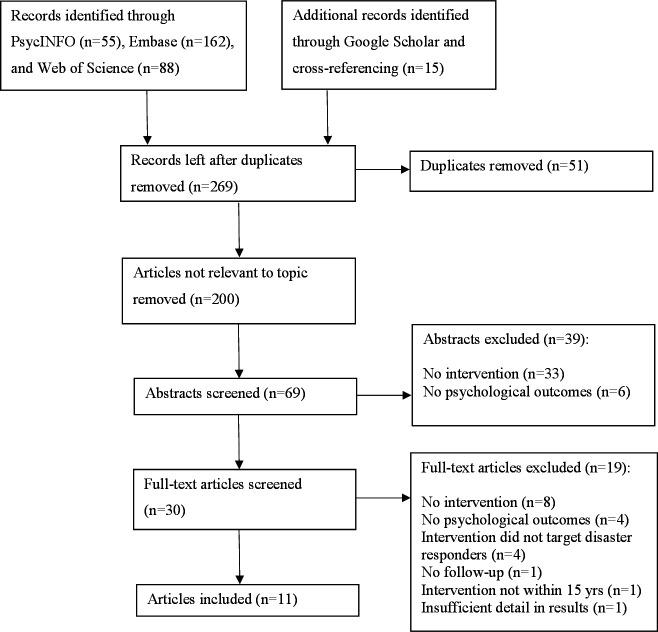
First, Embase, Web of Science, PsycINFO and Google Scholar were searched through a systematic literature review of early psychological interventions administered to frontline responders in the last 15 years. Interventions were included if they were designed to prevent or reduce psychological impact and had outcome measures of psychological distress (eg, general psychopathology, post-traumatic stress disorder and stress) and/or positive mental health domains (eg, resilience, self-efficacy and life satisfaction). Second, the suitability of these programmes for the healthcare workforce was evaluated according to the criteria of effectiveness, content applicability and feasibility.
RESULTS
Of 320 articles retrieved, 12 relevant studies were included that described six early psychological interventions. Although the evidence base is limited, psychological first aid, eye movement desensitisation and reprocessing, and trauma risk management showed effectiveness across at least two studies each with frontline workers. Resilience and coping for the healthcare community; anticipate, plan, and deter; and resilience at work programmes found promising results in single studies. Concerning other suitability criteria, all programmes appear applicable to healthcare settings and have acceptable feasibility for rapid implementation.
CONCLUSIONS
Despite the limited evidence, several interventions were identified as potentially suitable and useful for improving psychological functioning of healthcare workers across a variety of disaster situations. Service providers should continue to implement and evaluate early psychological interventions in frontline workers in order to refine best practices for managing the psychological impact of future disasters.
目的
在当前 COVID-19 大流行中,保护医护人员免受心理伤害是一个紧迫的临床问题。研究旨在预防或减轻心理健康症状的早期心理方案,并在一线应对者中进行了测试,这可能有助于服务提供者选择适合在医疗保健环境中快速传播的干预措施。
设计和结果测量
首先,通过对过去 15 年中针对一线应对者的早期心理干预措施的系统文献综述,在 Embase、Web of Science、PsycINFO 和 Google Scholar 上进行了搜索。如果干预措施旨在预防或减轻心理影响,并且具有心理困扰(例如一般精神病理学、创伤后应激障碍和压力)和/或积极心理健康领域(例如韧性、自我效能和生活满意度)的结果测量,则将其纳入研究。其次,根据有效性、内容适用性和可行性标准评估这些方案对医疗保健劳动力的适用性。
结果
从 320 篇文章中检索到 12 篇相关研究,描述了 6 种早期心理干预措施。尽管证据基础有限,但心理急救、眼动脱敏再处理和创伤风险管理在至少两项针对一线工作人员的研究中均显示出有效性。韧性和应对医护社区;预测、计划和威慑;以及工作场所的韧性计划在单项研究中取得了有希望的结果。关于其他适用性标准,所有方案似乎都适用于医疗保健环境,并且快速实施的可行性可以接受。
结论
尽管证据有限,但确定了几种干预措施,这些措施可能适合并有助于改善各种灾难情况下医护人员的心理功能。服务提供者应继续在一线工作人员中实施和评估早期心理干预措施,以完善管理未来灾难心理影响的最佳实践。
 Zotero 插件