
SARS-CoV-2 和其他人类冠状病毒表现出与病毒识别降低和免疫反应改变相关的先前存在的基因组模式。
SARS-CoV-2 and other human coronavirus show genome patterns previously associated to reduced viral recognition and altered immune response.
机构信息
Department of Animal Medicine, Production and Health (MAPS), University of Padua, Viale dell'Università 16, 35020, Legnaro, Padua, Italy.
出版信息
Sci Rep. 2021 May 21;11(1):10696. doi: 10.1038/s41598-021-90278-4.
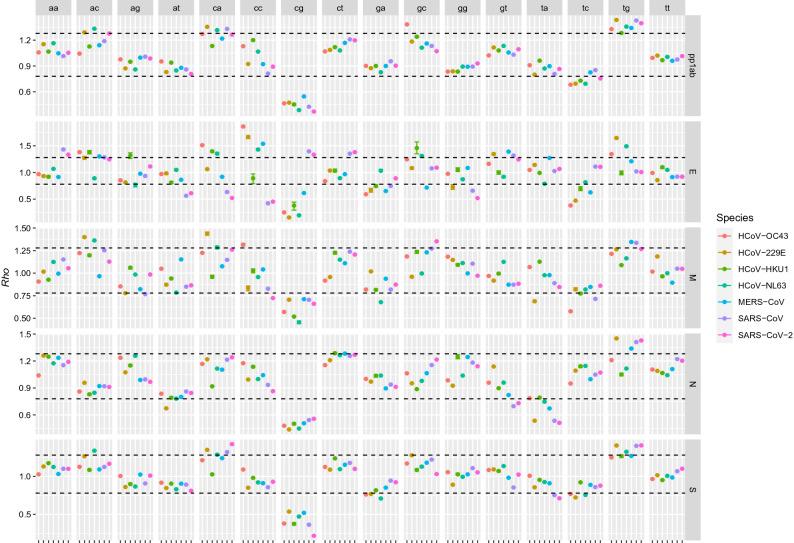
A new pandemic caused by the betacoronavirus SARS-CoV-2 originated in China in late 2019. Although often asymptomatic, a relevant percentage of affected people can develop severe pneumonia. Initial evidence suggests that dysregulation of the immune response could contribute to the pathogenesis, as previously demonstrated for SARS-CoV. The presence of genome composition features involved in delaying viral recognition is herein investigated for human coronaviruses (HCoVs), with a special emphasis on SARS-CoV-2. A broad collection of HCoVs polyprotein, envelope, matrix, nucleocapsid and spike coding sequences was downloaded and several statistics representative of genome composition and codon bias were investigated. A model able to evaluate and test the presence of a significant under- or over-representation of dinucleotide pairs while accounting for the underlying codon bias and protein sequence was also implemented. The study revealed the significant under-representation of CpG dinucleotide pair in all HcoV, but especially in SARS-CoV and even more in SARS-CoV-2. The presence of forces acting to minimize CpG content was confirmed by relative synonymous codon usage pattern. Codons containing the CpG pair were severely under-represented, primarily in the polyprotein and spike coding sequences of SARS-CoV-2. Additionally, a significant under-representation of the TpA pair was observed in the N and S region of SARS-CoV and SARS-CoV-2. Increasing experimental evidence has proven that CpG and TpA are targeted by innate antiviral host defences, contributing both to RNA degradation and RIG-1 mediated interferon production. The low content of these dinucleotides could contribute to a delayed interferon production, dysregulated immune response, higher viral replication and poor outcome. Significantly, the RIG-1 signalling pathway was proven to be defective in elderlies, suggesting a likely interaction between limited viral recognition and lower responsiveness in interferon production that could justify the higher disease severity and mortality in older patients.
一种由β冠状病毒 SARS-CoV-2 引起的新型大流行于 2019 年末在中国出现。尽管多数患者无症状,但仍有相当比例的患者会发展为重症肺炎。初步证据表明,免疫反应失调可能导致发病机制,正如之前对 SARS-CoV 所证明的那样。本文研究了人类冠状病毒(HCoV)中涉及延迟病毒识别的基因组组成特征,特别关注 SARS-CoV-2。下载了广泛的 HCoV 多蛋白、包膜、基质、核衣壳和刺突编码序列,并研究了代表基因组组成和密码子偏好的几个统计数据。还实现了一种能够评估和测试二核苷酸对的显著过少或过多表达的模型,同时考虑到潜在的密码子偏好和蛋白质序列。研究表明,所有 HcoV 中 CpG 二核苷酸对均显著过少,尤其是 SARS-CoV,甚至 SARS-CoV-2 更为明显。相对同义密码子使用模式证实了存在最小化 CpG 含量的作用力。包含 CpG 对的密码子严重过少,主要在 SARS-CoV-2 的多蛋白和刺突编码序列中。此外,在 SARS-CoV 和 SARS-CoV-2 的 N 和 S 区观察到 TpA 对的显著过少。越来越多的实验证据证明,CpG 和 TpA 是先天抗病毒宿主防御的靶标,这两者都有助于 RNA 降解和 RIG-1 介导的干扰素产生。这些二核苷酸的低含量可能导致干扰素产生延迟、免疫反应失调、病毒复制增加和预后不良。重要的是,已经证明 RIG-1 信号通路在老年人中存在缺陷,这表明病毒识别有限和干扰素产生反应性降低之间可能存在相互作用,这可以解释老年患者疾病严重程度和死亡率较高的原因。



 Zotero 插件