
差异缺氧相关基因表达对胶质母细胞瘤的影响。
Effect of differential hypoxia-related gene expression on glioblastoma.
机构信息
School of Medicine, Southeast University, Nanjing, Jiangsu, China.
Department of Neurosurgery, Cancer Center, Integrated Hospital of Traditional Chinese Medicine, Southern Medical University, Guangzhou, Guangdong, China.
出版信息
J Int Med Res. 2021 May;49(5):3000605211013774. doi: 10.1177/03000605211013774.
OBJECTIVE
Glioblastoma (GB) is a refractory malignancy with a high rate of recurrence and treatment resistance. Hypoxia-related genes are promising prognostic indicators for GB, so we herein developed a reliable hypoxia-related gene risk scoring model to predict the prognosis of patients with GB.
METHOD
Gene expression profiles and corresponding clinicopathological features of patients with GB were obtained from the Cancer Genome Atlas (TCGA; n = 160) and Gene Expression Omnibus (GEO) GSE7696 (n = 80) databases. Univariate and multivariate Cox regression analyses of differentially expressed hypoxia-related genes were performed using R 3.5.1 software.
RESULT
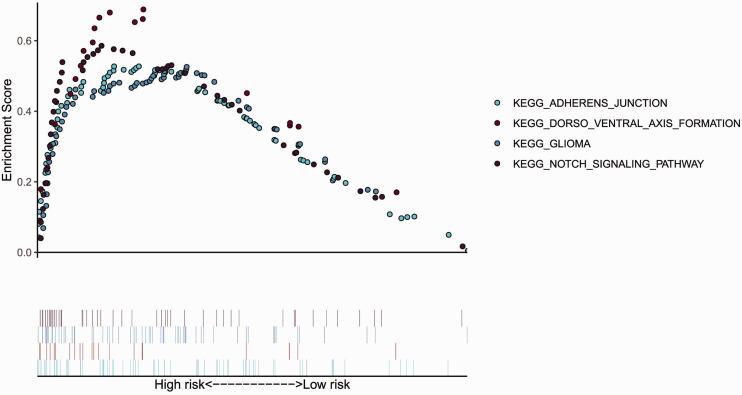
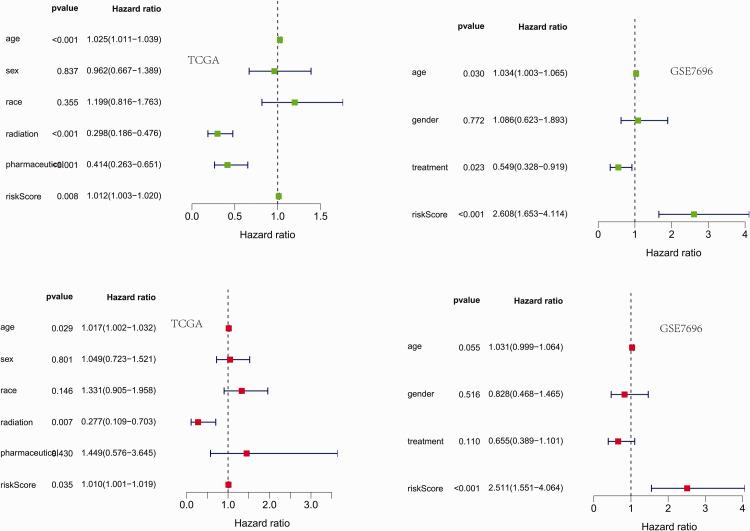
Fourteen prognosis-related genes were identified and used to construct a risk signature. Patients with high-risk scores had significantly lower overall survival (OS) than those with low-risk scores. The median risk score was used as a critical value and for OS prediction in an independent external verification GSE7696 cohort. Risk score was not significantly affected by clinical-related factors. We also developed a prediction nomogram based on the TCGA training set to predict survival rates, and included six independent prognostic parameters in the TCGA prediction model.
CONCLUSION
We determined a reliable hypoxia-related gene risk scoring model for predicting the prognosis of patients with GB.
目的
胶质母细胞瘤(GB)是一种难治性恶性肿瘤,复发率和治疗抵抗率均较高。与缺氧相关的基因是 GB 有前途的预后指标,因此我们在此开发了一种可靠的与缺氧相关的基因风险评分模型,以预测 GB 患者的预后。
方法
从癌症基因组图谱(TCGA;n=160)和基因表达综合(GEO)GSE7696(n=80)数据库中获取了 GB 患者的基因表达谱和相应的临床病理特征。使用 R 3.5.1 软件对差异表达的与缺氧相关的基因进行单因素和多因素 Cox 回归分析。
结果
确定了 14 个与预后相关的基因,并用于构建风险特征。高风险评分患者的总生存期(OS)明显低于低风险评分患者。中位数风险评分被用作临界值,并在独立的外部验证 GSE7696 队列中用于 OS 预测。风险评分不受临床相关因素的显著影响。我们还基于 TCGA 训练集开发了一个预测列线图,以预测生存率,并在 TCGA 预测模型中纳入了六个独立的预后参数。
结论
我们确定了一种可靠的与缺氧相关的基因风险评分模型,用于预测 GB 患者的预后。



 Zotero 插件