
SARS-CoV-2:来自巴基斯坦的大量血清阳性数据——群体免疫是否即将实现?
SARS-CoV-2: big seroprevalence data from Pakistan-is herd immunity at hand?
机构信息
Peshawar Medical College, Riphah International University, Warsak Road, Peshawar, Pakistan.
Prime Institute of Public Health, Peshawar Medical College, Warsak Road, Peshawar, Pakistan.
出版信息
Infection. 2021 Oct;49(5):983-988. doi: 10.1007/s15010-021-01629-2. Epub 2021 May 25.
PURPOSE
Seroprevalence surveys from different countries have reported SARS CoV-2 antibodies below 20% even in the most adversely affected areas and herd immunity cannot be predicted till more than half of the population gets the disease. The purpose of this survey was to estimate the magnitude of community-based spread of the infection, associated immunity, and the future prospects and proximity to a 'herd community'.
METHODS
The study was undertaken as a cluster randomized, cross-sectional countrywide survey. This largest community-based seroprevalence data of SARS-CoV-2 were collected between 15th and 31st July, 2020 from seven randomly selected cities belonging to the three most populous provinces of Pakistan. The FDA approved kit of ROCHE was used for detection of SARS-CoV-2 antibodies.
RESULTS
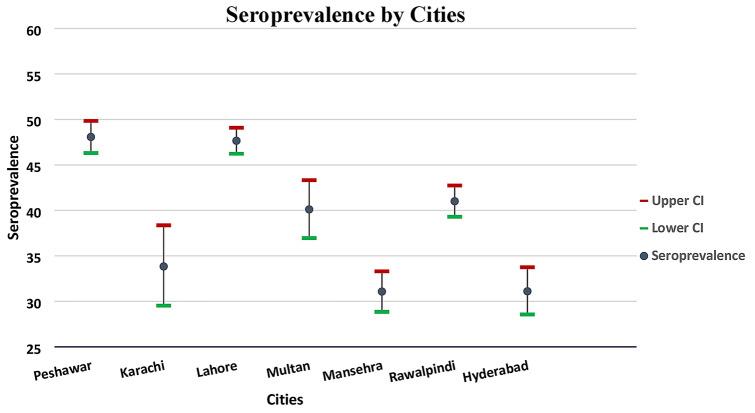
Serum samples of 15,390 participants were tested for SARS CoV-2 antibodies with an overall seroprevalence of 42.4%. The seroprevalence ranged from 31.1% to 48.1% in different cities with the highest in Punjab province (44.5%). In univariable analysis, the odds of seropositivity was higher in men compared to women (OR: 1.10, 95% CI: 1.01-1.19, P < 0.05). In multivariable analysis, the risk of being seropositive was lower (OR 0.72, 95% CI: 0.60-0.87, P < 0.01) in younger group (≤ 20 years) than in those aged above 60 years.
CONCLUSION
The study concluded that despite a reasonable seroprevalence, the country is yet to reach the base minimum of estimations for herd immunity. The durability of immunity though debated at the moment, has shown an evidenced informed shift towards longer side.
目的
来自不同国家的血清流行率调查报告显示,即使在受影响最严重的地区,SARS-CoV-2 抗体也低于 20%,而且在超过一半的人口患病之前,无法预测群体免疫。本调查的目的是评估感染的社区传播程度、相关免疫力以及未来的前景和接近“群体社区”的程度。
方法
本研究是一项在全国范围内进行的聚类随机、横断面研究。这项关于 SARS-CoV-2 的最大的社区血清流行率数据是在 2020 年 7 月 15 日至 31 日期间从巴基斯坦三个人口最多的省份中随机选择的七个城市收集的。使用罗氏公司经食品和药物管理局批准的试剂盒检测 SARS-CoV-2 抗体。
结果
对 15390 名参与者的血清样本进行了 SARS CoV-2 抗体检测,总血清阳性率为 42.4%。不同城市的血清阳性率从 31.1%到 48.1%不等,其中旁遮普省最高(44.5%)。在单变量分析中,男性血清阳性的几率高于女性(比值比:1.10,95%置信区间:1.01-1.19,P<0.05)。在多变量分析中,与年龄大于 60 岁的人相比,年龄在 20 岁及以下的人血清阳性的风险较低(比值比:0.72,95%置信区间:0.60-0.87,P<0.01)。
结论
本研究得出结论,尽管血清阳性率合理,但该国尚未达到群体免疫的最低估计值。尽管目前对免疫持久性存在争议,但有证据表明,免疫时间会延长。
 Zotero 插件