
一种用于估计年龄相关粒子剂量的全肺计算模型。
A whole lung in silico model to estimate age dependent particle dosimetry.
机构信息
Department of Mechanical and Industrial Engineering, Northeastern University, Boston, USA.
Inria Saclay-Ile-de-France, Inria, France.
出版信息
Sci Rep. 2021 May 27;11(1):11180. doi: 10.1038/s41598-021-90509-8.
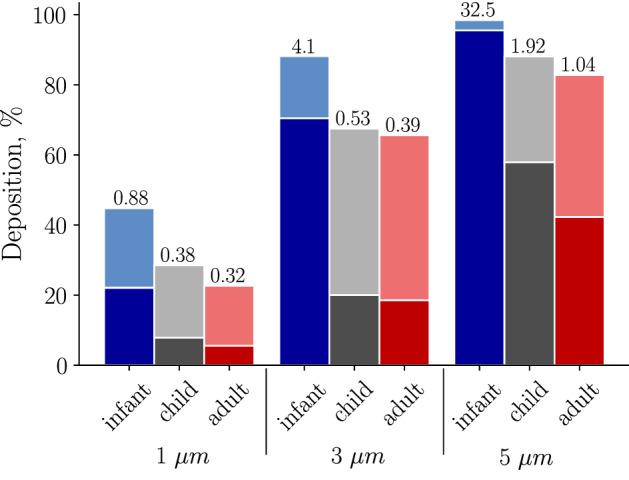
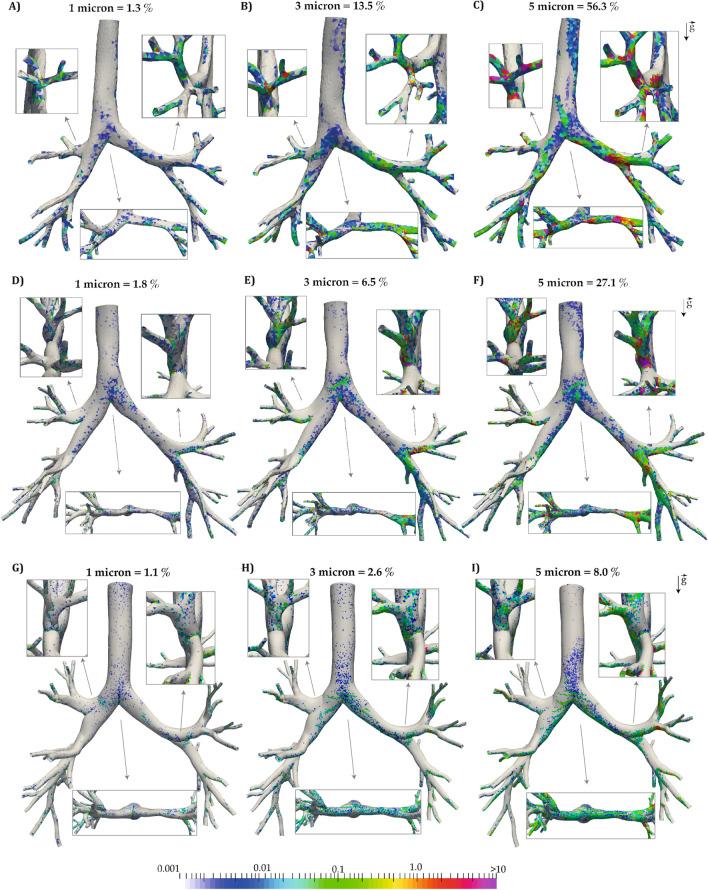
Anatomical and physiological changes alter airflow characteristics and aerosol distribution in the developing lung. Correlation between age and aerosol dosimetry is needed, specifically because youth are more susceptible to medication side effects. In this study, we estimate aerosol dosages (particle diameters of 1, 3, and 5 [Formula: see text]m) in a 3 month-old infant, a 6 year-old child, and a 36 year-old adult by performing whole lung subject-specific particle simulations throughout respiration. For 3 [Formula: see text]m diameter particles we estimate total deposition as 88, 73, and [Formula: see text] and the conducting versus respiratory deposition ratios as 4.0, 0.5, and 0.4 for the infant, child, and adult, respectively. Due to their lower tidal volumes and functional residual capacities the deposited mass is smaller while the tissue concentrations are larger in the infant and child subjects, compared to the adult. Furthermore, we find that dose cannot be predicted by simply scaling by tidal volumes. These results highlight the need for additional clinical and computational studies that investigate the efficiency of treatment, while optimizing dosage levels in order to alleviate side effects, in youth.
解剖学和生理学的变化改变了发育中肺的气流特征和气溶胶分布。需要建立年龄与气溶胶剂量之间的相关性,特别是因为年轻人更容易受到药物副作用的影响。在这项研究中,我们通过在整个呼吸过程中对整个肺部进行特定于主体的颗粒模拟,来估算 3 个月大的婴儿、6 岁儿童和 36 岁成人的气溶胶剂量(粒径为 1、3 和 5 [Formula: see text]m)。对于 3 [Formula: see text]m 直径的颗粒,我们估计婴儿、儿童和成人的总沉积量分别为 88、73 和 [Formula: see text],而传导与呼吸沉积比分别为 4.0、0.5 和 0.4。由于潮气量和功能残气量较低,与成人相比,婴儿和儿童受试者的沉积量较小,而组织浓度较大。此外,我们发现,简单地按潮气量进行缩放并不能预测剂量。这些结果强调需要进行更多的临床和计算研究,以研究治疗效率,并优化剂量水平,从而减轻年轻人的副作用。


 Zotero 插件