
钓鱼诱饵中的微塑料作为欧洲淡水的一种隐蔽污染源。
Microplastic in angling baits as a cryptic source of contamination in European freshwaters.
机构信息
CNRS, Université Toulouse III - Paul Sabatier, IRD, UMR 5174 Laboratoire Évolution et Diversité Biologique (EDB), 118 route de Narbonne, 31062, Toulouse, France.
CNRS, Université Toulouse III - Paul Sabatier, UMR 5623 Laboratoire des Interactions Moléculaires et Réactivité Chimique et Photochimique (IMRCP), 118 route de Narbonne, 31062, Toulouse, France.
出版信息
Sci Rep. 2021 May 27;11(1):11255. doi: 10.1038/s41598-021-90468-0.
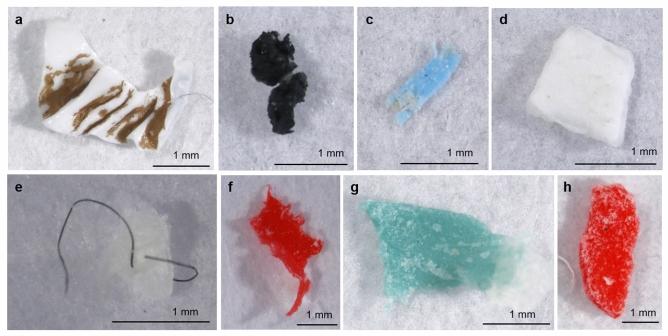
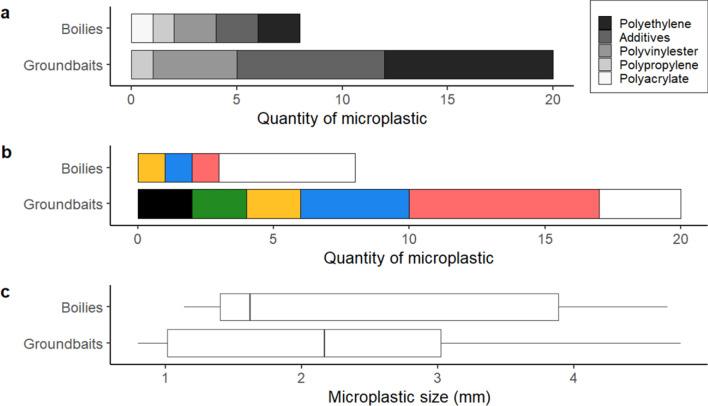
High environmental microplastic pollution, and its largely unquantified impacts on organisms, are driving studies to assess their potential entry pathways into freshwaters. Recreational angling, where many anglers release manufactured baits into freshwater ecosystems, is a widespread activity with important socio-economic implications in Europe. It also represents a potential microplastic pathway into freshwaters that has yet to be quantified. Correspondingly, we analysed three different categories of industrially-produced baits ('groundbait', 'boilies' and 'pellets') for their microplastic contamination (particles 700 µm to 5 mm). From 160 samples, 28 microplastics were identified in groundbait and boilies, with a mean concentration of 17.4 (± 48.1 SD) MP kg and 6.78 (± 29.8 SD) mg kg, yet no microplastics within this size range were recorded in the pellets. Microplastic concentrations significantly differed between bait categories and companies, but microplastic characteristics did not vary. There was no correlation between microplastic contamination and the number of bait ingredients, but it was positively correlated with C:N ratio, indicating a higher contamination in baits with higher proportion of plant-based ingredients. We thus reveal that bait microplastics introduced accidentally during manufacturing and/or those originating from contaminated raw ingredients might be transferred into freshwaters. However, further studies are needed to quantify the relative importance of this cryptic source of contamination and how it influences microplastic levels in wild fish.
高环境微塑料污染及其对生物的大量未量化影响,促使人们研究评估其进入淡水环境的潜在途径。休闲钓鱼是一种在欧洲广泛存在的活动,具有重要的社会经济意义。它也是一种潜在的将微塑料引入淡水环境的途径,但尚未进行量化。相应地,我们分析了三种不同类别的工业生产的诱饵(“底饵”、“鱼饵”和“颗粒”)的微塑料污染(700µm 至 5mm 的颗粒)。在 160 个样本中,在底饵和鱼饵中发现了 28 个微塑料,平均浓度分别为 17.4(±48.1 SD)MP kg 和 6.78(±29.8 SD)mg kg,但在这个尺寸范围内的颗粒中没有记录到微塑料。诱饵种类和公司之间的微塑料浓度存在显著差异,但微塑料特征没有差异。微塑料污染与诱饵成分数量之间没有相关性,但与 C:N 比呈正相关,表明植物成分比例较高的诱饵污染程度更高。因此,我们揭示了在制造过程中意外引入的诱饵微塑料和/或源自受污染原料的微塑料可能会转移到淡水中。然而,需要进一步的研究来量化这种隐匿性污染源的相对重要性以及它如何影响野生鱼类中的微塑料水平。


 Zotero 插件