
COVID-19 住院患者的 RNA 血症和相关全身细胞因子的时间动力学。
Temporal Kinetics of RNAemia and Associated Systemic Cytokines in Hospitalized COVID-19 Patients.
机构信息
Department of Viroscience, Erasmus MC, Rotterdam, The Netherlands.
Medical Microbiology and Infectious Diseases, Erasmus MC, Rotterdam, The Netherlands.
出版信息
mSphere. 2021 Jun 30;6(3):e0031121. doi: 10.1128/mSphere.00311-21. Epub 2021 May 28.
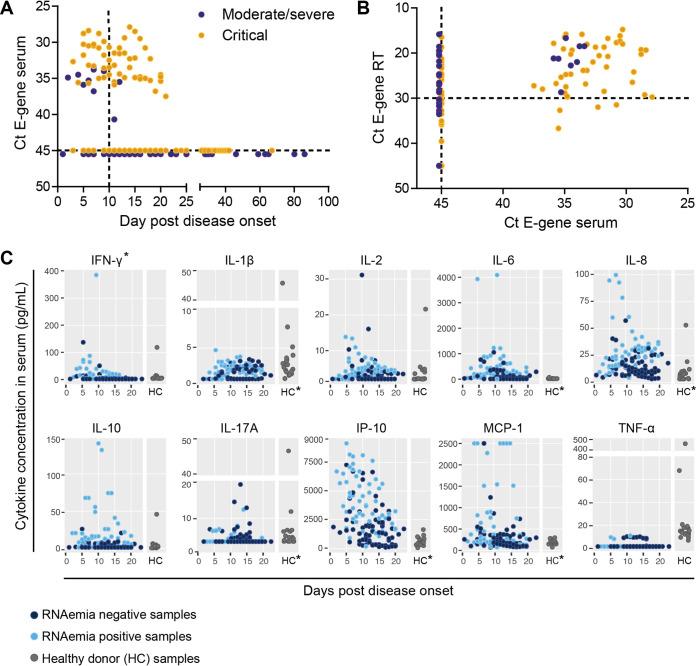
COVID-19 is associated with a wide range of extrarespiratory complications, of which the pathogenesis is currently not fully understood. However, both systemic spread and systemic inflammatory responses are thought to contribute to the systemic pathogenesis. In this study, we determined the temporal kinetics of viral RNA in serum (RNAemia) and the associated inflammatory cytokines and chemokines during the course of COVID-19 in hospitalized patients. We show that RNAemia can be detected in 90% of the patients who develop critical disease, compared to 50% of the patients who develop moderate or severe disease. Furthermore, RNAemia lasts longer in patients who develop critical disease. Elevated levels of interleukin-10 (IL-10) and MCP-1-but not IL-6-are associated with viral load in serum, whereas higher levels of IL-6 in serum were associated with the development of critical disease. In conclusion, RNAemia is common in hospitalized patients, with the highest frequency and duration in patients who develop critical disease. The fact that several cytokines or chemokines are directly associated with the presence of viral RNA in the circulation suggests that the development of RNAemia is an important factor in the systemic pathogenesis of COVID-19. Severe COVID-19 can be considered a systemic disease as many extrarespiratory complications occur. However, the systemic pathogenesis is poorly understood. Here, we show that the presence of viral RNA in the blood (RNAemia) occurs more frequently in patients who develop critical disease, compared to patients with moderate or severe disease. In addition, RNAemia is associated with increased levels of inflammatory cytokines and chemokines, like MCP-1 and IL-10, in serum during the course of disease. This suggests that extrarespiratory spread of SARS-CoV-2 contributes to systemic inflammatory responses, which are an important factor in the systemic pathogenesis of COVID-19.
COVID-19 与广泛的肺部外并发症相关,其发病机制目前尚未完全阐明。然而,全身性传播和全身性炎症反应都被认为是导致全身发病机制的原因。在这项研究中,我们确定了住院患者 COVID-19 病程中血清中病毒 RNA(RNAemia)的时间动力学及其相关炎症细胞因子和趋化因子。我们发现,与发生中度或重度疾病的患者相比,90%发生危重症的患者可检测到 RNAemia,而发生中度或重度疾病的患者中只有 50%可检测到 RNAemia。此外,发生危重症的患者中 RNAemia 持续时间更长。血清中白细胞介素-10(IL-10)和 MCP-1 的水平升高与病毒载量相关,而血清中 IL-6 水平升高与发生危重症相关。总之,RNAemia 在住院患者中很常见,在发生危重症的患者中发生率和持续时间最高。几个细胞因子或趋化因子与循环中病毒 RNA 的存在直接相关的事实表明,RNAemia 的发生是 COVID-19 全身发病机制的重要因素。严重的 COVID-19 可被视为全身性疾病,因为许多肺部外并发症发生。然而,其全身发病机制尚不清楚。在这里,我们发现与发生中度或重度疾病的患者相比,发生危重症的患者血液中存在病毒 RNA(RNAemia)的情况更为常见。此外,在疾病过程中,RNAemia 与血清中炎症细胞因子和趋化因子(如 MCP-1 和 IL-10)水平升高相关。这表明 SARS-CoV-2 的肺部外传播有助于全身炎症反应,这是 COVID-19 全身发病机制的一个重要因素。
 Zotero 插件