
使用数字追踪器和持续葡萄糖监测改善健康成年人及2型糖尿病患者的血糖调节
Improvement in Glucose Regulation Using a Digital Tracker and Continuous Glucose Monitoring in Healthy Adults and Those with Type 2 Diabetes.
作者信息
Dehghani Zahedani Ashkan, Shariat Torbaghan Solmaz, Rahili Salar, Karlin Kirill, Scilley Darrin, Thakkar Riya, Saberi Maziyar, Hashemi Noosheen, Perelman Dalia, Aghaeepour Nima, McLaughlin Tracey, Snyder Michael P
机构信息
January AI, 1259 El Camino Real #231, Menlo Park, CA, 94025, USA.
出版信息
Diabetes Ther. 2021 Jul;12(7):1871-1886. doi: 10.1007/s13300-021-01081-3. Epub 2021 May 28.
INTRODUCTION
While continuous glucose monitoring (CGM) has been shown to decrease both hyper- and hypoglycemia in insulin-treated diabetes, its value in non-insulin-treated type 2 diabetes (T2D) and prediabetes is unclear. Studies examining the reduction in hyperglycemia with the use of CGM in non-insulin-treated T2D are limited.
METHODS
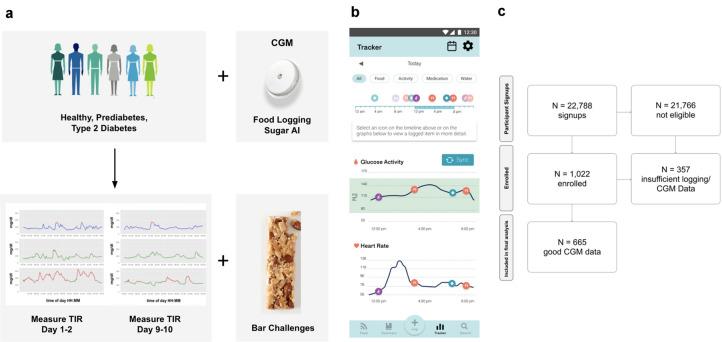
We investigated the potential benefit of CGM combined with a mobile app that links each individual's glucose tracing to meal composition, heart rate, and physical activity in a cohort of 1022 individuals, ranging from nondiabetic to non-insulin-treated T2D, spanning a wide range of demographic, geographic, and socioeconomic characteristics. The primary endpoint was the change in time in range (TIR), defined as 54-140 mg/dL for healthy and prediabetes, and 54-180 mg/dL for T2D, from the beginning to end of a 10-day period of use of the Freestyle Libre CGM. Logged food intake, physical activity, continuous glucose, and heart rate data were captured by a smartphone-based app that continuously provided feedback to participants, overlaying daily glucose patterns with activity and food intake, including macronutrient breakdown, glycemic load (GL), and glycemic index (GI).
RESULTS
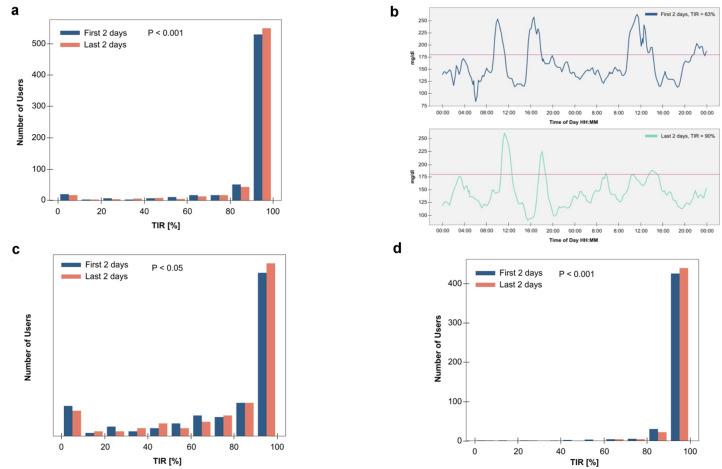
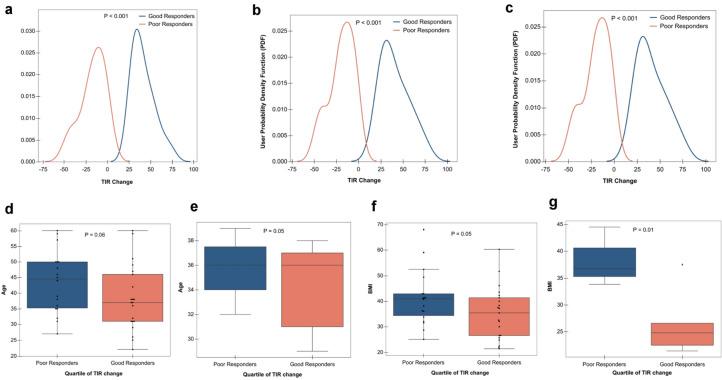
A total of 665 participants meeting eligibility and data requirements were included in the final analysis. Among self-reported nondiabetic participants, CGM identified glucose excursions in the diabetic range among 15% of healthy and 36% of those with prediabetes. In the group as a whole, TIR improved significantly (p < 0.001). Among the 51.4% of participants who improved, TIR increased by an average of 6.4% (p < 0.001). Of those with poor baseline TIR, defined as TIR below comparable A1c thresholds for T2D and prediabetes, 58.3% of T2D and 91.7% of healthy/prediabetes participants improved their TIR by an average of 22.7% and 23.2%, respectively. Predictors of improved response included no prior diagnosis of T2D and lower BMI.
CONCLUSIONS
These results indicate that 10-day use of CGM as a part of multimodal data collection, with synthesis and feedback to participants provided by a mobile health app, can significantly reduce hyperglycemia in non-insulin-treated individuals, including those with early stages of glucose dysregulation.
引言
虽然连续血糖监测(CGM)已被证明可减少胰岛素治疗的糖尿病患者的高血糖和低血糖情况,但其在非胰岛素治疗的2型糖尿病(T2D)和糖尿病前期患者中的价值尚不清楚。关于在非胰岛素治疗的T2D患者中使用CGM降低高血糖的研究有限。
方法
我们在1022名个体组成的队列中调查了CGM与一款移动应用程序相结合的潜在益处,该应用程序将每个人的血糖追踪与饮食成分、心率和身体活动联系起来,这些个体涵盖了从非糖尿病到非胰岛素治疗的T2D患者,具有广泛的人口统计学、地理和社会经济特征。主要终点是血糖在目标范围内的时间(TIR)变化,健康和糖尿病前期患者定义为54 - 140mg/dL,T2D患者定义为54 - 180mg/dL,这是在使用Freestyle Libre CGM的10天期间开始到结束时的变化。通过一款基于智能手机的应用程序记录食物摄入量、身体活动、连续血糖和心率数据,该应用程序持续向参与者提供反馈,将每日血糖模式与活动和食物摄入量叠加,包括宏量营养素分解、血糖负荷(GL)和血糖指数(GI)。
结果
最终分析纳入了665名符合资格和数据要求的参与者。在自我报告的非糖尿病参与者中,CGM在15%的健康参与者和36%的糖尿病前期参与者中发现了处于糖尿病范围的血糖波动。在整个组中,TIR有显著改善(p < 0.001)。在改善的51.4%的参与者中,TIR平均增加了6.4%(p < 0.001)。在基线TIR较差(定义为低于T2D和糖尿病前期可比糖化血红蛋白阈值)的参与者中,58.3%的T2D患者和91.7%的健康/糖尿病前期参与者的TIR分别平均提高了22.7%和23.2%。改善反应的预测因素包括未曾诊断为T2D和较低的体重指数。
结论
这些结果表明,作为多模式数据收集的一部分,使用CGM 10天,并通过移动健康应用程序向参与者提供综合和反馈,可以显著降低非胰岛素治疗个体(包括那些处于血糖调节异常早期阶段的个体)的高血糖。



 Zotero 插件