
基于 MRI 的铁表型分析及非稳态铁调节基因遗传性血色素沉着症患者的下一代测序选择。
MRI-Based Iron Phenotyping and Patient Selection for Next-Generation Sequencing of Non-Homeostatic Iron Regulator Hemochromatosis Genes.
机构信息
Department of Medicine I and Christian Doppler Laboratory on Iron and Phosphate Biology, Medical University of Innsbruck, Innsbruck, Austria.
Department of Radiology, Medical University of Innsbruck, Innsbruck, Austria.
出版信息
Hepatology. 2021 Nov;74(5):2424-2435. doi: 10.1002/hep.31982. Epub 2021 Jul 13.
BACKGROUND AND AIMS
High serum ferritin is frequent among patients with chronic liver disease and commonly associated with hepatic iron overload. Genetic causes of high liver iron include homozygosity for the p.Cys282Tyr variant in homeostatic iron regulator (HFE) and rare variants in non-HFE genes. The aims of the present study were to describe the landscape and frequency of mutations in hemochromatosis genes and determine whether patient selection by noninvasive hepatic iron quantification using MRI improves the diagnostic yield of next-generation sequencing (NGS) in patients with hyperferritinemia.
APPROACH AND RESULTS
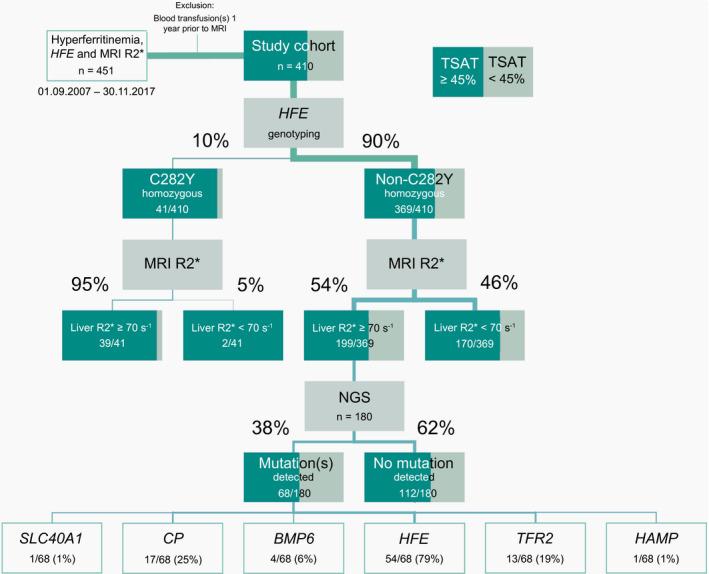
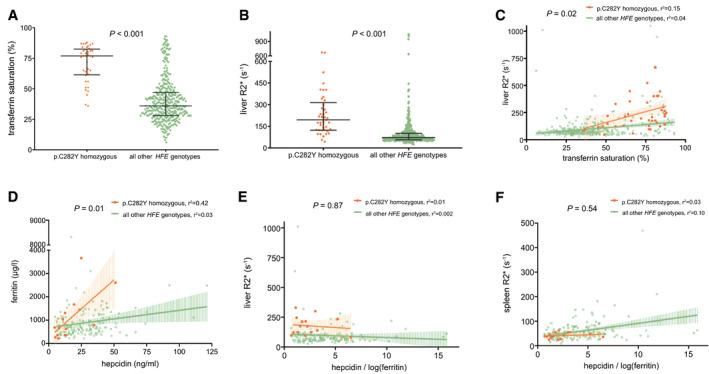
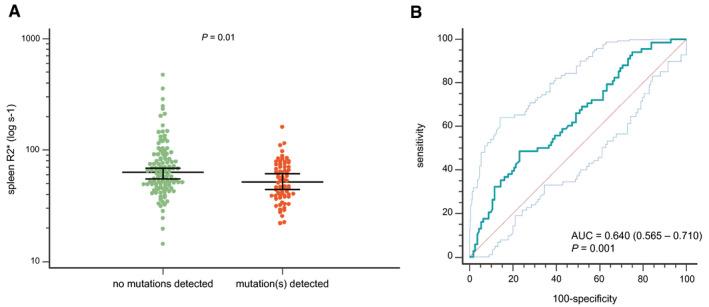
A cohort of 410 unselected liver clinic patients with high serum ferritin (defined as ≥200 μg/L for women and ≥300 μg/L for men) was investigated by HFE genotyping and abdominal MRI R2*. Forty-one (10%) patients were homozygous for the p.Cys282Tyr variant in HFE. Of the remaining 369 patients, 256 (69%) had high transferrin saturation (TSAT; ≥45%) and 199 (53%) had confirmed hepatic iron overload (liver R2* ≥70 s ). NGS of hemochromatosis genes was carried out in 180 patients with hepatic iron overload, and likely pathogenic variants were identified in 68 of 180 (38%) patients, mainly in HFE (79%), ceruloplasmin (25%), and transferrin receptor 2 (19%). Low spleen iron (R2* <50 s ), but not TSAT, was significantly associated with the presence of mutations. In 167 patients (93%), no monogenic cause of hepatic iron overload could be identified.
CONCLUSIONS
In patients without homozygosity for p.Cys282Tyr, coincident pathogenic variants in HFE and non-HFE genes could explain hyperferritinemia with hepatic iron overload in a subset of patients. Unlike HFE hemochromatosis, this type of polygenic hepatic iron overload presents with variable TSAT. High ferritin in blood is an indicator of the iron storage disease, hemochromatosis. A simple genetic test establishes this diagnosis in the majority of patients affected. MRI of the abdomen can guide further genetic testing.
背景与目的
高血清铁蛋白在慢性肝病患者中很常见,通常与肝铁过载有关。导致肝铁过高的遗传原因包括铁稳态调节剂(HFE)中 p.Cys282Tyr 变体的纯合性和非 HFE 基因中的罕见变体。本研究的目的是描述血色病基因的突变情况和频率,并确定通过 MRI 对肝铁进行非侵入性定量来选择患者是否可以提高高血铁蛋白血症患者下一代测序(NGS)的诊断率。
方法和结果
对 410 名未选择的肝脏诊所高血清铁蛋白(女性定义为≥200μg/L,男性定义为≥300μg/L)患者进行了 HFE 基因分型和腹部 MRI R2检查。41 名(10%)患者为 HFE 中 p.Cys282Tyr 变体的纯合子。在其余 369 名患者中,256 名(69%)患者转铁蛋白饱和度(TSAT;≥45%)高,199 名(53%)患者证实肝铁过载(肝脏 R2≥70s)。对 199 名肝铁过载患者进行了血色病基因的 NGS,在 180 名患者中发现了可能的致病性变异,主要在 HFE(79%)、铜蓝蛋白(25%)和转铁蛋白受体 2(19%)中。低脾脏铁(R2*<50s),而不是 TSAT,与突变的存在显著相关。在 167 名(93%)患者中,未发现肝铁过载的单基因原因。
结论
在没有 p.Cys282Tyr 纯合性的患者中,HFE 和非 HFE 基因中的共同致病性变异可能解释了一部分患者的高血铁蛋白血症伴肝铁过载。与 HFE 血色病不同,这种多基因肝铁过载的 TSAT 存在差异。血液中的高铁蛋白是铁储存疾病血色病的一个指标。简单的基因测试可以在大多数受影响的患者中确立这一诊断。腹部 MRI 可以指导进一步的基因测试。


 Zotero 插件