
ADAMTS13 对严重 COVID-19 中 VWF 多聚体分布的调节。
ADAMTS13 regulation of VWF multimer distribution in severe COVID-19.
机构信息
Irish Centre for Vascular Biology, School of Pharmacy and Biomolecular Sciences, Royal College of Surgeons in Ireland, Dublin, Ireland.
National Coagulation Centre, St James's Hospital, Dublin, Ireland.
出版信息
J Thromb Haemost. 2021 Aug;19(8):1914-1921. doi: 10.1111/jth.15409. Epub 2021 Jun 20.
BACKGROUND
Consistent with fulminant endothelial cell activation, elevated plasma von Willebrand factor (VWF) antigen levels have been reported in patients with COVID-19. The multimeric size and function of VWF are normally regulated through A Disintegrin And Metalloprotease with ThrombSpondin Motif type 1 motif, member 13 (ADAMTS-13)--mediated proteolysis.
OBJECTIVES
This study investigated the hypothesis that ADAMTS-13 regulation of VWF multimer distribution may be impaired in severe acute respiratory syndrome-coronavirus-2 (SARS-CoV-2) infection contributing to the observed microvascular thrombosis.
PATIENTS AND METHODS
Patients with COVID-19 (n = 23) were recruited from the Beaumont Hospital Intensive Care Unit (ICU) in Dublin. Plasma VWF antigen, multimer distribution, ADAMTS-13 activity, and known inhibitors thereof were assessed.
RESULTS
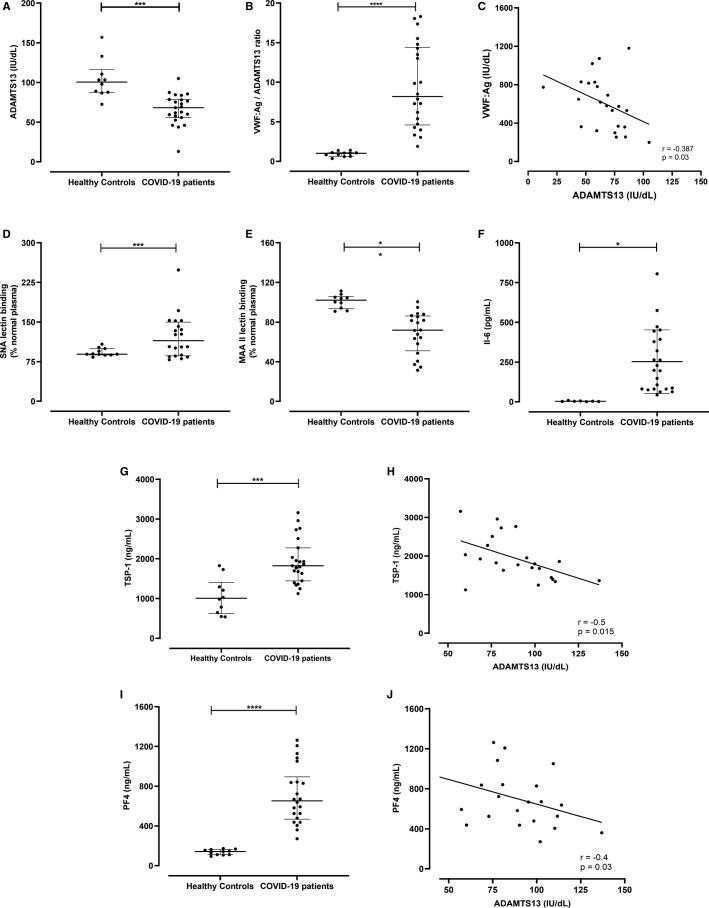
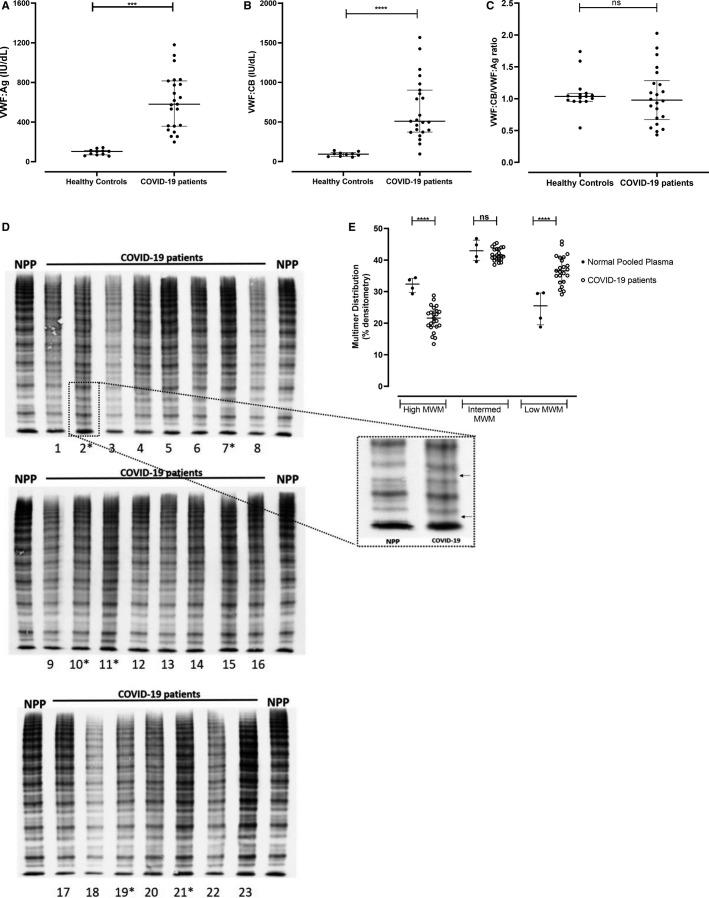
We observed markedly increased VWF collagen-binding activity in patients with severe COVID-19 compared to controls (median 509.1 versus 94.3 IU/dl). Conversely, plasma ADAMTS-13 activity was significantly reduced (median 68.2 IU/dl). In keeping with an increase in VWF:ADAMTS-13 ratio, abnormalities in VWF multimer distribution were common in patients with COVID-19, with reductions in high molecular weight VWF multimers. Terminal sialylation regulates VWF susceptibility to proteolysis by ADAMTS-13 and other proteases. We observed that both N- and O-linked sialylation were altered in severe COVID-19. Furthermore, plasma levels of the ADAMTS-13 inhibitors interleukin-6, thrombospondin-1, and platelet factor 4 were significantly elevated.
CONCLUSIONS
These findings support the hypothesis that SARS-CoV-2 is associated with profound quantitative and qualitative increases in plasma VWF levels, and a multifactorial down-regulation in ADAMTS-13 function. Further studies will be required to determine whether therapeutic interventions to correct ADAMTS-13-VWF multimer dysfunction may be useful in COVID-microvascular thrombosis and angiopathy.
背景
暴发性内皮细胞激活时,血浆血管性血友病因子(von Willebrand factor,VWF)抗原水平升高已在 COVID-19 患者中报道。VWF 的多聚体大小和功能通常通过 A Disintegrin And Metalloprotease with ThrombSpondin Motif type 1 motif, member 13(ADAMTS-13)介导的蛋白水解来调节。
目的
本研究旨在验证假设,即严重急性呼吸综合征冠状病毒 2(SARS-CoV-2)感染可能会损害 ADAMTS-13 对 VWF 多聚体分布的调节,从而导致观察到的微血管血栓形成。
患者和方法
从都柏林 Beaumont 医院重症监护病房(ICU)招募了 COVID-19 患者(n=23)。评估了血浆 VWF 抗原、多聚体分布、ADAMTS-13 活性及其已知抑制剂。
结果
与对照组相比,严重 COVID-19 患者的 VWF 胶原结合活性显著升高(中位数 509.1 与 94.3 IU/dl)。相反,血浆 ADAMTS-13 活性显著降低(中位数 68.2 IU/dl)。与 VWF:ADAMTS-13 比值增加一致,COVID-19 患者的 VWF 多聚体分布异常常见,高分子量 VWF 多聚体减少。末端唾液酸化调节 VWF 对 ADAMTS-13 和其他蛋白酶的易感性。我们观察到,严重 COVID-19 患者的 N-和 O-连接唾液酸化均发生改变。此外,ADAMTS-13 抑制剂白细胞介素 6、血小板反应蛋白 1 和血小板因子 4 的血浆水平显著升高。
结论
这些发现支持 SARS-CoV-2 与血浆 VWF 水平的显著定量和定性增加以及 ADAMTS-13 功能的多因素下调相关的假设。需要进一步研究以确定是否纠正 ADAMTS-13-VWF 多聚体功能障碍的治疗干预措施是否对 COVID-19 微血管血栓形成和血管病变有用。
 Zotero 插件