
塞利尼索、硼替佐米和地塞米松与硼替佐米和地塞米松治疗既往多发性骨髓瘤:细胞遗传学风险的结果。
Selinexor, bortezomib, and dexamethasone versus bortezomib and dexamethasone in previously treated multiple myeloma: Outcomes by cytogenetic risk.
机构信息
Icahn School of Medicine at Mount Sinai Tisch Cancer Institute, New York, New York, USA.
General Hospital Evangelismos, Athens, Greece.
出版信息
Am J Hematol. 2021 Sep 1;96(9):1120-1130. doi: 10.1002/ajh.26261. Epub 2021 Jul 5.
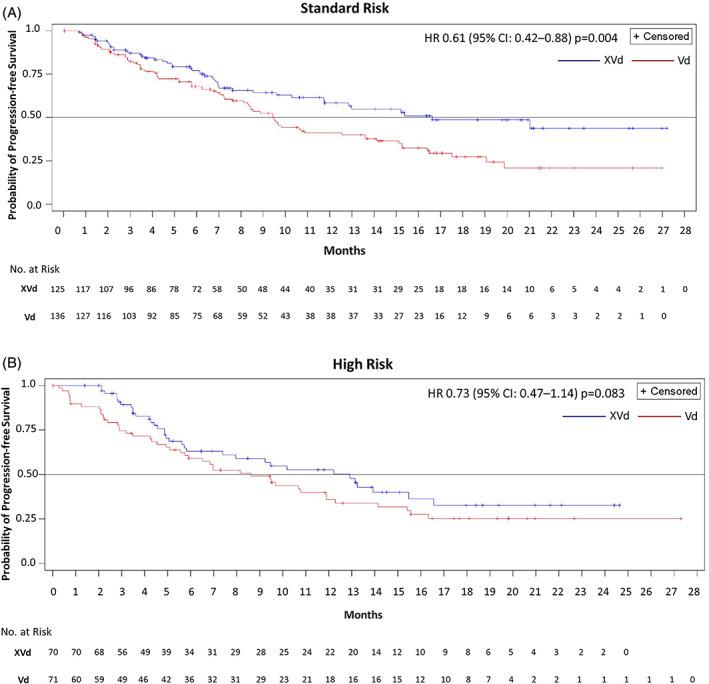
In the phase 3 BOSTON study, patients with multiple myeloma (MM) after 1-3 prior regimens were randomized to once-weekly selinexor (an oral inhibitor of exportin 1 [XPO1]) plus bortezomib-dexamethasone (XVd) or twice-weekly bortezomib-dexamethasone (Vd). Compared with Vd, XVd was associated with significant improvements in median progression-free survival (PFS), overall response rate (ORR), and lower rates of peripheral neuropathy, with trends in overall survival (OS) favoring XVd. In BOSTON, 141 (35.1%) patients had MM with high-risk (presence of del[17p], t[4;14], t[14;16], or ≥4 copies of amp1q21) cytogenetics (XVd, n = 70; Vd, n = 71), and 261 (64.9%) exhibited standard-risk cytogenetics (XVd, n = 125; Vd, n = 136). Among patients with high-risk MM, median PFS was 12.91 months for XVd and 8.61 months for Vd (HR, 0.73 [95% CI, (0.4673, 1.1406)], p = 0.082), and ORRs were 78.6% and 57.7%, respectively (OR 2.68; p = 0.004). In the standard-risk subgroup, median PFS was 16.62 months for XVd and 9.46 months for Vd (HR 0.61; p = 0.004), and ORRs were 75.2% and 64.7%, respectively (OR 1.65; p = 0.033). The safety profiles of XVd and Vd in both subgroups were consistent with the overall population. These data suggest that selinexor can confer benefits to patients with MM regardless of cytogenetic risk. ClinicalTrials.gov identifier: NCT03110562.
在 3 期 BOSTON 研究中,经过 1-3 种先前方案治疗的多发性骨髓瘤 (MM) 患者被随机分配至每周一次的 selinexor(一种外排蛋白 1 [XPO1] 的口服抑制剂)联合硼替佐米-地塞米松(XVd)或每周两次的硼替佐米-地塞米松(Vd)。与 Vd 相比,XVd 与中位无进展生存期 (PFS)、总缓解率 (ORR) 的显著改善相关,周围神经病变发生率较低,总生存 (OS) 趋势有利于 XVd。在 BOSTON 研究中,141 例(35.1%)MM 患者具有高危(存在 del[17p]、t[4;14]、t[14;16] 或≥4 个 amp1q21 拷贝)细胞遗传学(XVd,n=70;Vd,n=71),261 例(64.9%)表现为标准风险细胞遗传学(XVd,n=125;Vd,n=136)。在高危 MM 患者中,XVd 的中位 PFS 为 12.91 个月,Vd 的中位 PFS 为 8.61 个月(HR,0.73[95%CI,(0.4673,1.1406)],p=0.082),ORR 分别为 78.6%和 57.7%(OR 2.68;p=0.004)。在标准风险亚组中,XVd 的中位 PFS 为 16.62 个月,Vd 的中位 PFS 为 9.46 个月(HR 0.61;p=0.004),ORR 分别为 75.2%和 64.7%(OR 1.65;p=0.033)。XVd 和 Vd 在两个亚组中的安全性特征与总体人群一致。这些数据表明,selinexor 可使 MM 患者获益,无论细胞遗传学风险如何。临床试验注册:NCT03110562。
 Zotero 插件