
D-α-生育酚聚乙二醇琥珀酸酯-聚(ε-己内酯)(TPGS-PCL)纳米载体的设计与开发用于紫杉醇的增溶和控制释放。
Design and Development of D‒α‒Tocopheryl Polyethylene Glycol Succinate‒‒Poly(ε-Caprolactone) (TPGS--PCL) Nanocarriers for Solubilization and Controlled Release of Paclitaxel.
机构信息
Department of Pharmaceutics, College of Pharmacy, King Saud University, P.O. Box 2457, Riyadh 11451, Saudi Arabia.
Nanobiotechnology Research Unit, College of Pharmacy, King Saud University, P.O. Box 2457, Riyadh 11451, Saudi Arabia.
出版信息
Molecules. 2021 May 4;26(9):2690. doi: 10.3390/molecules26092690.
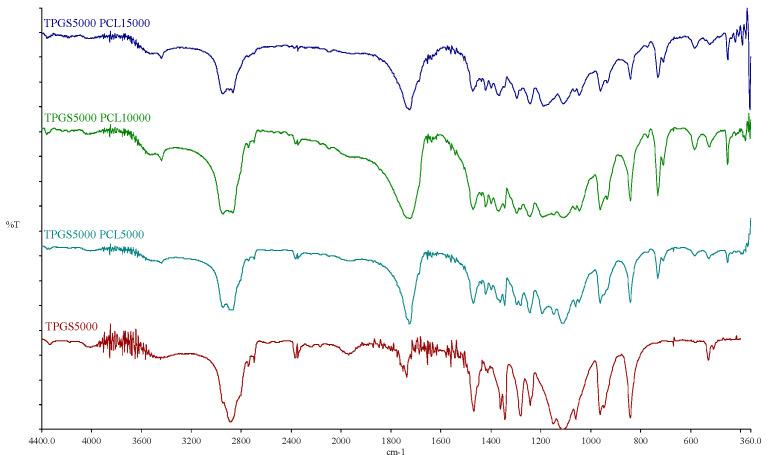
The objective of this study was to synthesize and characterize a set of biodegradable block copolymers based on TPGS--poly(ε-caprolactone) (TPGS--PCL) and to assess their self-assembled structures as a nanodelivery system for paclitaxel (PAX). The conjugation of PCL to TPGS was hypothesized to increase the stability and the drug solubilization characteristics of TPGS micelles. TPGS--PCL copolymer with various PCL/TPGS ratios were synthesized via ring opening bulk polymerization of ε-caprolactone using TPGS, with different molecular weights of PEG (1-5 kDa), as initiators and stannous octoate as a catalyst. The synthesized copolymers were characterized using H NMR, GPC, FTIR, XRD, and DSC. Assembly of block copolymers was achieved via the cosolvent evaporation method. The self-assembled structures were characterized for their size, polydispersity, and CMC using dynamic light scattering (DLS) technique. The results from the spectroscopic and thermal analyses confirmed the successful synthesis of the copolymers. Only copolymers that consisted of TPGS with PEG molecular weights ≥ 2000 Da were able to self-assemble and form nanocarriers of ≤200 nm in diameter. Moreover, TPGS--PCL, TPGS--PCL, and TPGS--PCL micelles enhanced the aqueous solubility of PAX from 0.3 µg/mL up to 88.4 ug/mL in TPGS--PCL. Of the abovementioned micellar formulations, TPGS--PCL showed the slowest in vitro release of PAX. Specifically, the PAX-loaded TPGS--PCL micellar formulation showed less than 10% drug release within the first 12 h, and around 36% cumulative drug release within 72 h compared to 61% and 100% PAX release, respectively, from the commercially available formulation (Ebetaxel) at the same time points. Our results point to a great potential for TPGS--PCL micelles to efficiently solubilize and control the release of PAX.
本研究的目的是合成和表征一组基于 TPGS-聚(ε-己内酯)(TPGS-PCL)的可生物降解嵌段共聚物,并评估其自组装结构作为紫杉醇(PAX)的纳米递药系统。假设将 PCL 接枝到 TPGS 上可以提高 TPGS 胶束的稳定性和药物增溶特性。通过使用 TPGS 作为引发剂和辛酸亚锡作为催化剂,通过开环本体聚合ε-己内酯合成了具有不同分子量的聚乙二醇(1-5 kDa)的 TPGS-PCL 嵌段共聚物。使用 1H NMR、GPC、FTIR、XRD 和 DSC 对合成的共聚物进行了表征。通过共溶剂蒸发法实现嵌段共聚物的组装。使用动态光散射(DLS)技术对自组装结构的粒径、多分散性和 CMC 进行了表征。光谱和热分析结果证实了共聚物的成功合成。只有包含分子量≥2000 Da 的聚乙二醇的 TPGS 共聚物才能自组装并形成直径≤200nm 的纳米载体。此外,TPGS-PCL、TPGS-PCL 和 TPGS-PCL 胶束将 PAX 的水溶解度从 0.3μg/mL 提高到 88.4μg/mL。在上述胶束制剂中,TPGS-PCL 显示出 PAX 最慢的体外释放。具体而言,与相同时间点的市售制剂(Ebetaxel)相比,载有 PAX 的 TPGS-PCL 胶束制剂在最初 12 小时内的药物释放量不到 10%,而在 72 小时内的累积药物释放量约为 36%,而 PAX 的释放量分别为 61%和 100%。我们的结果表明,TPGS-PCL 胶束具有高效溶解和控制 PAX 释放的巨大潜力。




 Zotero 插件