
慢性便秘患者排便协同失调和慢传输型便秘的患病率及临床特征
Prevalence and Clinical Characteristics of Dyssynergic Defecation and Slow Transit Constipation in Patients with Chronic Constipation.
作者信息
Tanner Samuel, Chaudhry Ahson, Goraya Navneet, Badlani Rohan, Jehangir Asad, Shahsavari Dariush, Malik Zubair, Parkman Henry P
机构信息
Section of Gastroenterology, Department of Medicine, Lewis Katz School of Medicine at Temple University, Philadelphia, PA 19140, USA.
出版信息
J Clin Med. 2021 May 9;10(9):2027. doi: 10.3390/jcm10092027.
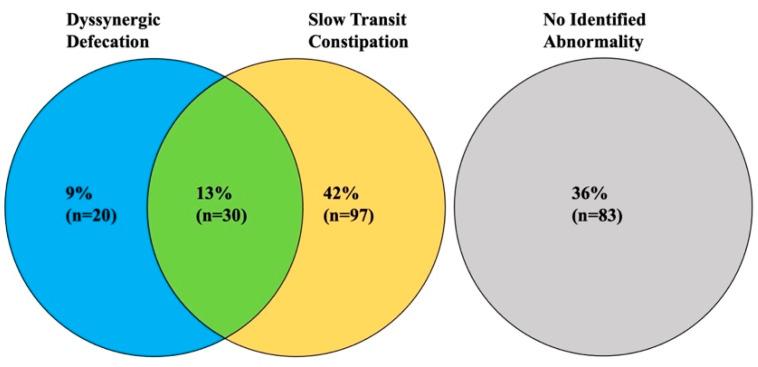
Patients with chronic constipation who do not respond to initial treatments often need further evaluation for dyssynergic defecation (DD) and slow transit constipation (STC). The aims of this study are to characterize the prevalence of DD and STC in patients referred to a motility center with chronic constipation and correlate diagnoses of DD and STC to patient demographics, medical history, and symptoms. High-resolution ARM (HR-ARM), balloon expulsion testing (BET) and whole gut transit scintigraphy (WGTS) of consecutive patients with chronic constipation were reviewed. Patients completed questionnaires describing their medical history and symptoms at the time of testing. A total of 230 patients completed HR-ARM, BET, and WGTS. Fifty (22%) patients had DD, and 127 (55%) patients had STC. Thirty patients (13%) had both DD and STC. There were no symptoms that were suggestive of STC vs. DD; however, patients with STC and DD reported more severe constipation than patients with normal transit and anorectal function. Patients with chronic constipation often need evaluation for both DD and STC to better understand their pathophysiology of symptoms and help direct treatment.
对初始治疗无反应的慢性便秘患者通常需要对排便协同失调(DD)和慢传输型便秘(STC)进行进一步评估。本研究的目的是确定转诊至动力中心的慢性便秘患者中DD和STC的患病率,并将DD和STC的诊断与患者的人口统计学、病史及症状相关联。回顾了连续慢性便秘患者的高分辨率肛管直肠测压(HR-ARM)、气囊排出试验(BET)和全胃肠通过闪烁扫描(WGTS)。患者在检查时完成了描述其病史和症状的问卷。共有230例患者完成了HR-ARM、BET和WGTS。50例(22%)患者有DD,127例(55%)患者有STC。30例(13%)患者同时有DD和STC。没有症状提示是STC还是DD;然而,STC和DD患者报告的便秘比传输正常和肛门直肠功能正常的患者更严重。慢性便秘患者通常需要对DD和STC进行评估,以更好地了解其症状的病理生理学并指导治疗。
 Zotero 插件