
过度的先天免疫在泰勒病毒诱导的脱髓鞘疾病发展过程中引导致病性适应性免疫。
Excessive Innate Immunity Steers Pathogenic Adaptive Immunity in the Development of Theiler's Virus-Induced Demyelinating Disease.
作者信息
Kim Byung S
机构信息
Department of Microbiology-Immunology, Northwestern University Feinberg School of Medicine, Chicago, IL 60611, USA.
出版信息
Int J Mol Sci. 2021 May 17;22(10):5254. doi: 10.3390/ijms22105254.
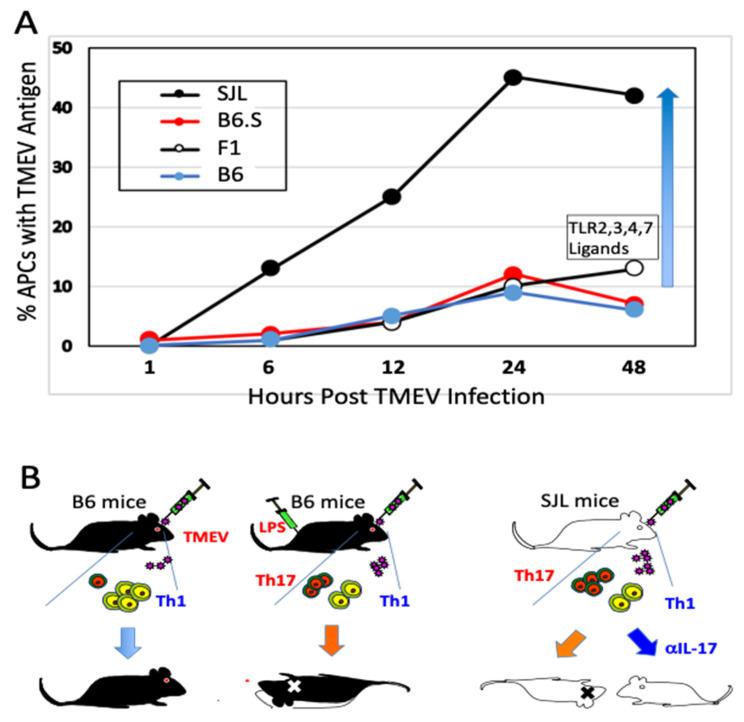
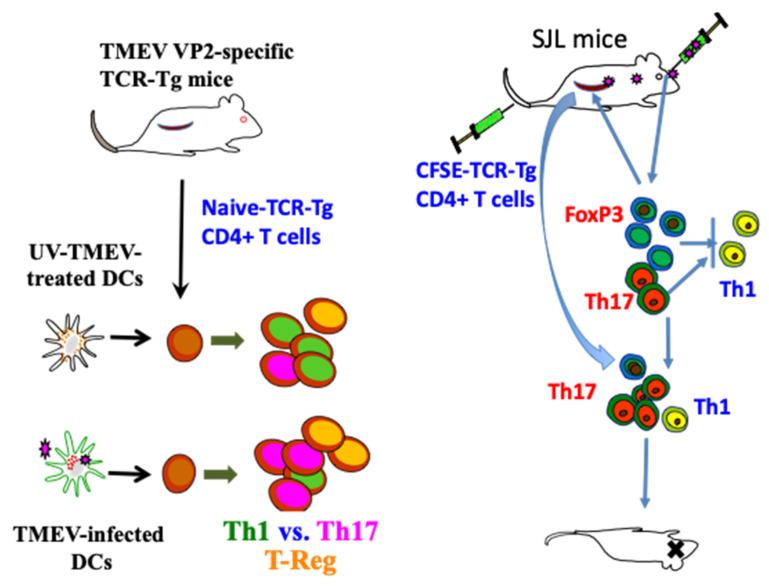
Several virus-induced models were used to study the underlying mechanisms of multiple sclerosis (MS). The infection of susceptible mice with Theiler's murine encephalomyelitis virus (TMEV) establishes persistent viral infections and induces chronic inflammatory demyelinating disease. In this review, the innate and adaptive immune responses to TMEV are discussed to better understand the pathogenic mechanisms of viral infections. Professional (dendritic cells (DCs), macrophages, and B cells) and non-professional (microglia, astrocytes, and oligodendrocytes) antigen-presenting cells (APCs) are the major cell populations permissive to viral infection and involved in cytokine production. The levels of viral loads and cytokine production in the APCs correspond to the degrees of susceptibility of the mice to the TMEV-induced demyelinating diseases. TMEV infection leads to the activation of cytokine production via TLRs and MDA-5 coupled with NF-κB activation, which is required for TMEV replication. These activation signals further amplify the cytokine production and viral loads, promote the differentiation of pathogenic Th17 responses, and prevent cellular apoptosis, enabling viral persistence. Among the many chemokines and cytokines induced after viral infection, IFN α/β plays an essential role in the downstream expression of costimulatory molecules in APCs. The excessive levels of cytokine production after viral infection facilitate the pathogenesis of TMEV-induced demyelinating disease. In particular, IL-6 and IL-1β play critical roles in the development of pathogenic Th17 responses to viral antigens and autoantigens. These cytokines, together with TLR2, may preferentially generate deficient FoxP3CD25 regulatory cells converting to Th17. These cytokines also inhibit the apoptosis of TMEV-infected cells and cytolytic function of CD8 T lymphocytes (CTLs) and prolong the survival of B cells reactive to viral and self-antigens, which preferentially stimulate Th17 responses.
几种病毒诱导模型被用于研究多发性硬化症(MS)的潜在机制。用泰勒氏鼠脑脊髓炎病毒(TMEV)感染易感小鼠可建立持续性病毒感染并诱发慢性炎性脱髓鞘疾病。在本综述中,将讨论对TMEV的先天性和适应性免疫反应,以更好地理解病毒感染的致病机制。专业抗原呈递细胞(树突状细胞(DCs)、巨噬细胞和B细胞)和非专业抗原呈递细胞(小胶质细胞、星形胶质细胞和少突胶质细胞)是允许病毒感染并参与细胞因子产生的主要细胞群体。抗原呈递细胞中病毒载量和细胞因子产生的水平与小鼠对TMEV诱导的脱髓鞘疾病的易感性程度相对应。TMEV感染通过Toll样受体(TLRs)和黑色素瘤分化相关基因5(MDA-5)导致细胞因子产生的激活,同时伴有核因子κB(NF-κB)的激活,这是TMEV复制所必需的。这些激活信号进一步放大细胞因子的产生和病毒载量,促进致病性辅助性T细胞17(Th17)反应的分化,并防止细胞凋亡,从而使病毒持续存在。在病毒感染后诱导产生的众多趋化因子和细胞因子中,干扰素α/β在抗原呈递细胞中共刺激分子的下游表达中起重要作用。病毒感染后细胞因子产生的过量水平促进了TMEV诱导的脱髓鞘疾病的发病机制。特别是,白细胞介素-6(IL-6)和白细胞介素-1β在针对病毒抗原和自身抗原的致病性Thl7反应的发展中起关键作用。这些细胞因子与TLR2一起,可能优先产生转化为Th17的缺陷型叉头框蛋白3(FoxP3)+ CD25 +调节性细胞。这些细胞因子还抑制TMEV感染细胞的凋亡以及细胞毒性T淋巴细胞(CTLs)的溶细胞功能,并延长对病毒和自身抗原反应性B细胞的存活时间,这些B细胞优先刺激Th17反应。



 Zotero 插件