
ST段抬高型心肌梗死患者中用于预测左心室重构的选定基线心电图参数的诊断性能
Diagnostic Performance of Selected Baseline Electrocardiographic Parameters for Prediction of Left Ventricular Remodeling in Patients with ST-Segment Elevation Myocardial Infarction.
作者信息
Kasprzak Michał, Fabiszak Tomasz, Koziński Marek, Kubica Jacek
机构信息
Department of Cardiology and Internal Medicine, Collegium Medicum, Nicolaus Copernicus University, ul. M. Skłodowskiej-Curie 9, 85-094 Bydgoszcz, Poland.
Department of Cardiology and Internal Medicine, Medical University of Gdansk, ul. Powstania Styczniowego 9B, 81-519 Gdynia, Poland.
出版信息
J Clin Med. 2021 May 29;10(11):2405. doi: 10.3390/jcm10112405.
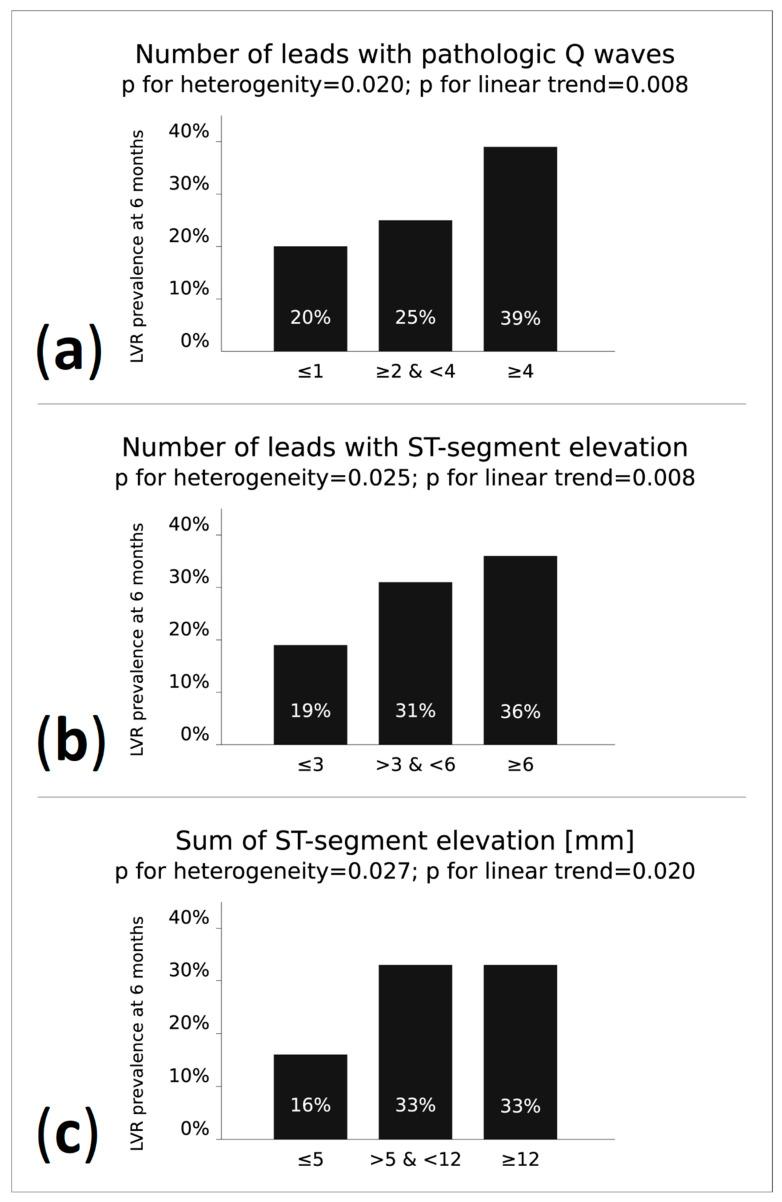
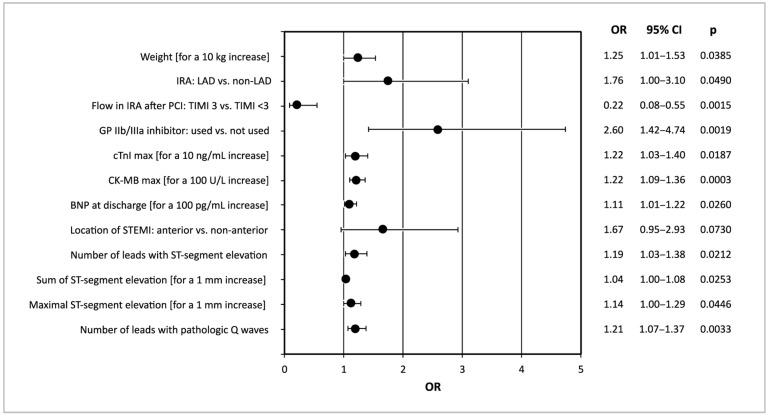
To evaluate the diagnostic performance of selected baseline electrocardiographic (ECG) parameters as predictors of left ventricular remodeling (LVR) in patients with a first ST-segment elevation myocardial infarction (STEMI) treated with primary percutaneous coronary intervention (PCI). The study was performed as a single-center cohort study, with 249 patients (74.7% males) included in the final analysis. Nine baseline ECG parameters were evaluated, with respect to occurrence of LVR 6 months after STEMI (defined as an echocardiography-assessed relative >20% increase in end-diastolic left ventricular volume compared with the value at discharge from hospital). The baseline ECG predictors of LVR, identified in univariate analysis, included the number of leads with ST-segment elevation (odds ratio (OR) 1.19, 95% confidence interval (CI) 1.03-1.38, = 0.0212), number of leads with Q-waves (OR 1.21, 95% CI 1.07-1.37, = 0.0033), sum of ST-segment elevation (OR 1.04, 95% CI 1.00-1.08; = 0.0253) and maximal ST-segment elevation (OR 1.14; 95% CI 1.00-1.29; = 0.0446). When added to demographic, clinical and angiographic data, the number of leads with ST-segment elevation (OR 1.17, 95% CI 1.01-1.36; = 0.0413), number of leads with Q-waves (OR 1.15, 95% CI 1.01-1.32; = 0.0354) and the sum of ST-segment elevation (OR 1.04, 95% CI 1.00-1.08; = 0.0331) successfully predicted development of LVR in multivariate logistic regression models. However, after inclusion of biochemical data in multivariate models, none of the electrocardiographic parameters, but increasing body weight, TIMI flow after PCI < 3 and higher maximal values of myocardial necrosis biomarker, was independently associated with the occurrence of LVR 6 months after STEMI. Our study demonstrates modest utility of pre-reperfusion ECG for the prediction of LVR occurrence after six months of STEMI.
为评估经皮冠状动脉介入治疗(PCI)的首次ST段抬高型心肌梗死(STEMI)患者中,选定的基线心电图(ECG)参数作为左心室重构(LVR)预测指标的诊断性能。该研究作为一项单中心队列研究进行,最终纳入分析249例患者(男性占74.7%)。评估了9项基线ECG参数,以观察STEMI后6个月LVR的发生情况(定义为经超声心动图评估,舒张末期左心室容积较出院时增加>20%)。单因素分析中确定的LVR基线ECG预测指标包括ST段抬高导联数(比值比(OR)1.19,95%置信区间(CI)1.03 - 1.38,P = 0.0212)、Q波导联数(OR 1.21,95% CI 1.07 - 1.37,P = 0.0033)、ST段抬高总和(OR 1.04,95% CI 1.00 - 1.08;P = 0.0253)以及最大ST段抬高(OR 1.14;95% CI 1.00 - 1.29;P = 0.0446)。当将这些指标加入人口统计学、临床和血管造影数据后,ST段抬高导联数(OR 1.17,95% CI 1.01 - 1.36;P = 0.0413)、Q波导联数(OR 1.15,95% CI 1.01 - 1.32;P = 0.0354)和ST段抬高总和(OR 1.04,95% CI 1.00 - 1.08;P = 0.0331)在多因素逻辑回归模型中成功预测了LVR的发生。然而,在多因素模型中纳入生化数据后,没有一项心电图参数与STEMI后6个月LVR的发生独立相关,但体重增加、PCI后TIMI血流<3以及心肌坏死生物标志物的更高最大值与LVR的发生相关。我们的研究表明,再灌注前心电图对预测STEMI六个月后LVR发生的作用有限。

 Zotero 插件