
维奈托克在慢性淋巴细胞白血病、急性髓系白血病和多发性骨髓瘤中的综述。
Review of Venetoclax in CLL, AML and Multiple Myeloma.
作者信息
Lasica Masa, Anderson Mary Ann
机构信息
Department of Haematology, St Vincent's Hospital, Melbourne 3065, Australia.
Department of Haematology, Peter MacCallum Cancer Centre, Melbourne 3000, Australia.
出版信息
J Pers Med. 2021 May 24;11(6):463. doi: 10.3390/jpm11060463.
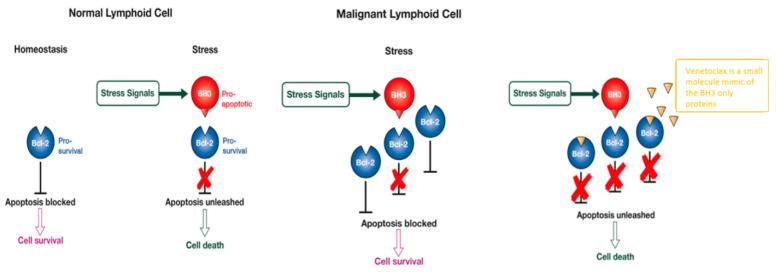
Venetoclax is a highly selective and effective B-cell lymphoma-2 (BCL-2) inhibitor, which is able to reinstate the apoptotic potential of cancer cells. With its full repertoire yet to be explored, it has changed the therapeutic landscape in haematological malignancies, and most particularly chronic lymphocytic leukaemia (CLL), acute myeloid leukaemia (AML) and multiple myeloma (MM). In CLL, it has shown remarkable efficacy both as monotherapy and in combination therapy. Based on data from MURANO and CLL14 studies, fixed-duration combination therapy of venetoclax with anti-CD20 antibody is now the standard of care in numerous countries. In AML, although of limited efficacy as a single agent, venetoclax combination therapy has demonstrated encouraging outcomes including rapid, durable responses and acceptable toxicity, particularly in the older, unfit patient population. Multiple myeloma with translocation (t)(11;14) harbours high BCL-2/ myeloid cell leukaemia sequence-1 (MCL-1) and BCL-2/BCL-XL ratio and is, therefore, particularly suited for venetoclax-based therapy. Despite a wide ranging and evolving clinical role in these diseases, venetoclax treatment is not curative and, over time, clonal evolution and disease relapse appear to be the norm. While a variety of distinct resistance mechanisms have been identified, frequently emerging in a sub-clonal pattern, the full picture is yet to be characterised. Further illumination of the complex interplay of various factors is needed to pave the way for rational combination therapies aimed at circumventing resistance and improving durability of disease control. Serial molecular studies can aid in identification of new prognostically significant and/or targetable mutations.
维奈托克是一种高度选择性且有效的B细胞淋巴瘤2(BCL-2)抑制剂,它能够恢复癌细胞的凋亡潜能。尽管其全部作用机制尚未完全阐明,但它已经改变了血液系统恶性肿瘤的治疗格局,尤其是在慢性淋巴细胞白血病(CLL)、急性髓系白血病(AML)和多发性骨髓瘤(MM)方面。在CLL中,它作为单药治疗和联合治疗均显示出显著疗效。基于MURANO和CLL14研究的数据,维奈托克与抗CD20抗体的固定疗程联合治疗目前在许多国家已成为标准治疗方案。在AML中,尽管维奈托克作为单药疗效有限,但联合治疗已显示出令人鼓舞的结果,包括快速、持久的缓解以及可接受的毒性,尤其是在老年、身体状况不佳的患者群体中。伴有11号和14号染色体易位(t)(11;14)的多发性骨髓瘤具有高BCL-2/髓系细胞白血病序列-1(MCL-1)和BCL-2/BCL-XL比值,因此特别适合基于维奈托克的治疗。尽管维奈托克在这些疾病中具有广泛且不断演变的临床作用,但它并不能治愈疾病,随着时间的推移,克隆进化和疾病复发似乎是常态。虽然已经确定了多种不同的耐药机制,且这些机制经常以亚克隆模式出现,但全貌仍有待明确。需要进一步阐明各种因素之间复杂的相互作用,为旨在规避耐药性和提高疾病控制持久性的合理联合治疗铺平道路。系列分子研究有助于识别新的具有预后意义和/或可靶向的突变。
 Zotero 插件