
通过改造独特的非天然细胞色素P450单加氧酶实现苯乙烯的高度()-对映选择性环氧化。 注:括号内内容原文缺失,翻译时保留原样。
Enabling highly ()-enantioselective epoxidation of styrene by engineering unique non-natural P450 peroxygenases.
作者信息
Zhao Panxia, Chen Jie, Ma Nana, Chen Jingfei, Qin Xiangquan, Liu Chuanfei, Yao Fuquan, Yao Lishan, Jin Longyi, Cong Zhiqi
机构信息
CAS Key Laboratory of Biofuels, Shandong Provincial Key Laboratory of Synthetic Biology, Qingdao Institute of Bioenergy and Bioprocess Technology, Chinese Academy of Sciences Qingdao Shandong 266101 China
University of Chinese Academy of Sciences Beijing 100049 China.
出版信息
Chem Sci. 2021 Mar 22;12(18):6307-6314. doi: 10.1039/d1sc00317h.
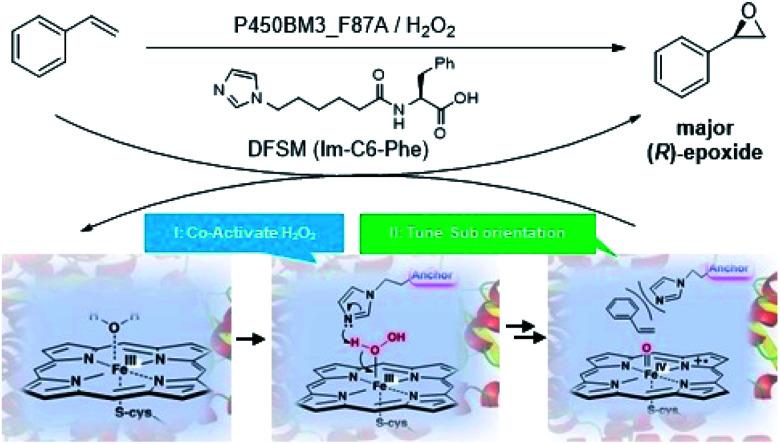
Unlike the excellent ()-enantioselective epoxidation of styrene performed by natural styrene monooxygenases (ee > 99%), the ()-enantioselective epoxidation of styrene has not yet achieved a comparable efficiency using natural or engineered oxidative enzymes. This report describes the HO-dependent ()-enantioselective epoxidation of unfunctionalized styrene and its derivatives by site-mutated variants of a unique non-natural P450BM3 peroxygenase, working in tandem with a dual-functional small molecule (DFSM). The observed ()-enantiomeric excess (ee) of styrene epoxidation is up to 99% with a turnover number (TON) of 918 by the best enantioselective mutant F87A/T268I/L181Q, while the best active mutant F87A/T268I/V78A/A184L (with 98% ee) gave a catalytic TON of 4350, representing the best activity of a P450 peroxygenase towards styrene epoxidation to date. Following this approach, a set of styrene derivatives, such as -, -, -chlorostyrenes and fluorostyrenes, could also be epoxidized with modest to very good TONs (362-3480) and high ()-enantioselectivities (95-99% ee). The semi-preparative scale synthesis of ()-styrene oxide performed at 0 °C with high conversion, maintaining enantioselectivity, and moderate isolated yields, further suggests the potential application of the current P450 enzymatic system in styrene epoxidation. This study indicates that the synergistic use of protein engineering and an exogenous DFSM constitutes an efficient strategy to control the enantioselectivity of styrene epoxidation, thus substantially expanding the chemical scope of P450 enzymes as useful bio-oxidative catalysts.
与天然苯乙烯单加氧酶对苯乙烯进行的出色的()-对映选择性环氧化反应(对映体过量值ee>99%)不同,使用天然或工程氧化酶对苯乙烯进行的()-对映选择性环氧化反应尚未达到可比的效率。本报告描述了一种独特的非天然P450BM3过氧合酶的位点突变变体与双功能小分子(DFSM)协同作用,对未官能化苯乙烯及其衍生物进行的依赖HO的()-对映选择性环氧化反应。通过最佳对映选择性突变体F87A/T268I/L181Q,观察到苯乙烯环氧化反应的()-对映体过量值(ee)高达99%,周转数(TON)为918,而最佳活性突变体F87A/T268I/V78A/A184L(ee为98%)的催化TON为4350,代表了迄今为止P450过氧合酶对苯乙烯环氧化反应的最佳活性。按照这种方法,一组苯乙烯衍生物,如-、-、-氯苯乙烯和氟苯乙烯,也可以以适中到非常好的TON值(362-3480)和高()-对映选择性(95-99%ee)进行环氧化反应。在0°C下进行的()-环氧苯乙烷的半制备规模合成,具有高转化率、保持对映选择性和适中的分离产率,进一步表明了当前P450酶系统在苯乙烯环氧化反应中的潜在应用。这项研究表明,蛋白质工程与外源性DFSM的协同使用构成了一种控制苯乙烯环氧化反应对映选择性的有效策略,从而大大扩展了P450酶作为有用生物氧化催化剂的化学应用范围。



 Zotero 插件