
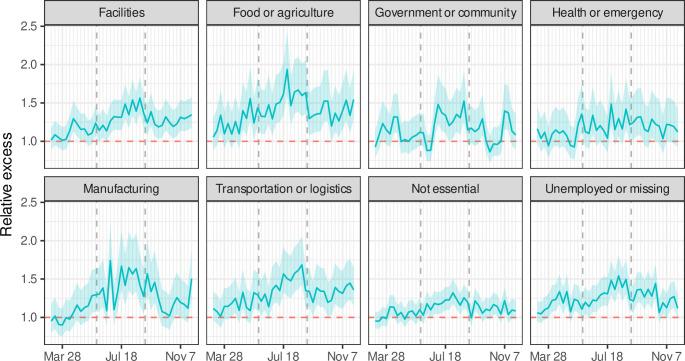
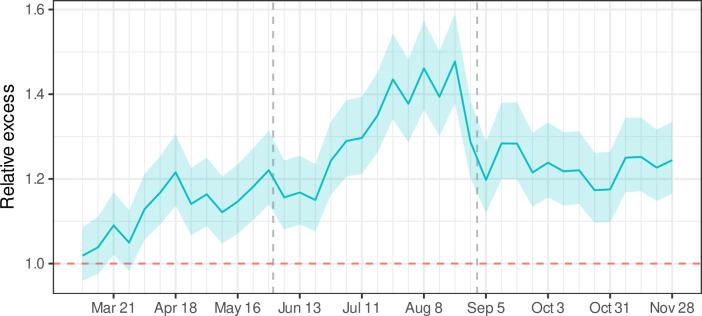
2020 年 3 月至 11 月期间,加利福尼亚州 18-65 岁人群中与 COVID-19 大流行相关的超额死亡率,按职业部门和职业分类。
Excess mortality associated with the COVID-19 pandemic among Californians 18-65 years of age, by occupational sector and occupation: March through November 2020.
机构信息
Institute for Global Health Sciences, University of California, San Francisco, California, United States of America.
Department of Epidemiology and Biostatistics, University of California, San Francisco, California, United States of America.
出版信息
PLoS One. 2021 Jun 4;16(6):e0252454. doi: 10.1371/journal.pone.0252454. eCollection 2021.
BACKGROUND
Though SARS-CoV-2 outbreaks have been documented in occupational settings and in-person essential work has been suspected as a risk factor for COVID-19, occupational differences in excess mortality have, to date, not been examined. Such information could point to opportunities for intervention, such as vaccine prioritization or regulations to enforce safer work environments.
METHODS AND FINDINGS
Using autoregressive integrated moving average models and California Department of Public Health data representing 356,188 decedents 18-65 years of age who died between January 1, 2016 and November 30, 2020, we estimated pandemic-related excess mortality by occupational sector and occupation, with additional stratification of the sector analysis by race/ethnicity. During these first 9 months of the COVID-19 pandemic, working-age adults experienced 11,628 more deaths than expected, corresponding to 22% relative excess and 46 excess deaths per 100,000 living individuals. Sectors with the highest relative and per-capita excess mortality were food/agriculture (39% relative excess; 75 excess deaths per 100,000), transportation/logistics (31%; 91 per 100,000), manufacturing (24%; 61 per 100,000), and facilities (23%; 83 per 100,000). Across racial and ethnic groups, Latino working-age Californians experienced the highest relative excess mortality (37%) with the highest excess mortality among Latino workers in food and agriculture (59%; 97 per 100,000). Black working-age Californians had the highest per-capita excess mortality (110 per 100,000), with relative excess mortality highest among transportation/logistics workers (36%). Asian working-age Californians had lower excess mortality overall, but notable relative excess mortality among health/emergency workers (37%), while White Californians had high per-capita excess deaths among facilities workers (70 per 100,000).
CONCLUSIONS
Certain occupational sectors are associated with high excess mortality during the pandemic, particularly among racial and ethnic groups also disproportionately affected by COVID-19. In-person essential work is a likely venue of transmission of coronavirus infection and must be addressed through vaccination and strict enforcement of health orders in workplace settings.
背景
尽管已经记录到 SARS-CoV-2 在职业环境中的爆发,并且人们怀疑面对面的必要工作是 COVID-19 的一个风险因素,但迄今为止,职业差异造成的超额死亡率尚未得到研究。这些信息可能为干预措施提供机会,例如疫苗接种优先级或实施更安全工作环境的法规。
方法和发现
我们使用自回归综合移动平均模型和加利福尼亚州公共卫生部的数据,这些数据代表了 2016 年 1 月 1 日至 2020 年 11 月 30 日期间 18-65 岁的 356,188 名死者,我们根据职业部门和职业估算了与大流行相关的超额死亡率,并按种族/族裔进一步细分了部门分析。在 COVID-19 大流行的头 9 个月中,成年工作者的死亡人数比预期多 11,628 人,相对超额死亡率为 22%,每 10 万人中有 46 人超额死亡。相对和人均超额死亡率最高的部门是食品/农业(39%的相对超额;每 10 万人中有 75 人超额死亡)、运输/物流(31%;每 10 万人中有 91 人超额死亡)、制造业(24%;每 10 万人中有 61 人超额死亡)和设施(23%;每 10 万人中有 83 人超额死亡)。在所有种族和族裔群体中,拉丁裔成年加利福尼亚人经历了最高的相对超额死亡率(37%),其中从事食品和农业工作的拉丁裔工人的超额死亡率最高(59%;每 10 万人中有 97 人超额死亡)。黑人成年加利福尼亚人死亡率最高(每 10 万人中有 110 人),其中运输/物流工人的相对超额死亡率最高(36%)。亚裔成年加利福尼亚人整体超额死亡率较低,但卫生/紧急工作人员的相对超额死亡率显著(37%),而设施工人的白人成年加利福尼亚人每 10 万人中有 70 人超额死亡。
结论
在大流行期间,某些职业部门与高死亡率相关,尤其是在同样受到 COVID-19 严重影响的种族和族裔群体中。面对面的必要工作可能是冠状病毒感染传播的场所,必须通过在工作场所接种疫苗和严格执行卫生命令来解决。
 Zotero 插件