
健康差异和社会经济地位在急诊胃肠道手术中的作用。
The Role of Health Disparities and Socioeconomic Status in Emergent Gastrointestinal Procedures.
作者信息
May Eve, Brown Kristin O, Gracely Edward, Podkameni Gisele, Franklin Linda, Pall Harpreet
机构信息
Department of Gastroenterology, Hepatology, and Nutrition, Children's National Hospital, Washington, District of Columbia, USA.
Section of Gastroenterology, Hepatology, and Nutrition, St. Christopher's Hospital for Children, Philadelphia, Pennsylvania, USA.
出版信息
Health Equity. 2021 Apr 30;5(1):270-276. doi: 10.1089/heq.2020.0141. eCollection 2021.
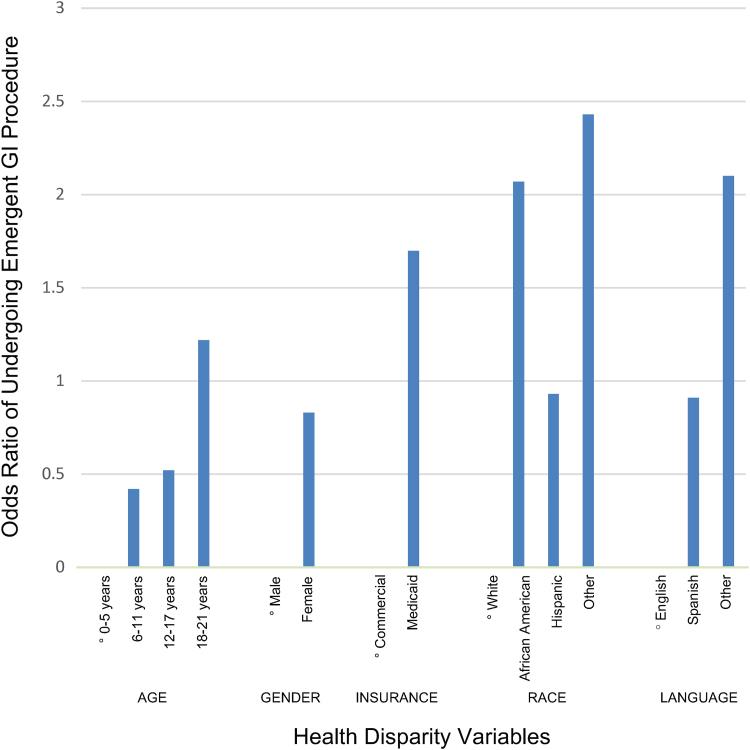
There is limited data describing the role of health disparity factors and socioeconomic status (SES) on emergent versus nonemergent gastrointestinal (GI) procedures within pediatrics. We aimed to characterize risk factors and determine the role of SES on emergent versus nonemergent GI care. We hypothesized that patients with lower SES incur higher risk of having emergent procedures performed. Retrospective chart review was performed between 2012 and 2016, with 2556 patient records reviewed. Demographic data and SES categories were determined. The majority of emergent procedures were performed on an inpatient basis. Health disparity factors analyzed included age, gender, insurance type, race, language, and SES using census tracts. Logistic regression analyses and paired t-tests were utilized. Two hundred eighty-six (11.2%) patients had emergent GI procedures performed. Logistic regression (odds ratio [OR], confidence interval (95% CI)] showed patients from 6-11 to 12-17 years of age were less likely to seek emergent care than the youngest group [0.47, 0.33-0.66 and 0.61, 0.45-0.84]. Patients with Medicaid insurance [1.68, 1.27-2.26], African American or "other" race [2.07, 1.48-2.90 and 2.43, 1.77-3.36, respectively], as well as "other" language [2.1, 1.14-3.99] more often sought emergent care. Using geocoded data, we found that as SES increases by 1, emergent risk for procedures decreased by 2.9% (OR 0.97, =0.045). Children with lower SES, at extremes of age (<5, >18 years), non-English or Spanish speaking and with Medicaid insurance are at higher risk of undergoing emergent GI procedures. This study gives us an opportunity to plan targeted interventions to improve access and quality of care.
关于健康差异因素和社会经济地位(SES)在儿科急诊与非急诊胃肠道(GI)手术中的作用,相关数据有限。我们旨在明确风险因素,并确定SES在急诊与非急诊GI护理中的作用。我们假设SES较低的患者进行急诊手术的风险更高。在2012年至2016年期间进行了回顾性病历审查,共审查了2556份患者记录。确定了人口统计学数据和SES类别。大多数急诊手术是在住院患者中进行的。分析的健康差异因素包括年龄、性别、保险类型、种族、语言以及使用人口普查区划分的SES。采用了逻辑回归分析和配对t检验。286名(11.2%)患者接受了急诊GI手术。逻辑回归(优势比[OR],置信区间[95%CI])显示,6至11岁和12至17岁的患者比最年幼组寻求急诊护理的可能性更小[0.47,0.33 - 0.66和0.61,0.45 - 0.84]。有医疗补助保险的患者[1.68,1.27 - 2.26]、非裔美国人或“其他”种族的患者[分别为2.07,1.48 - 2.90和2.43,1.77 - 3.36]以及说“其他”语言的患者[2.1,1.14 - 3.99]更常寻求急诊护理。利用地理编码数据,我们发现随着SES每增加1,手术的急诊风险降低2.9%(OR 0.97,P = 0.045)。SES较低、处于年龄极端情况(<5岁,>18岁)、非英语或西班牙语使用者以及有医疗补助保险的儿童接受急诊GI手术的风险更高。这项研究为我们提供了一个机会来规划有针对性的干预措施,以改善医疗服务的可及性和质量。
 Zotero 插件