
性别和 ε4 对认知无症状中老年人大脑灌注轨迹与年龄相关性的影响:一项纵向研究。
Impact of sex and ε4 on age-related cerebral perfusion trajectories in cognitively asymptomatic middle-aged and older adults: A longitudinal study.
机构信息
Wisconsin Alzheimer's Disease Research Center, University of Wisconsin School of Medicine and Public Health, Madison, WI, USA.
The Swedish School of Sport and Health Science, GIH, Stockholm, Sweden.
出版信息
J Cereb Blood Flow Metab. 2021 Nov;41(11):3016-3027. doi: 10.1177/0271678X211021313. Epub 2021 Jun 8.
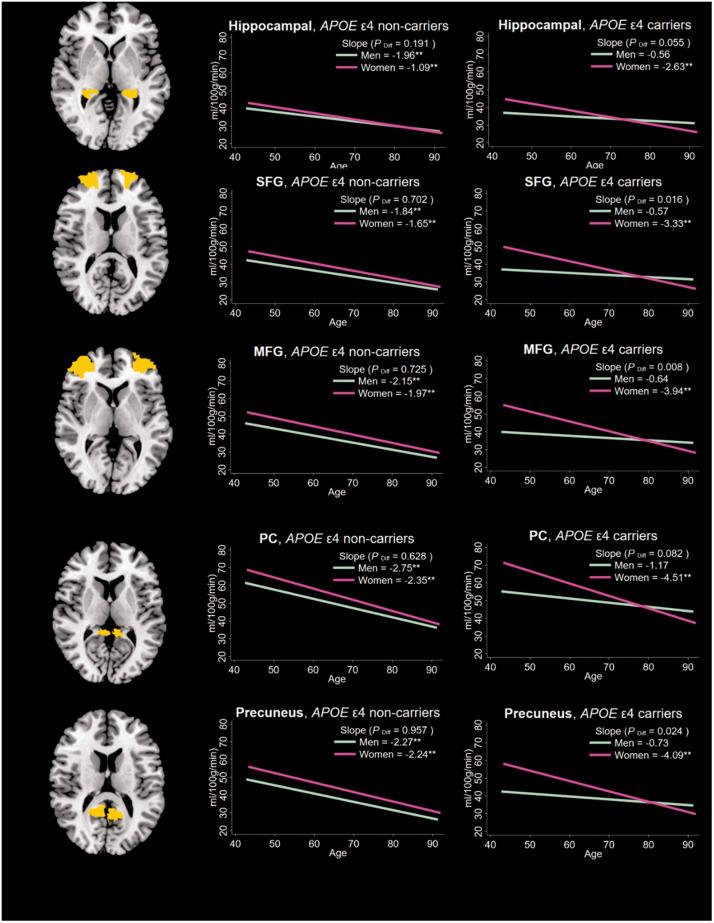
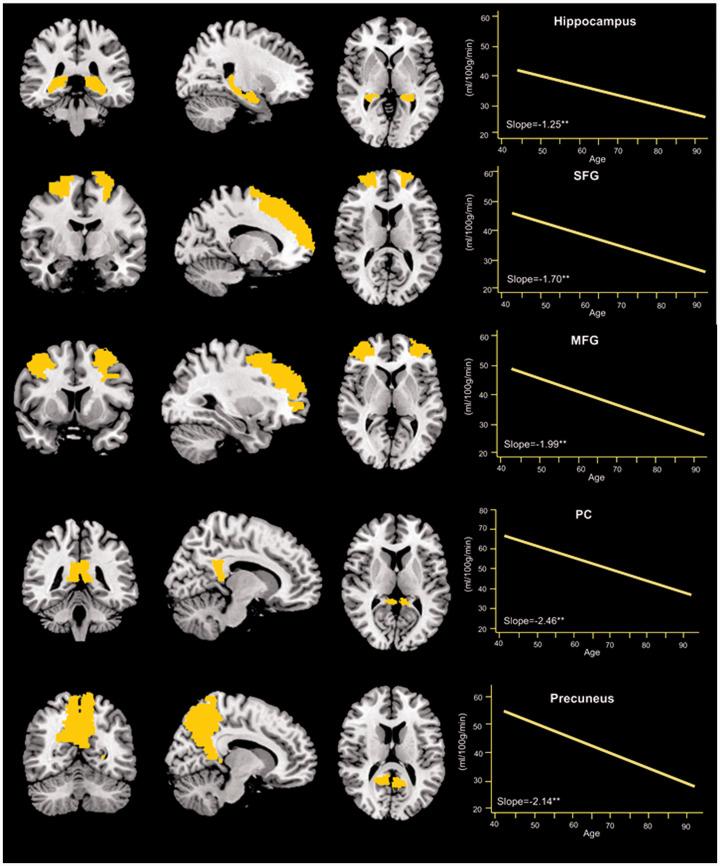
Cerebral hypoperfusion is thought to contribute to cognitive decline in Alzheimer's disease, but the natural trajectory of cerebral perfusion in cognitively healthy adults has not been well-studied. This longitudinal study is consisted of 950 participants (40-89 years), who were cognitively unimpaired at their first visit. We investigated the age-related changes in cerebral perfusion, and their associations with genotype, biological sex, and cardiometabolic measurements. During the follow-up period (range 0.13-8.24 years), increasing age was significantly associated with decreasing cerebral perfusion, in total gray-matter (β=-1.43), hippocampus (-1.25), superior frontal gyrus (-1.70), middle frontal gyrus (-1.99), posterior cingulate (-2.46), and precuneus (-2.14), with all P-values < 0.01. Compared with male-ɛ4 carriers, female-ɛ4 carriers showed a faster decline in global and regional cerebral perfusion with increasing age, whereas the age-related decline in cerebral perfusion was similar between male- and female-ɛ4 non-carriers. Worse cardiometabolic profile (i.e., increased blood pressure, body mass index, total cholesterol, and blood glucose) was associated with lower cerebral perfusion at all the visits. When time-varying cardiometabolic measurements were adjusted in the model, the synergistic effect of sex and -ɛ4 on age-related cerebral perfusion-trajectories became largely attenuated. Our findings demonstrate that -genotype and sex interactively impact cerebral perfusion-trajectories in mid- to late-life. This effect may be partially explained by cardiometabolic alterations.
脑灌注不足被认为是导致阿尔茨海默病认知能力下降的原因之一,但认知健康成年人的脑灌注自然轨迹尚未得到充分研究。这项纵向研究包括 950 名参与者(40-89 岁),他们在首次就诊时认知能力正常。我们研究了脑灌注随年龄的变化及其与基因型、生物性别和心血管代谢测量的关系。在随访期间(范围 0.13-8.24 年),年龄的增加与总灰质(β=-1.43)、海马体(-1.25)、额上回(-1.70)、额中回(-1.99)、后扣带回(-2.46)和楔前叶(-2.14)的脑灌注减少显著相关,所有 P 值均<0.01。与男性ɛ4携带者相比,女性ɛ4携带者随着年龄的增长,大脑整体和区域灌注的下降速度更快,而男性和女性ɛ4非携带者的大脑灌注随年龄的下降趋势相似。心血管代谢状况较差(即血压、体重指数、总胆固醇和血糖升高)与所有就诊时的脑灌注降低相关。当在模型中调整时变的心血管代谢测量值时,性别和ɛ4 对年龄相关脑灌注轨迹的协同作用大大减弱。我们的研究结果表明,基因型和性别在中年至晚年相互作用影响脑灌注轨迹。这种影响可能部分可以通过心血管代谢的改变来解释。
 Zotero 插件