
“角落拳击法”:一种改良的逆行方法用于处理1 - 2厘米的近端输尿管结石
'Boxing in the corner': A modified retrograde approach for the management of proximal ureteric stones of 1-2 cm.
作者信息
Elgebaly Omar Farid, Abdeldaeim Hussein, Abouyoussif Tamer, Fahmy Ahmed Mahmoud, Edris Faisal, Zahran Abdelrahman, Assem Akram
机构信息
Department of Urology, Faculty of Medicine, Alexandria University, Alexandria, Egypt.
出版信息
Arab J Urol. 2021 Feb 2;19(2):141-146. doi: 10.1080/2090598X.2021.1881421.
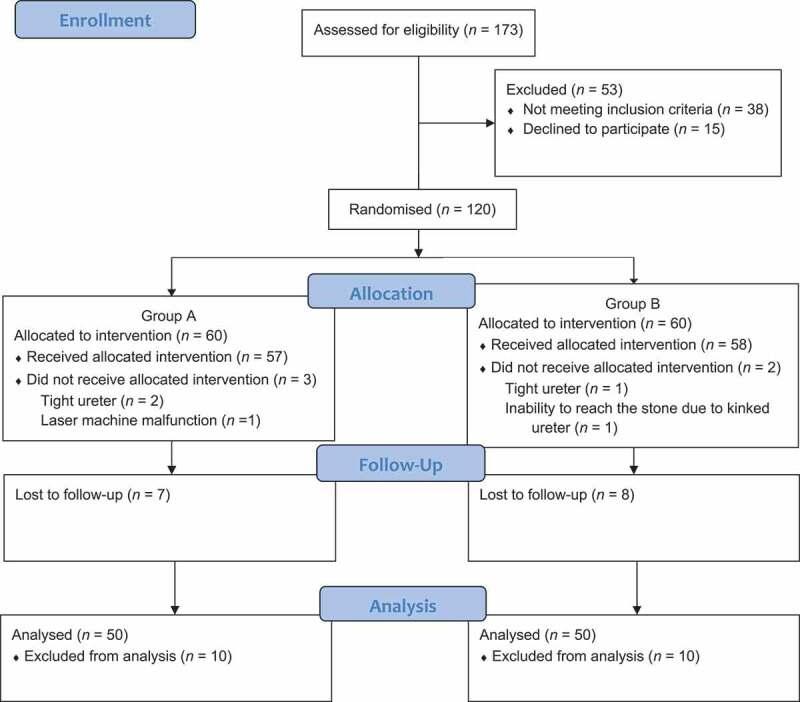
: To study a modification to the conventional retrograde ureteroscopic approach for treating proximal ureteric stones of 1-2 cm; we intentionally push the stone from the proximal ureter into a favourable calyx then the flexible ureteroscope is used to fragment the trapped stone using laser lithotripsy ('boxing in the corner'). : The study was conducted in a randomised prospective manner and included 100 patients who presented with a single proximal ureteric stone of 1-2 cm. We randomised the patients into two equal groups: Group A (50 patients) underwent the conventional retrograde technique (CRT) and Group B (50 patients) underwent the modified retrograde technique (MRT) with the primary intention of relocating the stone into a favourable calyx. Intended relocation of the proximal ureteric stone in the MRT group was achieved in a stepwise manner. All intraoperative parameters and postoperative outcomes were recorded and compared between the two groups. : There was no statistical significant difference in terms of the patients' demographics and stone criteria between the two groups. The stone-free rate (SFR) was significantly higher in Group B (92%) compared to Group A (78%) ( = 0.049). Fluoroscopy time was significantly longer in Group B ( < 0.001), while operative time, lithotripsy time and hospital stay were comparable. There was no difference between the groups regarding complications. : The MRT was found to be safe and more effective than the CRT for treating proximal ureteric stones of 1-2 cm, with a significantly higher SFR. CONSORT: Consolidated Standards of Reporting Trials; ESWL: extracorporeal shockwave lithotripsy; fURS: flexible ureteroscope; NCCT: non-contrast CT; SFR: stone-free rate; YAG: yttrium-aluminium-garnet.
为研究对传统逆行输尿管镜治疗方法的一种改良,用于治疗1 - 2厘米的近端输尿管结石;我们有意将结石从近端输尿管推至有利的肾盏,然后使用软性输尿管镜通过激光碎石术将被困结石击碎(“角落里围堵”)。该研究采用随机前瞻性方式进行,纳入了100例患有单个1 - 2厘米近端输尿管结石的患者。我们将患者随机分为两组:A组(50例患者)采用传统逆行技术(CRT),B组(50例患者)采用改良逆行技术(MRT),主要目的是将结石重新定位到有利的肾盏。MRT组近端输尿管结石的预期重新定位是逐步实现的。记录并比较两组的所有术中参数和术后结果。两组患者的人口统计学和结石标准在统计学上无显著差异。B组的无石率(SFR)显著高于A组(92%对78%)(P = 0.049)。B组的透视时间显著更长(P < 0.001),而手术时间、碎石时间和住院时间相当。两组在并发症方面无差异。发现MRT在治疗1 - 2厘米的近端输尿管结石方面比CRT更安全、更有效,无石率显著更高。CONSORT:试验报告统一标准;ESWL:体外冲击波碎石术;fURS:软性输尿管镜;NCCT:非增强CT;SFR:无石率;YAG:钇铝石榴石
 Zotero 插件