
印度艰难梭菌感染负担的系统文献综述
Systematic Literature Review on Burden of difficile Infection in India.
作者信息
Ghia Canna J, Waghela Shaumil, Rambhad Gautam S
机构信息
Medical and Scientific Affairs, Pfizer Limited, Mumbai, India.
出版信息
Clin Pathol. 2021 May 31;14:2632010X211013816. doi: 10.1177/2632010X211013816. eCollection 2021 Jan-Dec.
BACKGROUND
Owing to limited diagnostic facilities and surveillance protocols, there is a paucity on the prevalence data of infections (CDIs) in developing countries such as India.
OBJECTIVE
The aims of these studies are (1) to determine the prevalence of CDI in India, (2) to understand the risk factors of CDI, and (3) to determine the impact of different diagnostic methods on reported CDI rates.
METHOD
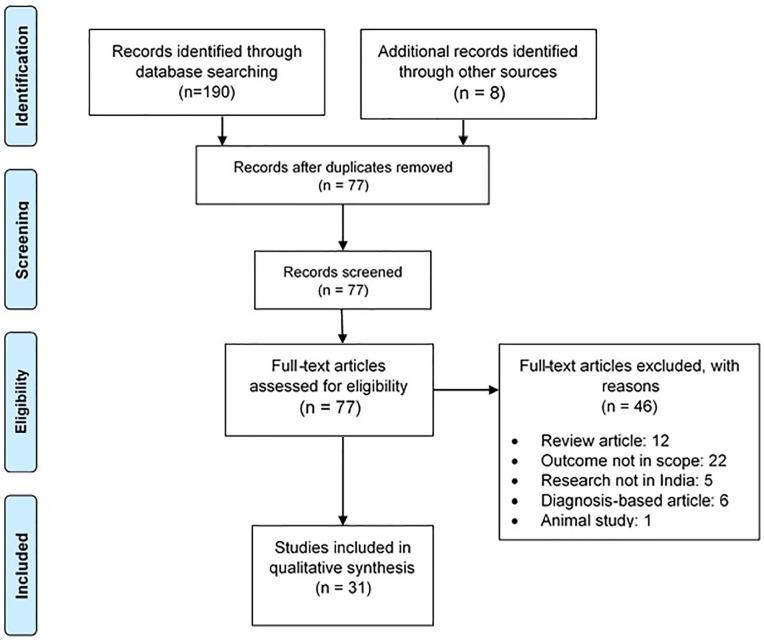
A systematic literature search was conducted using PubMed and Google Scholar database to identify Indian studies reporting the prevalence of CDI. A total of 31 studies, published between 1990 and 2020 were included in the final analysis. A chi-square test was used to determine statistically significant association between prevalence rates, accuracy of different diagnosis methods, and antibiotic usage rates of CDI.
RESULTS
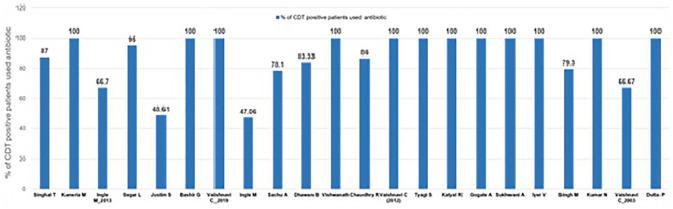
The prevalence of CDI was in the range of 3.4% to 18%, and the difference between regional prevalence of CDI was statistically significant ( < .001). The use of antibiotics, hospital stay, comorbidities, recent surgery, and the use of proton-pump inhibitors was considered as risk factors for the development of CDI. Compared to other regions, the rate of antibiotic usage was significantly higher in North India ( < .001). Among different diagnostic methods, detection was significantly higher with enzyme-linked immunosorbent assay (18.02%) versus other multiple testing methods used ( < .001).
CONCLUSION
There is a significant burden of CDI across the country. Further surveillance studies are required to monitor changes in prevalence of CDI, risk factors, and accuracy of diagnosis methods for a better understanding of the disease burden in India.
背景
由于诊断设施和监测方案有限,在印度等发展中国家,艰难梭菌感染(CDIs)的流行率数据匮乏。
目的
这些研究的目的是(1)确定印度CDI的流行率,(2)了解CDI的危险因素,以及(3)确定不同诊断方法对报告的CDI率的影响。
方法
使用PubMed和谷歌学术数据库进行系统的文献检索,以识别报告CDI流行率的印度研究。最终分析纳入了1990年至2020年期间发表的31项研究。采用卡方检验来确定流行率、不同诊断方法的准确性和CDI抗生素使用率之间的统计学显著关联。
结果
CDI的流行率在3.4%至18%之间,CDI区域流行率之间的差异具有统计学意义(P<0.001)。抗生素的使用、住院时间、合并症、近期手术以及质子泵抑制剂的使用被认为是发生CDI的危险因素。与其他地区相比,印度北部的抗生素使用率显著更高(P<0.001)。在不同的诊断方法中,酶联免疫吸附测定法的检测率显著更高(18.02%)vs使用的其他多种检测方法(P<0.001)。
结论
全国范围内CDI负担沉重。需要进一步的监测研究来监测CDI流行率、危险因素和诊断方法准确性的变化,以便更好地了解印度的疾病负担。
 Zotero 插件