
全球对流层臭氧对与 COVID-19 全球封锁相关的减少氮氧化物排放的响应。
Global tropospheric ozone responses to reduced NO emissions linked to the COVID-19 worldwide lockdowns.
机构信息
Jet Propulsion Laboratory, California Institute of Technology, Pasadena, CA, USA.
Joint Institute for Regional Earth System Science and Engineering, University of California, Los Angeles, 4242 Young Hall, 607 Charles E. Young Drive East, Los Angeles, CA 90095-7228, USA.
出版信息
Sci Adv. 2021 Jun 9;7(24). doi: 10.1126/sciadv.abf7460. Print 2021 Jun.
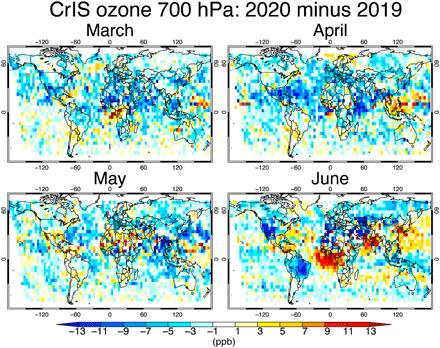
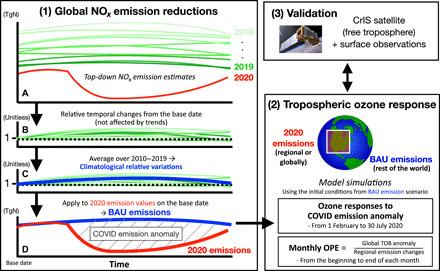
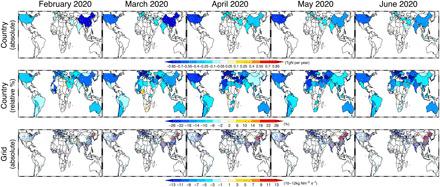
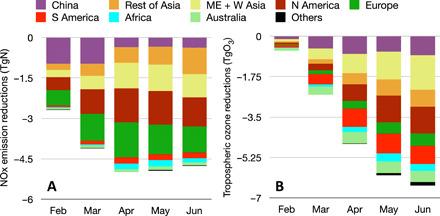
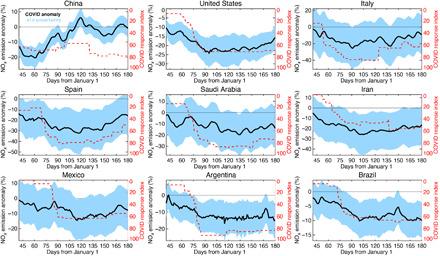
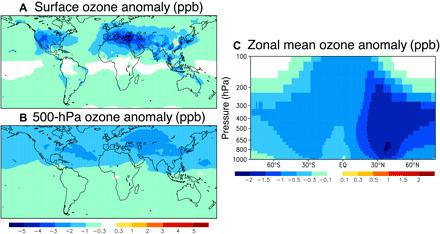
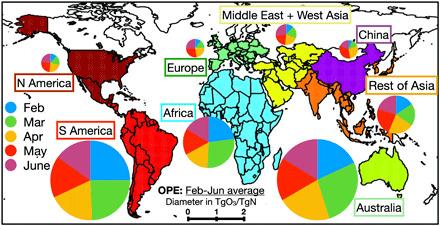
Efforts to stem the transmission of coronavirus disease 2019 (COVID-19) led to rapid, global ancillary reductions in air pollutant emissions. Here, we quantify the impact on tropospheric ozone using a multiconstituent chemical data assimilation system. Anthropogenic NO emissions dropped by at least 15% globally and 18 to 25% regionally in April and May 2020, which decreased free tropospheric ozone by up to 5 parts per billion, consistent with independent satellite observations. The global total tropospheric ozone burden declined by 6TgO (∼2%) in May and June 2020, largely due to emission reductions in Asia and the Americas that were amplified by regionally high ozone production efficiencies (up to 4 TgO/TgN). Our results show that COVID-19 mitigation left a global atmospheric imprint that altered atmospheric oxidative capacity and climate radiative forcing, providing a test of the efficacy of NO emissions controls for co-benefiting air quality and climate.
为了阻止 2019 年冠状病毒病(COVID-19)的传播,全球迅速采取措施,减少了空气污染物的排放。在这里,我们使用多成分化学数据同化系统来量化对流层臭氧的影响。2020 年 4 月和 5 月,全球人为 NOx 排放量至少下降了 15%,区域内下降了 18%至 25%,这使得自由对流层臭氧减少了多达 5 个十亿分之一,与独立卫星观测结果一致。2020 年 5 月和 6 月,全球对流层臭氧总负荷下降了 6TgO(约 2%),这主要是由于亚洲和美洲的排放量减少,加上区域内高臭氧生成效率(高达 4TgO/TgN)的放大效应。我们的结果表明,COVID-19 缓解措施在全球范围内留下了大气印记,改变了大气氧化能力和气候辐射强迫,为 NOx 排放控制对空气质量和气候的共同效益提供了检验。

 Zotero 插件