Suppr超能文献

在年轻健康成年人中应用噪声性前庭电刺激时,站立平衡的随机共振效应没有证据。

No evidence for stochastic resonance effects on standing balance when applying noisy galvanic vestibular stimulation in young healthy adults.

机构信息

Human Performance Research Centre, University of Konstanz, Konstanz, Germany.

German Center for Vertigo and Balance Disorders (DSGZ), Ludwig-Maximilians-University, Munich, Germany.

出版信息

Sci Rep. 2021 Jun 10;11(1):12327. doi: 10.1038/s41598-021-91808-w.

Abstract

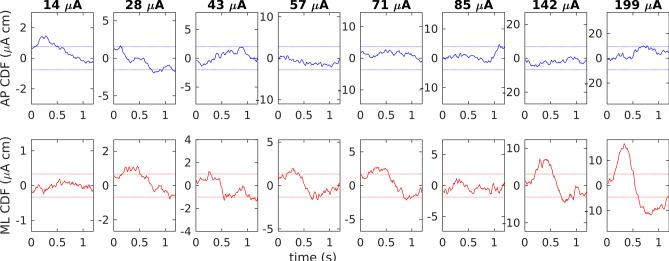
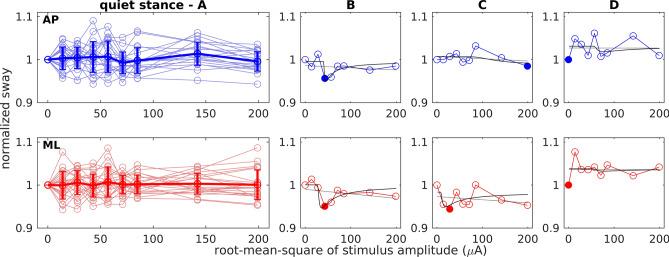
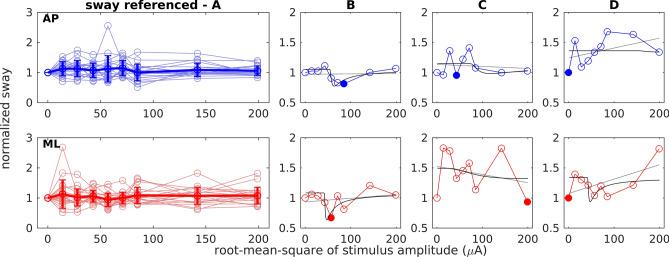
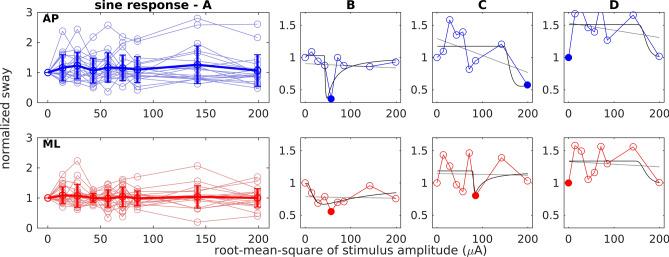
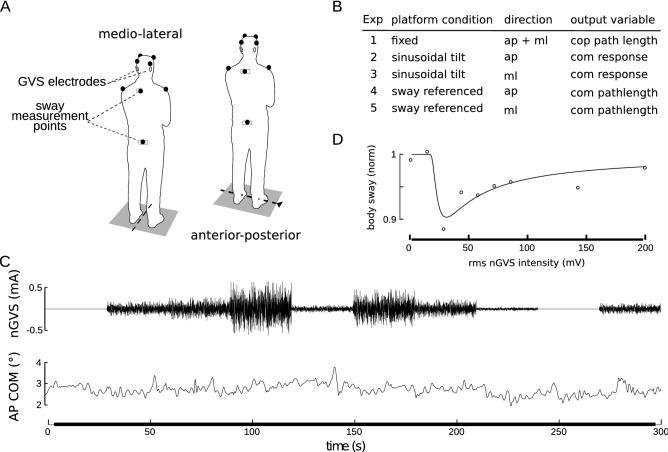
Noisy galvanic vestibular stimulation (nGVS) at imperceptible levels has been shown to reduce body sway. This reduction was commonly attributed to the mechanism of stochastic resonance (SR). However, it has never been explicitly tested whether nGVS-induced effects on body sway consistently follow a SR-like bell-shaped performance curve with maximal reductions in a particular range of noise intensities. To test this, body sway in 21 young healthy participants was measured during varying nGVS amplitudes while standing with eyes closed in 3 conditions (quiet stance, sway referencing, sinusoidal platform tilts). Presence of SR-like response dynamics in each trial was assessed (1) by a goodness-of-fit analysis using an established SR-curve model and (2) by ratings from 3 human experts. In accordance to theory, we found reductions of body sway at one nGVS amplitude in most trials (75-95%). However, only few trials exhibited SR-like bell-shaped performance curves with increasing noise amplitudes (10-33%). Instead, body sway measures rather fluctuated randomly across nGVS amplitudes. This implies that, at least in young healthy adults, nGVS effects on body sway are incompatible with SR. Thus, previously reported reductions of body sway at particular nGVS intensities more likely result from inherent variations of the performance metric or by other yet unknown mechanisms.

摘要

在不可察觉的水平上产生的嘈杂电前庭刺激 (nGVS) 已被证明可以减少身体摆动。这种减少通常归因于随机共振 (SR) 的机制。然而,从未明确测试过 nGVS 对身体摆动的影响是否始终遵循类似 SR 的钟形性能曲线,即在特定噪声强度范围内最大减少。为了测试这一点,在闭眼站立的 3 种条件下(安静站立、摆动参考、正弦平台倾斜),通过测量 21 名年轻健康参与者在不同 nGVS 幅度下的身体摆动,评估了 nGVS 诱导的身体摆动的变化。在每个试验中都评估了类似 SR 的响应动力学的存在(1)通过使用已建立的 SR 曲线模型进行拟合优度分析,以及(2)通过 3 位人类专家的评分。根据理论,我们发现大多数试验(75-95%)在一个 nGVS 幅度下减少了身体摆动。然而,只有少数试验表现出随着噪声幅度增加的类似 SR 的钟形性能曲线(10-33%)。相反,身体摆动测量值在 nGVS 幅度上随机波动。这意味着,至少在年轻健康成年人中,nGVS 对身体摆动的影响与 SR 不兼容。因此,以前报道的在特定 nGVS 强度下减少身体摆动更可能是由于性能指标的固有变化或其他未知机制所致。
https://cdn.ncbi.nlm.nih.gov/pmc/blobs/d3a3/8192540/d6b84afcfe67/41598_2021_91808_Fig1_HTML.jpg

相似文献

4
Low-intensity vestibular noise stimulation improves postural symptoms in progressive supranuclear palsy.
J Neurol. 2024 Jul;271(7):4577-4586. doi: 10.1007/s00415-024-12419-9. Epub 2024 May 9.
5
The after-effect of noisy galvanic vestibular stimulation on postural control in young people: A randomized controlled trial.
Neurosci Lett. 2020 Jun 11;729:135009. doi: 10.1016/j.neulet.2020.135009. Epub 2020 Apr 25.
6
Noisy galvanic vestibular stimulation influences head stability in young healthy adults while standing on a moving platform.
Gait Posture. 2024 Jan;107:177-181. doi: 10.1016/j.gaitpost.2023.09.014. Epub 2023 Oct 6.
7
Noisy galvanic vestibular stimulation effect on center of pressure sway during one-legged standing.
J Clin Neurosci. 2020 Dec;82(Pt A):173-178. doi: 10.1016/j.jocn.2020.10.050. Epub 2020 Nov 12.
8
Effect of noisy galvanic vestibular stimulation on center of pressure sway of static standing posture.
Brain Stimul. 2018 Jan-Feb;11(1):85-93. doi: 10.1016/j.brs.2017.10.007. Epub 2017 Oct 17.
9
No evidence for after-effects of noisy galvanic vestibular stimulation on motion perception.
Sci Rep. 2020 Feb 13;10(1):2545. doi: 10.1038/s41598-020-59374-9.
10
Effects of noisy galvanic vestibular stimulation on functional reach test.
Neurosci Lett. 2023 Jul 27;810:137336. doi: 10.1016/j.neulet.2023.137336. Epub 2023 Jun 12.

引用本文的文献

2
A review of parameter settings for galvanic vestibular stimulation in clinical applications.
Front Hum Neurosci. 2025 Feb 3;19:1518727. doi: 10.3389/fnhum.2025.1518727. eCollection 2025.
5
Low-intensity vestibular noise stimulation improves postural symptoms in progressive supranuclear palsy.
J Neurol. 2024 Jul;271(7):4577-4586. doi: 10.1007/s00415-024-12419-9. Epub 2024 May 9.
8
Electrical stimulation of the peripheral and central vestibular system.
Curr Opin Neurol. 2024 Feb 1;37(1):40-51. doi: 10.1097/WCO.0000000000001228. Epub 2023 Oct 25.
10
Scoping out noisy galvanic vestibular stimulation: a review of the parameters used to improve postural control.
Front Neurosci. 2023 May 2;17:1156796. doi: 10.3389/fnins.2023.1156796. eCollection 2023.

本文引用的文献

1
Noisy galvanic vestibular stimulation effect on center of pressure sway during one-legged standing.
J Clin Neurosci. 2020 Dec;82(Pt A):173-178. doi: 10.1016/j.jocn.2020.10.050. Epub 2020 Nov 12.
2
Reliability of Vestibular Perceptual Threshold Testing About the Yaw Axis.
Ear Hear. 2020 Nov/Dec;41(6):1772-1774. doi: 10.1097/AUD.0000000000000859.
3
The after-effect of noisy galvanic vestibular stimulation on postural control in young people: A randomized controlled trial.
Neurosci Lett. 2020 Jun 11;729:135009. doi: 10.1016/j.neulet.2020.135009. Epub 2020 Apr 25.
4
Impact of galvanic vestibular stimulation-induced stochastic resonance on the output of the vestibular system: A systematic review.
Brain Stimul. 2020 May-Jun;13(3):533-535. doi: 10.1016/j.brs.2020.01.006. Epub 2020 Jan 10.
5
Subthreshold stochastic vestibular stimulation affects balance-challenged standing and walking.
PLoS One. 2020 Apr 10;15(4):e0231334. doi: 10.1371/journal.pone.0231334. eCollection 2020.
6
No evidence for after-effects of noisy galvanic vestibular stimulation on motion perception.
Sci Rep. 2020 Feb 13;10(1):2545. doi: 10.1038/s41598-020-59374-9.
7
8
Reductions in body sway responses to a rhythmic support surface tilt perturbation can be caused by other mechanisms than prediction.
Exp Brain Res. 2020 Feb;238(2):465-476. doi: 10.1007/s00221-020-05723-z. Epub 2020 Jan 18.
10
Questioning the lasting effect of galvanic vestibular stimulation on postural control.
PLoS One. 2019 Nov 7;14(11):e0224619. doi: 10.1371/journal.pone.0224619. eCollection 2019.

文献AI研究员

20分钟写一篇综述,助力文献阅读效率提升50倍。

立即体验

用中文搜PubMed

大模型驱动的PubMed中文搜索引擎

马上搜索

文档翻译

学术文献翻译模型,支持多种主流文档格式。

立即体验