
中国上海某三级医院2010 - 2015年血流感染病原菌的分子特征
Molecular Characteristics of Causing Bloodstream Infections During 2010-2015 in a Tertiary Hospital, Shanghai, China.
作者信息
Li Dan, Li Pei, Yu Xiaoyan, Zhang Xuefei, Guo Qinglan, Xu Xiaogang, Wang Minggui, Wang Minghua
机构信息
Institute of Antibiotics, Huashan Hospital, Fudan University, Shanghai, People's Republic of China.
Key Laboratory of Clinical Pharmacology of Antibiotics, Ministry of Health, Shanghai, People's Republic of China.
出版信息
Infect Drug Resist. 2021 Jun 3;14:2079-2086. doi: 10.2147/IDR.S305281. eCollection 2021.
BACKGROUND
The bloodstream infections (BSI) caused by pose a serious threat to human health. To explore molecular characteristics of causing BSI, we collected isolates causing BSI in Huashan Hospital, Shanghai, China during 2010-2015.
METHODS
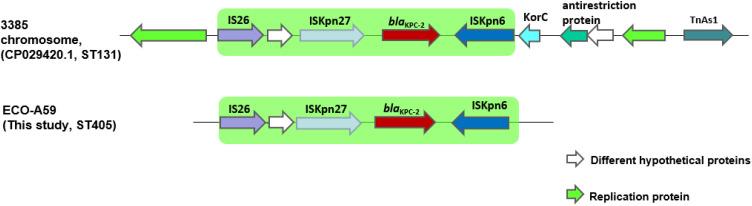
In all isolates causing BSI collected from this study, polymerase chain reaction (PCR) was used to detect ESBLs and carbapenemase genes, and minimum inhibitory concentrations (MICs) were determined with agar dilution method. Outer membrane proteins were examined by SDS-PAGE in carbapenem-resistant strains. The genetic background of gene was investigated by combining next-generation sequencing with a PCR mapping approach. Conjugation and transformation experiments were performed to verify the mobilization of . The transcription levels of the gene were measured by RT-PCR.
RESULTS
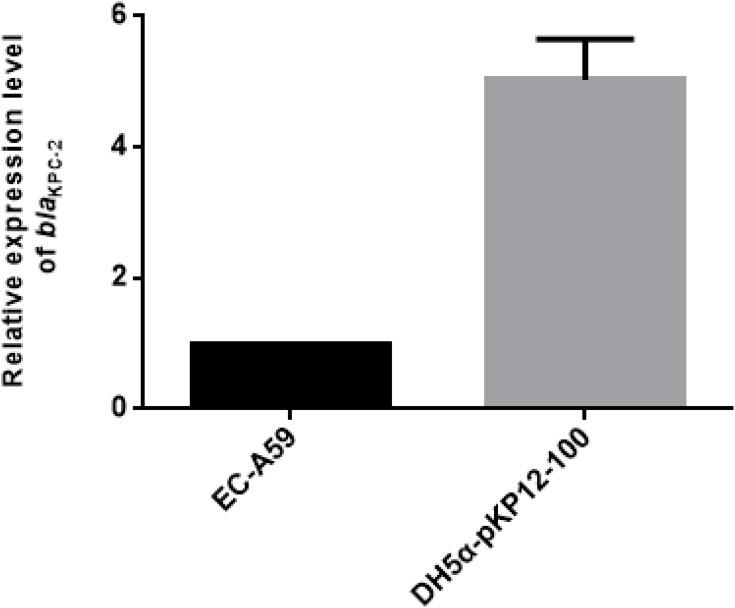
During 2010-2015, a total of 207 BSI strains were isolated. The positive rates of β-lactamase resistant genes were 0.48% ( ), 57% ( ), 23.67% ( ), 18.84% ( ), and 1.93% ( ). High rates of , and were consistent with the poor activity of third-generation cephalosporins and aztreonam in vitro, except for carbapenem and β-lactamase inhibitor combinations. Low susceptibility rates were observed for piperacillin (25.1%) in contrast to the increased susceptibility when combined with β-lactamase inhibitors, namely piperacillin-tazobactam (90.8%). Only one KPC-producing strain was detected. Despite the combination of OmpC loss, the low expression level of KPC may be responsible for its lower resistance to carbapenems compared to DH5α (pKP12-100).
CONCLUSION
strains isolated from BSI were still highly susceptible to carbapenems and β-lactamase inhibitor combinations, and was the dominant genotype of ESBLs. The low expression of may be the reason for the low resistance to carbapenems.
背景
由[病原体名称未给出]引起的血流感染(BSI)对人类健康构成严重威胁。为探究引起BSI的[病原体名称未给出]的分子特征,我们收集了2010 - 2015年期间在中国上海华山医院分离出的引起BSI的[病原体名称未给出]菌株。
方法
在本研究收集的所有引起BSI的[病原体名称未给出]菌株中,采用聚合酶链反应(PCR)检测超广谱β-内酰胺酶(ESBLs)和碳青霉烯酶基因,并用琼脂稀释法测定最低抑菌浓度(MICs)。对耐碳青霉烯类菌株通过十二烷基硫酸钠-聚丙烯酰胺凝胶电泳(SDS-PAGE)检测外膜蛋白。结合下一代测序与PCR定位方法研究[基因名称未给出]基因的遗传背景。进行接合和转化实验以验证[质粒名称未给出]的可移动性。通过逆转录PCR(RT-PCR)测量[基因名称未给出]基因的转录水平。
结果
2010 - 2015年期间,共分离出207株[病原体名称未给出]BSI菌株。β-内酰胺酶耐药基因的阳性率分别为0.48%([基因名称未给出1])、57%([基因名称未给出2])、23.67%([基因名称未给出3])、18.84%([基因名称未给出4])和1.93%([基因名称未给出5])。除碳青霉烯类和β-内酰胺酶抑制剂联合用药外,[基因名称未给出2]、[基因名称未给出3]和[基因名称未给出4]的高发生率与第三代头孢菌素和氨曲南在体外的低活性一致。与哌拉西林-他唑巴坦(90.8%)联合使用时敏感性增加形成对比,哌拉西林的低敏感率为25.1%。仅检测到一株产KPC的[病原体名称未给出]菌株。尽管存在外膜蛋白C(OmpC)缺失的情况,但与DH5α(pKP12 - 100)相比,KPC的低表达水平可能是其对碳青霉烯类耐药性较低的原因。
结论
从BSI分离出的[病原体名称未给出]菌株对碳青霉烯类和β-内酰胺酶抑制剂联合用药仍高度敏感,且[基因名称未给出2]是ESBLs的主要基因型。[基因名称未给出]的低表达可能是对碳青霉烯类耐药性低的原因。


 Zotero 插件