
miR-140-5p通过直接靶向胰岛素抵抗的HepG2细胞中的GYS1和PPP1CC加重胰岛素抵抗。
miR-140-5p Aggravates Insulin Resistance via Directly Targeting GYS1 and PPP1CC in Insulin-Resistant HepG2 Cells.
作者信息
Li Xuemei, Ye Yan, Wang Baoli, Zhao Shujun
机构信息
NHC Key Laboratory of Hormones and Development, Tianjin Key Laboratory of Metabolic Diseases, Chu Hsien-I Memorial Hospital & Tianjin Institute of Endocrinology, Tianjin Medical University, Tianjin, 300134, People's Republic of China.
出版信息
Diabetes Metab Syndr Obes. 2021 Jun 4;14:2515-2524. doi: 10.2147/DMSO.S304055. eCollection 2021.
BACKGROUND
Much attention has been paid to the regulatory role of microRNA (miRNA) in insulin resistance. Nevertheless, how miR-140-5p regulates insulin resistance remains unclear. In this research, we aim to investigate the roles of miR-140-5p in insulin resistance.
METHODS
qRT-PCR is used to analyze the expression level of miR-140-5p in insulin-resistant HepG2 cells. Glucose consumption and glucose uptake are detected to study the effect of miR-140-5p knockdown in insulin-resistant HepG2 cells and miR-140-5p overexpression in HepG2 cells. Bioinformatic analysis, luciferase reporter assay and confirmatory experiments are applied to identify the target gene bound with miR-140-5p and study the effect of miR-140-5p on the downstream substrates of target genes. Rescue experiments have verified the roles of miR-140-5p and target gene in glucose metabolism.
RESULTS
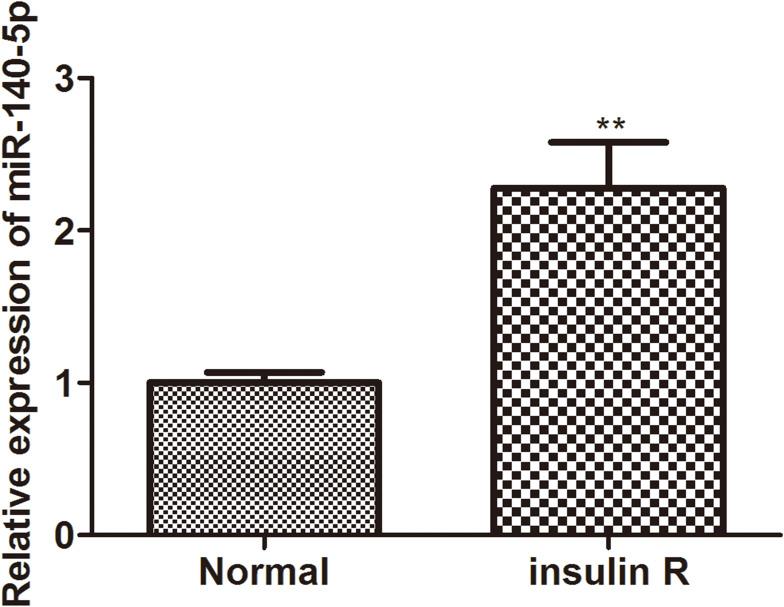
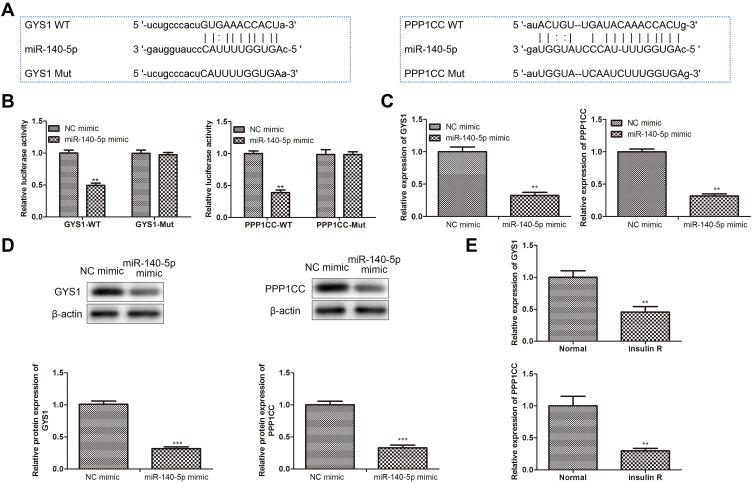
The expression level of miR-140-5p was upregulated in insulin-resistant HepG2 cells and was significantly correlated with cellular glucose metabolism. Functionally, miR-140-5p overexpression induced impairment of glucose consumption and glucose uptake. Besides, bioinformatics analysis indicated that glycogen synthetase (GYS1) and protein phosphatase 1 catalytic subunit gamma (PPP1CC) were the target genes of miR-140-5p. Western blotting and qRT-PCR results revealed a negative correlation between GYS1, PPP1CC and miR-140-5p. The glycogen detection results showed that miR140-5p inhibited the production of the downstream substrates of the target gene. Rescue experiments showed that inhibition of GYS1 or PPP1CC partially enhanced the insulin-resistant effects of miR-140-5p knockdown in insulin-resistant HepG2 cells.
CONCLUSION
miR-140-5p overexpression augments the development of insulin resistance and miR-140-5p may be served as a therapeutic target of metabolic diseases.
背景
微小RNA(miRNA)在胰岛素抵抗中的调节作用已受到广泛关注。然而,miR-140-5p如何调节胰岛素抵抗仍不清楚。在本研究中,我们旨在探讨miR-140-5p在胰岛素抵抗中的作用。
方法
采用qRT-PCR分析胰岛素抵抗的HepG2细胞中miR-140-5p的表达水平。检测葡萄糖消耗和葡萄糖摄取,以研究miR-140-5p敲低对胰岛素抵抗的HepG2细胞的影响以及miR-140-5p过表达对HepG2细胞的影响。应用生物信息学分析、荧光素酶报告基因检测和验证实验来鉴定与miR-140-5p结合的靶基因,并研究miR-140-5p对靶基因下游底物的影响。拯救实验验证了miR-140-5p和靶基因在葡萄糖代谢中的作用。
结果
胰岛素抵抗的HepG2细胞中miR-140-5p的表达水平上调,且与细胞葡萄糖代谢显著相关。在功能上,miR-140-5p过表达导致葡萄糖消耗和葡萄糖摄取受损。此外,生物信息学分析表明糖原合成酶(GYS1)和蛋白磷酸酶1催化亚基γ(PPP1CC)是miR-140-5p的靶基因。蛋白质印迹和qRT-PCR结果显示GYS1、PPP1CC与miR-140-5p呈负相关。糖原检测结果表明miR140-5p抑制了靶基因下游底物的产生。拯救实验表明,抑制GYS1或PPP1CC可部分增强miR-140-5p敲低对胰岛素抵抗的HepG2细胞的胰岛素抵抗作用。
结论
miR-140-5p过表达加剧胰岛素抵抗的发展,miR-140-5p可能作为代谢性疾病的治疗靶点。



 Zotero 插件