
沙特卫生部在 COVID-19 大流行期间的 Twitter 传播策略和公众参与:内容分析研究。
The Saudi Ministry of Health's Twitter Communication Strategies and Public Engagement During the COVID-19 Pandemic: Content Analysis Study.
机构信息
Department of Health Informatics, College of Public Health and Health Informatics, King Saud bin Abdulaziz University for Health Sciences, Riyadh, Saudi Arabia.
King Abdullah International Medical Research Center, Riyadh, Saudi Arabia.
出版信息
JMIR Public Health Surveill. 2021 Jul 12;7(7):e27942. doi: 10.2196/27942.
BACKGROUND
During a public health crisis such as the current COVID-19 pandemic, governments and health authorities need quick and accurate methods of communicating with the public. While social media can serve as a useful tool for effective communication during disease outbreaks, few studies have elucidated how these platforms are used by the Ministry of Health (MOH) during disease outbreaks in Saudi Arabia.
OBJECTIVE
Guided by the Crisis and Emergency Risk Communication model, this study aimed to explore the MOH's use of Twitter and the public's engagement during different stages of the COVID-19 pandemic in Saudi Arabia.
METHODS
Tweets and corresponding likes and retweets were extracted from the official Twitter account of the MOH in Saudi Arabia for the period of January 1 through August 31, 2020. Tweets related to COVID-19 were identified; subsequently, content analysis was performed, in which tweets were coded for the following message types: risk messages, warnings, preparations, uncertainty reduction, efficacy, reassurance, and digital health responses. Public engagement was measured by examining the numbers of likes and retweets. The association between outbreak stages and types of messages was assessed, as well as the effect of these messages on public engagement.
RESULTS
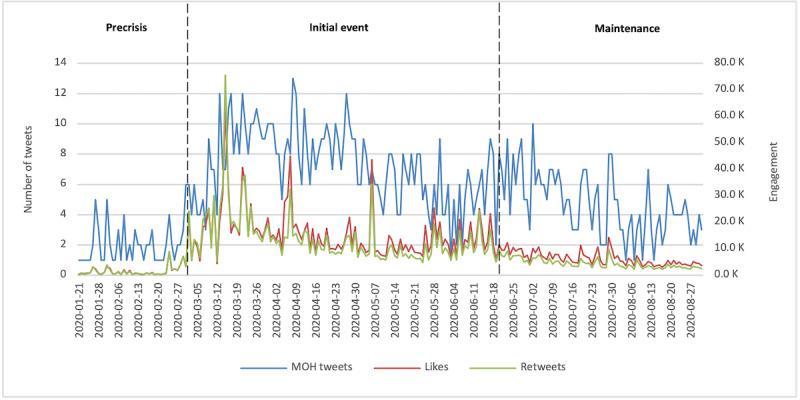
The MOH posted a total of 1393 original tweets during the study period. Of the total tweets, 1293 (92.82%) were related to COVID-19, and 1217 were ultimately included in the analysis. The MOH posted the majority of its tweets (65.89%) during the initial stage of the outbreak. Accordingly, the public showed the highest level of engagement (as indicated by numbers of likes and retweets) during the initial stage. The types of messages sent by the MOH significantly differed across outbreak stages, with messages related to uncertainty reduction, reassurance, and efficacy being prevalent among all stages. Tweet content, media type, and crisis stage influenced the level of public engagement. Engagement was negatively associated with the inclusion of hyperlinks and multimedia files, while higher level of public engagement was associated with the use of hashtags. Tweets related to warnings, uncertainty reduction, and reassurance received high levels of public engagement.
CONCLUSIONS
This study provides insights into the Saudi MOH's communication strategy during the COVID-19 pandemic. Our results have implications for researchers, governments, health organizations, and practitioners with regard to their communication practices during outbreaks. To increase public engagement, governments and health authorities should consider the public's need for information. This, in turn, could raise public awareness regarding disease outbreaks.
背景
在当前 COVID-19 大流行等公共卫生危机期间,政府和卫生当局需要快速准确地与公众沟通。虽然社交媒体可以作为疾病爆发期间有效沟通的有用工具,但很少有研究阐明沙特阿拉伯卫生部(MOH)在疾病爆发期间如何使用这些平台。
目的
本研究以危机和应急风险沟通模型为指导,旨在探讨 MOH 在沙特阿拉伯 COVID-19 疫情的不同阶段使用 Twitter 以及公众参与的情况。
方法
从 2020 年 1 月 1 日至 8 月 31 日,提取沙特阿拉伯 MOH 官方 Twitter 账户上的推文及其对应点赞和转发。识别与 COVID-19 相关的推文;随后,进行内容分析,对推文进行风险信息、警告、准备、减少不确定性、效果、安慰和数字健康反应等信息类型的编码。通过检查点赞和转发数量来衡量公众参与度。评估暴发阶段与信息类型之间的关系,以及这些信息对公众参与度的影响。
结果
在研究期间,MOH 总共发布了 1393 条原创推文。在总共的推文中,有 1293 条(92.82%)与 COVID-19 相关,最终有 1217 条被纳入分析。MOH 在疫情爆发的初始阶段发布了其大部分推文(65.89%)。因此,公众在初始阶段表现出最高水平的参与度(点赞和转发数量)。MOH 发布的信息类型在疫情爆发的不同阶段显著不同,与减少不确定性、安慰和效果相关的信息在所有阶段都很普遍。推文内容、媒体类型和危机阶段影响公众参与度。参与度与包含超链接和多媒体文件呈负相关,而较高的公众参与度与使用主题标签相关。与警告、减少不确定性和安慰相关的推文获得了较高水平的公众参与度。
结论
本研究提供了沙特 MOH 在 COVID-19 大流行期间沟通策略的见解。我们的研究结果为研究人员、政府、卫生组织和从业人员在疫情爆发期间的沟通实践提供了启示。为了提高公众参与度,政府和卫生当局应考虑公众对信息的需求。这反过来又可以提高公众对疾病爆发的认识。

 Zotero 插件