
[1.1.1]螺桨烷的应变释放2-氮杂烯丙基阴离子加成/硼化反应:苄胺双环[1.1.1]戊基硼酸酯的合成与官能团化
Strain-release 2-azaallyl anion addition/borylation of [1.1.1]propellane: synthesis and functionalization of benzylamine bicyclo[1.1.1]pentyl boronates.
作者信息
Shelp Russell A, Ciro Anthony, Pu Youge, Merchant Rohan R, Hughes Jonathan M E, Walsh Patrick J
机构信息
Roy and Diana Vagelos Laboratories, Department of Chemistry, University of Pennsylvania 231 South 34th Street Philadelphia PA USA
Department of Discovery Chemistry, Merck & Co., Inc. South San Francisco California 94080 USA.
出版信息
Chem Sci. 2021 Apr 14;12(20):7066-7072. doi: 10.1039/d1sc01349a.
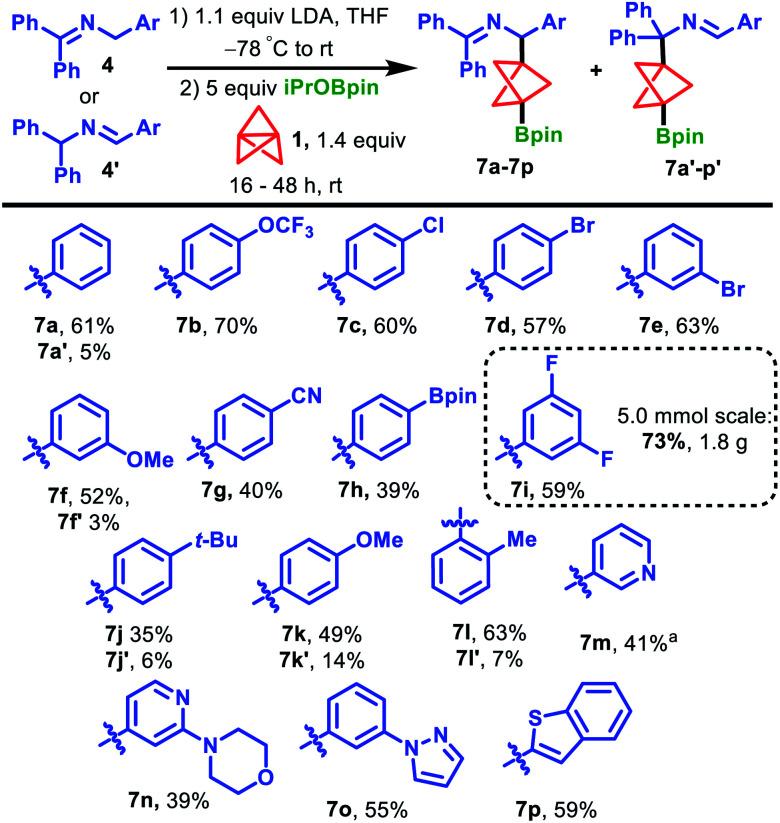
We report a 3-component reaction between -benzyl ketimines, [1.1.1]propellane, and pinacol boronates to generate benzylamine bicyclo[1.1.1]pentane (BCP) pinacol boronates. These structures are analogous to highly sought diarylmethanamine cores, which are common motifs in bioactive molecules. We demonstrate the versatility of the boronate ester handle downstream functionalization through a variety of reactions, including a challenging Pd-catalyzed (hetero)arylation that exhibits a broad substrate scope. Together, these methods enable the synthesis of high-value BCP benzylamines which are inaccessible by existing methods. Furthermore, we demonstrate the successful application of these newly developed (hetero)arylation conditions to a variety of challenging tertiary pinacol boronates, including nitrogen-containing heterocycles, 1,1-disubstituted cyclopropanes, and other BCP cores.
我们报道了一种苄基酮亚胺、[1.1.1]丙搭烯与频哪醇硼酸酯之间的三组分反应,以生成苄胺双环[1.1.1]戊烷(BCP)频哪醇硼酸酯。这些结构类似于备受关注的二芳基甲胺核心结构,它们是生物活性分子中的常见基序。我们通过各种反应展示了硼酸酯基团在下游官能化方面的多功能性,包括具有广泛底物范围的具有挑战性的钯催化(杂)芳基化反应。总之,这些方法能够合成现有方法无法获得的高价值BCP苄胺。此外,我们证明了这些新开发的(杂)芳基化条件在各种具有挑战性的叔频哪醇硼酸酯上的成功应用,包括含氮杂环、1,1 - 二取代环丙烷和其他BCP核心结构。




 Zotero 插件