
在 COVID-19 大流行期间,COPD 入院人数下降与社区呼吸道病毒感染负担降低有关。
Population Decline in COPD Admissions During the COVID-19 Pandemic Associated with Lower Burden of Community Respiratory Viral Infections.
机构信息
Division of Pulmonary and Critical Care, University of Maryland School of Medicine, Baltimore.
Department of Orthopaedics, University of Maryland School of Medicine, Baltimore.
出版信息
Am J Med. 2021 Oct;134(10):1252-1259.e3. doi: 10.1016/j.amjmed.2021.05.008. Epub 2021 Jun 12.
BACKGROUND
The Coronavirus disease 2019 (COVID-19) pandemic has led to widespread implementation of public health measures, such as stay-at-home orders, social distancing, and masking mandates. In addition to decreasing spread of severe acute respiratory syndrome coronavirus 2, these measures also impact the transmission of seasonal viral pathogens, which are common triggers of chronic obstructive pulmonary disease (COPD) exacerbations. Whether reduced viral prevalence mediates reduction in COPD exacerbation rates is unknown.
METHODS
We performed retrospective analysis of data from a large, multicenter health care system to assess admission trends associated with community viral prevalence and with initiation of COVID-19 pandemic control measures. We applied difference-in-differences analysis to compare season-matched weekly frequency of hospital admissions for COPD prior to and after implementation of public health measures for COVID-19. Community viral prevalence was estimated using regional Centers for Disease Control and Prevention test positivity data and correlated to COPD admissions.
RESULTS
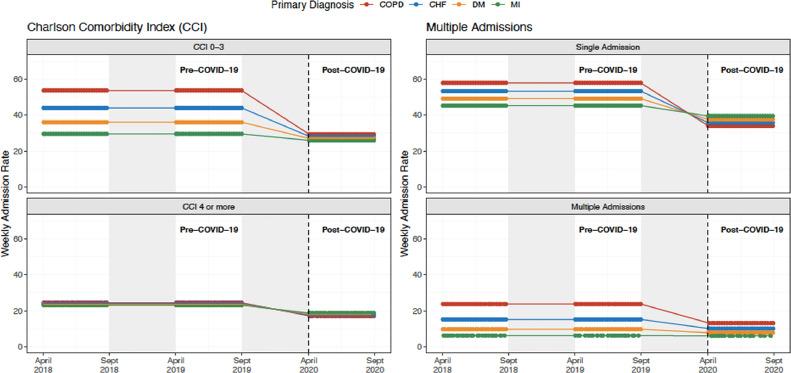
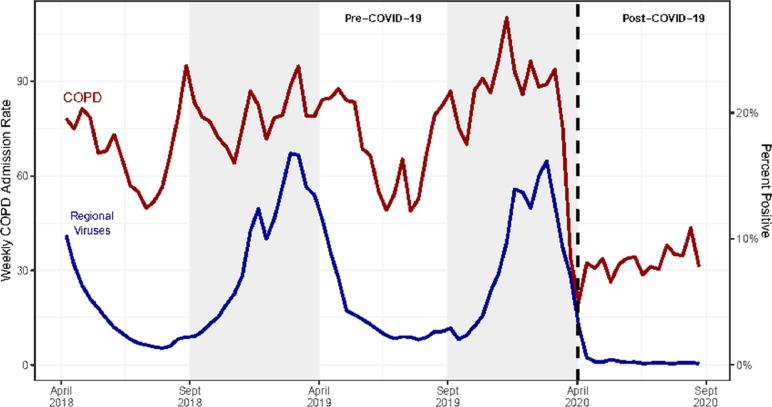
Data involving 4422 COPD admissions demonstrated a season-matched 53% decline in COPD admissions during the COVID-19 pandemic, which correlated to community viral burden (r = 0.73; 95% confidence interval, 0.67-0.78) and represented a 36% greater decline over admission frequencies observed in other medical conditions less affected by respiratory viral infections (incidence rate ratio 0.64; 95% confidence interval, 0.57-0.71, P < .001). The post-COVID-19 decline in COPD admissions was most pronounced in patients with fewer comorbidities and without recurrent admissions.
CONCLUSION
The implementation of public health measures during the COVID-19 pandemic was associated with decreased COPD admissions. These changes are plausibly explained by reduced prevalence of seasonal respiratory viruses.
背景
2019 年冠状病毒病(COVID-19)大流行导致广泛实施公共卫生措施,如居家令、社交距离和口罩强制令。除了减少严重急性呼吸综合征冠状病毒 2 的传播外,这些措施还会影响季节性病毒病原体的传播,而这些病原体是慢性阻塞性肺疾病(COPD)恶化的常见诱因。减少病毒流行是否会降低 COPD 恶化率尚不清楚。
方法
我们对来自大型多中心医疗保健系统的数据进行了回顾性分析,以评估与社区病毒流行以及 COVID-19 大流行控制措施启动相关的入院趋势。我们应用差异分析比较了 COVID-19 公共卫生措施实施前后与 COPD 相关的季节性匹配每周住院频率。使用区域疾病预防控制中心检测阳性数据来估计社区病毒流行情况,并将其与 COPD 入院相关联。
结果
涉及 4422 例 COPD 入院的数据表明,在 COVID-19 大流行期间,COPD 入院率呈季节性匹配下降 53%,这与社区病毒负担相关(r=0.73;95%置信区间,0.67-0.78),并且与受呼吸道病毒感染影响较小的其他医疗条件的入院频率相比,下降幅度更大(发病率比 0.64;95%置信区间,0.57-0.71,P<0.001)。在合并症较少且无反复入院的患者中,COVID-19 后 COPD 入院率下降更为明显。
结论
COVID-19 大流行期间实施公共卫生措施与 COPD 入院率下降有关。这些变化很可能是由于季节性呼吸道病毒流行率降低所致。

 Zotero 插件