
流感和呼吸道合胞病毒的医院利用率:一种新方法和关键评估。
Hospital utilization rates for influenza and RSV: a novel approach and critical assessment.
机构信息
Institute of Health Metrics and Evaluation, University of Washington, Seattle, USA.
Foundation for Influenza Epidemiology, Fondation de France, Paris, France.
出版信息
Popul Health Metr. 2021 Jun 14;19(1):31. doi: 10.1186/s12963-021-00252-5.
BACKGROUND
Influenza and respiratory syncytial virus (RSV) contribute significantly to the burden of acute lower respiratory infection (ALRI) inpatient care, but heterogeneous coding practices and availability of inpatient data make it difficult to estimate global hospital utilization for either disease based on coded diagnoses alone.
METHODS
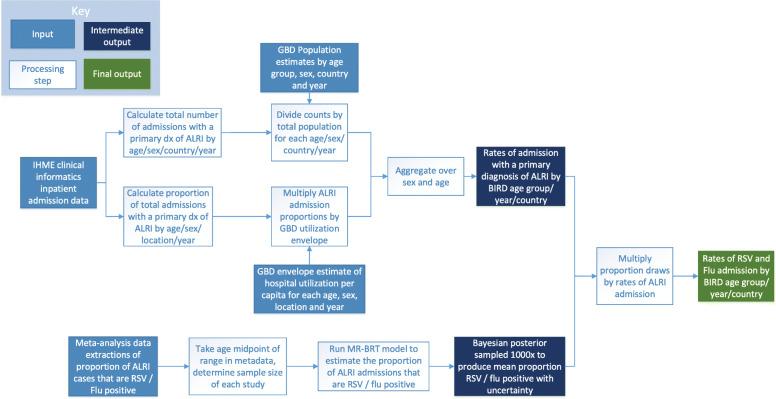
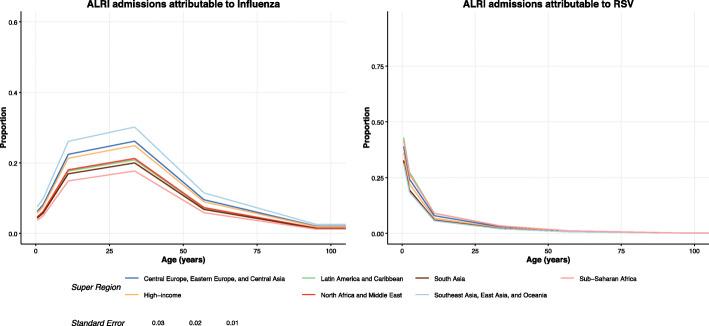
This study estimates rates of influenza and RSV hospitalization by calculating the proportion of ALRI due to influenza and RSV and applying this proportion to inpatient admissions with ALRI coded as primary diagnosis. Proportions of ALRI attributed to influenza and RSV were extracted from a meta-analysis of 360 total sources describing inpatient hospital admissions which were input to a Bayesian mixed effects model over age with random effects over location. Results of this model were applied to inpatient admission datasets for 44 countries to produce rates of hospital utilization for influenza and RSV respectively, and rates were compared to raw coded admissions for each disease.
RESULTS
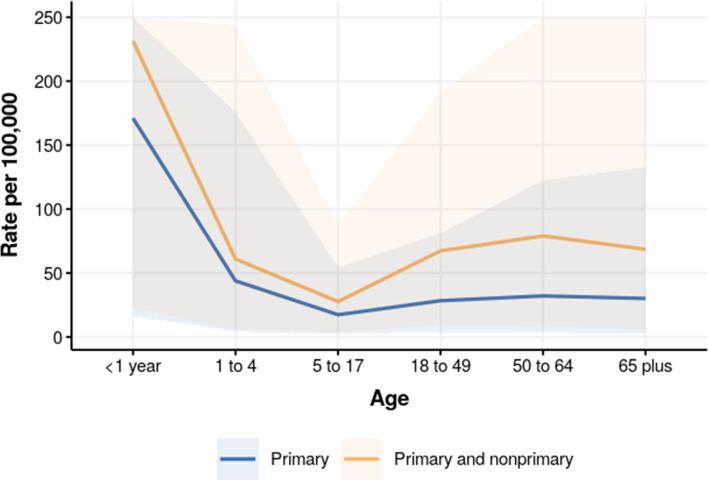
For most age groups, these methods estimated a higher national admission rate than the rate of directly coded influenza or RSV admissions in the same inpatient sources. In many inpatient sources, International Classification of Disease (ICD) coding detail was insufficient to estimate RSV burden directly. The influenza inpatient burden estimates in older adults appear to be substantially underestimated using this method on primary diagnoses alone. Application of the mixed effects model reduced heterogeneity between countries in influenza and RSV which was biased by coding practices and between-country variation.
CONCLUSIONS
This new method presents the opportunity of estimating hospital utilization rates for influenza and RSV using a wide range of clinical databases. Estimates generally seem promising for influenza and RSV associated hospitalization, but influenza estimates from primary diagnosis seem highly underestimated among older adults. Considerable heterogeneity remains between countries in ALRI coding (i.e., primary vs non-primary cause), and in the age profile of proportion positive for influenza and RSV across studies. While this analysis is interesting because of its wide data utilization and applicability in locations without laboratory-confirmed admission data, understanding the sources of variability and data quality will be essential in future applications of these methods.
背景
流感和呼吸道合胞病毒(RSV)是导致急性下呼吸道感染(ALRI)住院治疗负担的主要原因,但由于编码实践存在差异,以及住院数据的可用性,仅根据编码诊断来估计全球因流感和 RSV 而住院的人数非常困难。
方法
本研究通过计算流感和 RSV 引起的 ALRI 比例,并将其应用于编码为主要诊断的 ALRI 住院患者,从而估计流感和 RSV 的住院率。流感和 RSV 引起的 ALRI 比例是从一项描述住院患者入院的 360 个总来源的荟萃分析中提取的,该分析将年龄的贝叶斯混合效应模型与地点的随机效应结合在一起。该模型的结果应用于 44 个国家的住院患者入院数据集,分别产生流感和 RSV 的住院利用率,然后将这些利用率与每种疾病的原始编码入院率进行比较。
结果
对于大多数年龄组,这些方法估计的全国入院率高于同一住院来源中直接编码的流感或 RSV 入院率。在许多住院来源中,国际疾病分类(ICD)编码细节不足以直接估计 RSV 负担。仅使用主要诊断应用混合效应模型会大大低估老年人的流感住院负担估计值。应用混合效应模型减少了因编码实践和国家间差异而导致的流感和 RSV 国家间的异质性。
结论
这种新方法提供了使用广泛的临床数据库估计流感和 RSV 住院利用率的机会。流感和 RSV 相关住院治疗的估计值似乎很有希望,但仅从主要诊断来看,老年人的流感估计值似乎被严重低估。各国在 ALRI 编码(即主要病因与非主要病因)方面存在很大差异,而且在研究中流感和 RSV 阳性的年龄分布也存在很大差异。虽然由于其广泛的数据利用和在没有实验室确诊入院数据的地区的适用性,该分析很有趣,但在未来应用这些方法时,了解可变性和数据质量的来源将是至关重要的。




 Zotero 插件