
多溴二苯醚的产前浓度与儿童认知和心理运动功能之间的关联。
The association between prenatal concentrations of polybrominated diphenyl ether and child cognitive and psychomotor function.
作者信息
Solazzo Giulia, Wu Haotian, Laue Hannah E, Brennan Kasey, Knox Julia M, Gillet Virginie, Bovin Amélie, Abdelouahab Nadia, Posner Jonathan, Raffanello Elizabeth, Pieper Sarah, Bowman Fredrick DuBois, Drake Daniel, Baccarelli Andrea A, Takser Larissa
机构信息
Department of Environmental Health Sciences, Mailman School of Public Health, Columbia University, New York, New York.
Department of Epidemiology, Geisel School of Medicine, Dartmouth College, Lebanon, New Hampshire.
出版信息
Environ Epidemiol. 2021 May 11;5(3):e156. doi: 10.1097/EE9.0000000000000156. eCollection 2021 Jun.
UNLABELLED
Previous studies suggest a negative association between prenatal polybrominated diphenyl ethers (PBDEs) exposure and child cognitive and psychomotor development. However, the timing of the relationship between PBDE exposure and neurodevelopment is still unclear. We examined the association between PBDE concentration at two different prenatal times (early and late pregnancy) and cognitive function in children 6-8 years of age.
METHODS
Eight hundred pregnant women were recruited between 2007 and 2009 from Sherbrooke, Canada. Four PBDE congeners (BDE-47, -99, -100, and -153) were measured in maternal plasma samples collected during early pregnancy (12 weeks of gestation) and at delivery. At 6-8 years of age, 355 children completed a series of subtests spanning multiple neuropsychologic domains: verbal and memory skills were measured using the Wechsler Intelligence Scale for Children, Fourth Edition; visuospatial processing using both Wechsler Intelligence Scale for Children, Fourth Edition and Neuropsychological Assessment second edition; and attention was assessed through the Test of Everyday Attention for Children. Additionally, parents completed subtests from the Developmental Coordination Disorder Questionnaire to measure child motor control. We used linear regression and quantile g-computation models to estimate associations of PBDE congener concentrations and psychologic test scores.
RESULTS
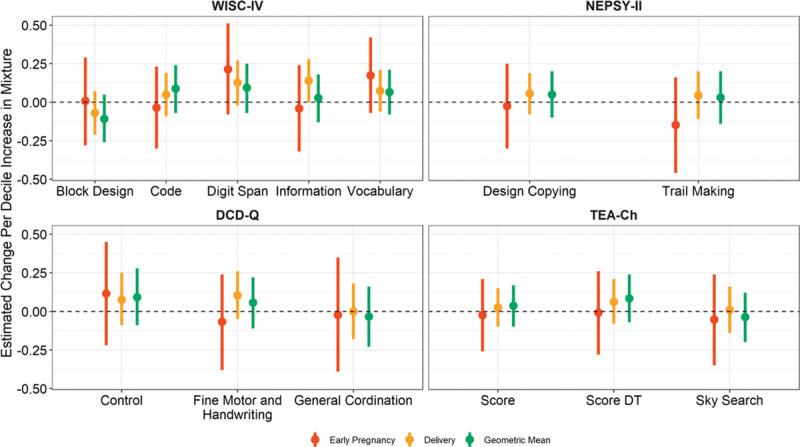
In our models, no significant associations were detected between PBDE mixture and any of the child psychologic scores. BDE-99 concentration at delivery was nominally associated with higher scores on short-term and working memory while a decrease in spatial perception and reasoning was nominally associated with higher BDE-100 concentration at delivery.
CONCLUSION
Overall, our results did not show a significant association between PBDEs and child cognitive and motor development.
未标注
先前的研究表明,产前多溴二苯醚(PBDEs)暴露与儿童认知和心理运动发育之间存在负相关。然而,PBDE暴露与神经发育之间关系的时间点仍不清楚。我们研究了两个不同产前时期(孕早期和孕晚期)的PBDE浓度与6至8岁儿童认知功能之间的关联。
方法
2007年至2009年期间,从加拿大舍布鲁克招募了800名孕妇。在孕早期(妊娠12周)和分娩时采集的母体血浆样本中测量了四种PBDE同系物(BDE-47、-99、-100和-153)。在6至8岁时,355名儿童完成了一系列跨越多个神经心理领域的子测试:使用韦氏儿童智力量表第四版测量语言和记忆技能;使用韦氏儿童智力量表第四版和神经心理学评估第二版测量视觉空间处理能力;通过儿童日常注意力测试评估注意力。此外,父母完成了发育协调障碍问卷中的子测试,以测量儿童的运动控制能力。我们使用线性回归和分位数g计算模型来估计PBDE同系物浓度与心理测试分数之间的关联。
结果
在我们的模型中,未检测到PBDE混合物与任何儿童心理分数之间存在显著关联。分娩时BDE-99浓度与短期和工作记忆得分较高名义上相关,而空间感知和推理能力下降与分娩时BDE-100浓度较高名义上相关。
结论
总体而言,我们的结果未显示PBDEs与儿童认知和运动发育之间存在显著关联。
 Zotero 插件