
男男性行为人群中的甲型肝炎病毒感染 - 2017-2018 年美国八个州。
Hepatitis A Virus Infections Among Men Who Have Sex with Men - Eight U.S. States, 2017-2018.
出版信息
MMWR Morb Mortal Wkly Rep. 2021 Jun 18;70(24):875-878. doi: 10.15585/mmwr.mm7024a2.
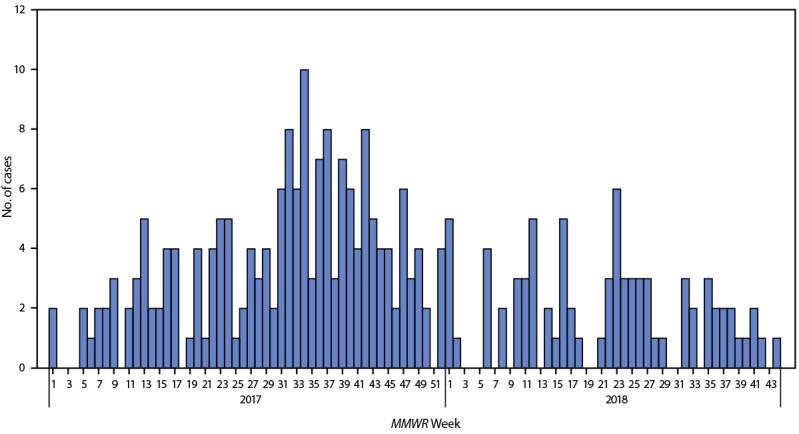
During 1995-2011, the overall incidence of hepatitis A decreased by 95% in the United States from 12 cases per 100,000 population during 1995 to 0.4 cases per 100,000 population during 2011, and then plateaued during 2012─2015. The incidence increased by 294% during 2016-2018 compared with the incidence during 2013-2015, with most cases occurring among populations at high risk for hepatitis A infection, including persons who use illicit drugs (injection and noninjection), persons who experience homelessness, and men who have sex with men (MSM) (1-3). Previous outbreaks among persons who use illicit drugs and MSM led to recommendations issued in 1996 by the Advisory Committee on Immunization Practices (ACIP) for routine hepatitis A vaccination of persons in these populations (4). Despite these long-standing recommendations, vaccination coverage rates among MSM remain low (5). In 2017, the New York City Department of Health and Mental Hygiene contacted CDC after public health officials noted an increase in hepatitis A infections among MSM. Laboratory testing* of clinical specimens identified strains of the hepatitis A virus (HAV) that subsequently matched strains recovered from MSM in other states. During January 1, 2017-October 31, 2018, CDC received reports of 260 cases of hepatitis A among MSM from health departments in eight states, a substantial increase from the 16 cases reported from all 50 states during 2013-2015. Forty-eight percent (124 of 258) of MSM patients were hospitalized for a median of 3 days. No deaths were reported. In response to these cases, CDC supported state and local health departments with public health intervention efforts to decrease HAV transmission among MSM populations. These efforts included organizing multistate calls among health departments to share information, providing guidance on developing targeted outreach and managing supplies for vaccine campaigns, and conducting laboratory testing of clinical specimens. Targeted outreach for MSM to increase awareness about hepatitis A infection and improve access to vaccination services, such as providing convenient locations for vaccination, are needed to prevent outbreaks among MSM.
1995 年至 2011 年期间,美国甲型肝炎的总体发病率从 1995 年每 10 万人 12 例下降至 2011 年的每 10 万人 0.4 例,之后在 2012 年至 2015 年期间保持稳定。2016 年至 2018 年期间,发病率与 2013 年至 2015 年相比增加了 294%,大多数病例发生在甲型肝炎感染高危人群中,包括使用非法药物(注射和非注射)的人群、无家可归者和男男性行为者(MSM)(1-3)。先前在使用非法药物者和 MSM 中爆发的疫情导致免疫实践咨询委员会(ACIP)于 1996 年建议对这些人群进行常规甲型肝炎疫苗接种(4)。尽管有这些长期建议,但 MSM 的疫苗接种覆盖率仍然很低(5)。2017 年,纽约市卫生和心理卫生部在公共卫生官员注意到 MSM 中甲型肝炎感染增加后联系了 CDC。临床标本的实验室检测*鉴定了甲型肝炎病毒(HAV)的毒株,随后与从其他州的 MSM 中回收的毒株相匹配。2017 年 1 月 1 日至 2018 年 10 月 31 日,CDC 从八个州的卫生部门收到了 260 例 MSM 甲型肝炎病例报告,与 2013 年至 2015 年期间所有 50 个州报告的 16 例病例相比,这一数字显著增加。48%(258 例中的 124 例)的 MSM 患者住院治疗,平均住院 3 天。没有死亡报告。针对这些病例,CDC 支持州和地方卫生部门采取公共卫生干预措施,以减少 MSM 人群中的 HAV 传播。这些措施包括组织卫生部门之间的多州电话会议,以分享信息,提供关于制定针对目标人群的外展和管理疫苗接种活动供应的指导,以及对临床标本进行实验室检测。需要针对 MSM 进行有针对性的外展,以提高对甲型肝炎感染的认识,并改善接种疫苗服务的可及性,例如提供方便的接种地点,以防止 MSM 中爆发疫情。
 Zotero 插件