
糖皮质激素介导的小窝蛋白-1诱导破坏细胞骨架组织,抑制非愈合性伤口的细胞迁移和再上皮化。
Glucocorticoid-mediated induction of caveolin-1 disrupts cytoskeletal organization, inhibits cell migration and re-epithelialization of non-healing wounds.
机构信息
Wound Healing and Regenerative Medicine Research Program, Department of Dermatology and Cutaneous Surgery, University of Miami Miller School of Medicine, Miami, FL, USA.
Departments of Ophthalmology, Physiology, and Oklahoma Center for Neuroscience, University of Oklahoma Health Sciences Center, Oklahoma City, OK, USA.
出版信息
Commun Biol. 2021 Jun 18;4(1):757. doi: 10.1038/s42003-021-02298-5.
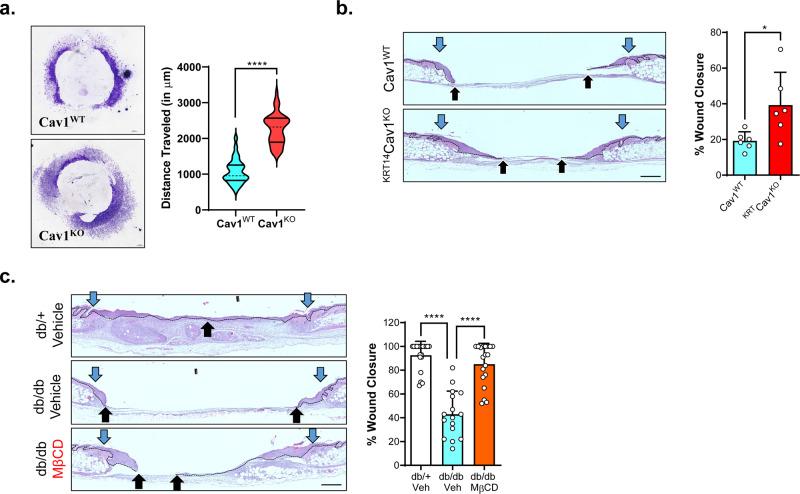
Although impaired keratinocyte migration is a recognized hallmark of chronic wounds, the molecular mechanisms underpinning impaired cell movement are poorly understood. Here, we demonstrate that both diabetic foot ulcers (DFUs) and venous leg ulcers (VLUs) exhibit global deregulation of cytoskeletal organization in genomic comparison to normal skin and acute wounds. Interestingly, we found that DFUs and VLUs exhibited downregulation of ArhGAP35, which serves both as an inactivator of RhoA and as a glucocorticoid repressor. Since chronic wounds exhibit elevated levels of cortisol and caveolin-1 (Cav1), we posited that observed elevation of Cav1 expression may contribute to impaired actin-cytoskeletal signaling, manifesting in aberrant keratinocyte migration. We showed that Cav1 indeed antagonizes ArhGAP35, resulting in increased activation of RhoA and diminished activation of Cdc42, which can be rescued by Cav1 disruption. Furthermore, we demonstrate that both inducible keratinocyte specific Cav1 knockout mice, and MβCD treated diabetic mice, exhibit accelerated wound closure. Taken together, our findings provide a previously unreported mechanism by which Cav1-mediated cytoskeletal organization prevents wound closure in patients with chronic wounds.
虽然角质形成细胞迁移受损是慢性伤口的公认标志,但支撑细胞运动受损的分子机制仍知之甚少。在这里,我们证明与正常皮肤和急性伤口相比,糖尿病足溃疡 (DFU) 和静脉性腿部溃疡 (VLU) 在基因组水平上均表现出细胞骨架组织的全面失调。有趣的是,我们发现 DFU 和 VLU 表现出 ArhGAP35 的下调,ArhGAP35 既是 RhoA 的失活剂,也是糖皮质激素的抑制剂。由于慢性伤口表现出皮质醇和小窝蛋白 1 (Cav1) 的水平升高,我们假设观察到的 Cav1 表达升高可能导致肌动蛋白细胞骨架信号传导受损,表现为角质形成细胞迁移异常。我们表明 Cav1 确实拮抗 ArhGAP35,导致 RhoA 的激活增加和 Cdc42 的激活减少,这可以通过 Cav1 破坏来挽救。此外,我们证明诱导型角质形成细胞特异性 Cav1 敲除小鼠和 MβCD 处理的糖尿病小鼠均表现出伤口愈合加速。总之,我们的研究结果提供了一种以前未报道的机制,即 Cav1 介导的细胞骨架组织防止慢性伤口患者的伤口闭合。


 Zotero 插件